Sign In



 New Zealand; International
News release
From:
"Our new research reveals that tiny particles of stardust, made billions of years ago by long-dead stars, survived the birth of our Solar System. The long-held view was that the extreme heat (>1300 °C) near the young Sun completely vaporised everything that existed before it formed. However, our research shows that the stardust acted as anchors (or ‘nucleation seeds’) for the very first minerals to solidify around.
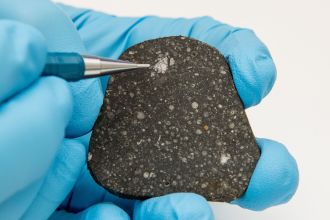
"We looked at the oldest solid objects in the Solar System: calcium-aluminium-rich inclusions (CAIs), which are mineral deposits found within ancient meteorites. We measured chemicals within these CAIs and discovered grains of stardust (minerals) that predated the formation of our Sun. This means that instead of a complete reset when the Sun formed, these surviving stardust grains were incorporated into the cold cloud of gas and dust that eventually collapsed to form our Solar System.
"In the same way as water vapour in Earth’s atmosphere required tiny dust particles to condense into raindrops, the first solid materials formed at the start of the Solar System required stardust particles to begin growing. The earliest solids to form in this way were tiny, heat-resistant minerals containing a lot of calcium and aluminium.
"This discovery fundamentally shifts our understanding of how planets are built. Everything in our cosmic neighbourhood today – from rocky planets like Earth and Mars to moons and asteroids – is constructed from those initial building blocks.
"These findings show that our Solar System didn’t start from a completely wiped-clean slate; rather it directly inherited intact, physical fragments of ancient stars, thus representing an exotic ingredient in the recipe for our Solar System."
Multimedia