 Sign In



 Australia; NSW; VIC; QLD; WA

News release
From:
QIMR Berghofer scientists have discovered a cancer-fighting RNA molecule that could hold the key to a new way of treating the most common form of breast cancer.
The team are developing their findings into a potential RNA-based therapy for hormone receptor-positive (HR+) breast cancer, offering hope to women with advanced disease who are no longer responding to existing drugs.
See VIDEO explainer here. (And VNR available to download here).
RNA molecules are like the working copies of our DNA. Advances in technology are helping uncover their role in essential biological functions, and RNA-based therapies are emerging as a highly promising new approach for targeting cancer.
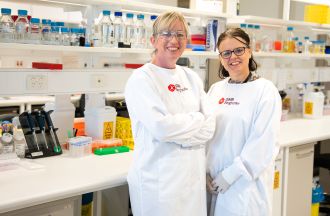
QIMR Berghofer Professors Stacey Edwards and Juliet French study how our DNA and RNA work, with the goal of finding better ways to treat and ultimately cure breast cancer. Their seven-year study, published in the prestigious journal Molecular Cancer, details their discovery of the previously unknown RNA molecule that protects against HR+ breast cancer.
Professor French said the RNA molecule they discovered has a two-pronged mode of attack against the cancer cells that is both precise and potent.
“We think this is going to be a therapy that can treat this cancer and save women’s lives. When we introduce the RNA molecule into our preclinical models, it specifically kills only hormone receptor-positive breast cancer cells, and not healthy cells,” Professor French said.
“It does this in two different ways. It induces cancer cell death from within the tumour cell, and it also interacts with and binds to a receptor that activates the immune system to recognise and kill the cancer cells.” (See Animation video here).
Professor Stacey Edwards, who has dedicated her career to breast cancer research after losing her mother to the disease at a young age, said it was incredibly rewarding to discover a potentially transformative treatment.
“We knew we had something exciting, but we’d hit so many dead ends trying to understand how the RNA molecule was working. Then came the day in our lab when we saw the cancer cells completely destroyed, while the healthy cells were alive. It was a true eureka moment. We could hardly believe what we were seeing, so we just kept repeating the experiment to be sure the results were real,” Professor Edwards said.
“My beautiful mum developed breast cancer when she was just 34 years old and I was only five, so I grew up seeing her go through horrible treatments. From a very young age, I knew that I wanted to do breast cancer research to help my mum and others like her.
“Unfortunately, she passed away just as I finished my university degree, but she knew I was on my way. To now be developing something that we believe is going to make a difference is a very special moment.”
Breast cancer is the most commonly diagnosed cancer in women in Australia and globally. Around 70 per cent of all cases are HR+ breast cancers.
While existing treatments, such as hormone-blocking therapies, have greatly improved survival rates, up to a third of patients do not respond or develop drug resistance over time, allowing their cancer to return and spread. HR+ breast cancer is often described as a ‘cold cancer’ meaning it can hide from the immune system, so immunotherapies also typically fail to work.
The potential new RNA therapy could be used on its own, but because it also activates the immune system it could make existing immunotherapies more effective. The team plans to test different combinations of the RNA therapy with current immunotherapies.
They are also developing lipid nanoparticles to help deliver the RNA therapy directly into the cancer cells.
The researchers are grateful for the funding support that has advanced this work, including from the National Breast Cancer Foundation of Australia and the National Health and Medical Research Council.
They are seeking partners and further funding to progress to the next stage of drug development, with the ultimate goal of a clinical trial in patients with advanced HR+ breast cancer.
One of the advantages of RNA-based therapies is that they can be developed more quickly than conventional drugs, as seen with the rapid development of RNA-based vaccines during the COVID-19 pandemic.
The newly discovered RNA molecule is a type known as a long noncoding RNA (lncRNA). Around 98 per cent of the human genome is made up of RNA molecules that are ‘noncoding’ meaning they don’t translate into proteins but carry out other important functions like regulating gene expression. Once dismissed as ‘junk DNA’, this research breakthrough is another step towards realising the potential of this type of RNA for targeting cancers.
The study is available at this link https://link.springer.com/article/10.1186/s12943-025-02510-8 in Molecular Cancer with DOI10.1186/s12943-025-02510-8.
Multimedia

Attachments
Note: Not all attachments are visible to the general public. Research URLs will go live after the embargo ends.


