 Sign In



 Australia; International; NSW; SA
News release
From:
Australian architecture from the 1950s to the 1980s has deeper ties to Asia than previously recognised, according to new research led by Adelaide University.
The study argues that some of the most distinctive tendencies in post-war Australian architecture were shaped by direct encounters with Asian architecture, craft, philosophy and culture, challenging the long-held view that these were primarily a response to local landscapes, materials and bush settings.
The research reframes the “Sydney School”, an influential movement in the development of modern Australian architecture, as part of a much longer and more complex story of cultural exchange between Australia and Asia.
“The Sydney School has always been understood through its visual characteristics, including low rooflines, rough materiality, organic forms and sensitivity to the Australian bush,” said lead author Dr Amit Srivastava, from Adelaide University’s School of Architecture and Built Environment.
“What we show is that beneath that stylistic surface was something far more significant: a gradual, profound, intellectual reorientation toward Asia spanning four decades.”
Rather than simply borrowing Asian forms from a distance, a few Australian architects chose to live, study and work alongside local scholars, craftspeople, clients and collaborators across the region, and their contributions are documented through this research.
Published in Architectural Theory Review, the study draws on more than 15 years of research, including newly accessible archival material from the State Library of New South Wales, as well as letters, drawings, photographs, passports, newspaper clippings, project documentation and interviews conducted across Australia, Hong Kong and the United States.
The narrative is structured around the journeys of three architects – Adrian Snodgrass, Alan Gilbert and Peter Muller – whose personal friendship and epistolary exchange is used to reveal the broader network of professional connections that emerged between Australia and Asia at this time.
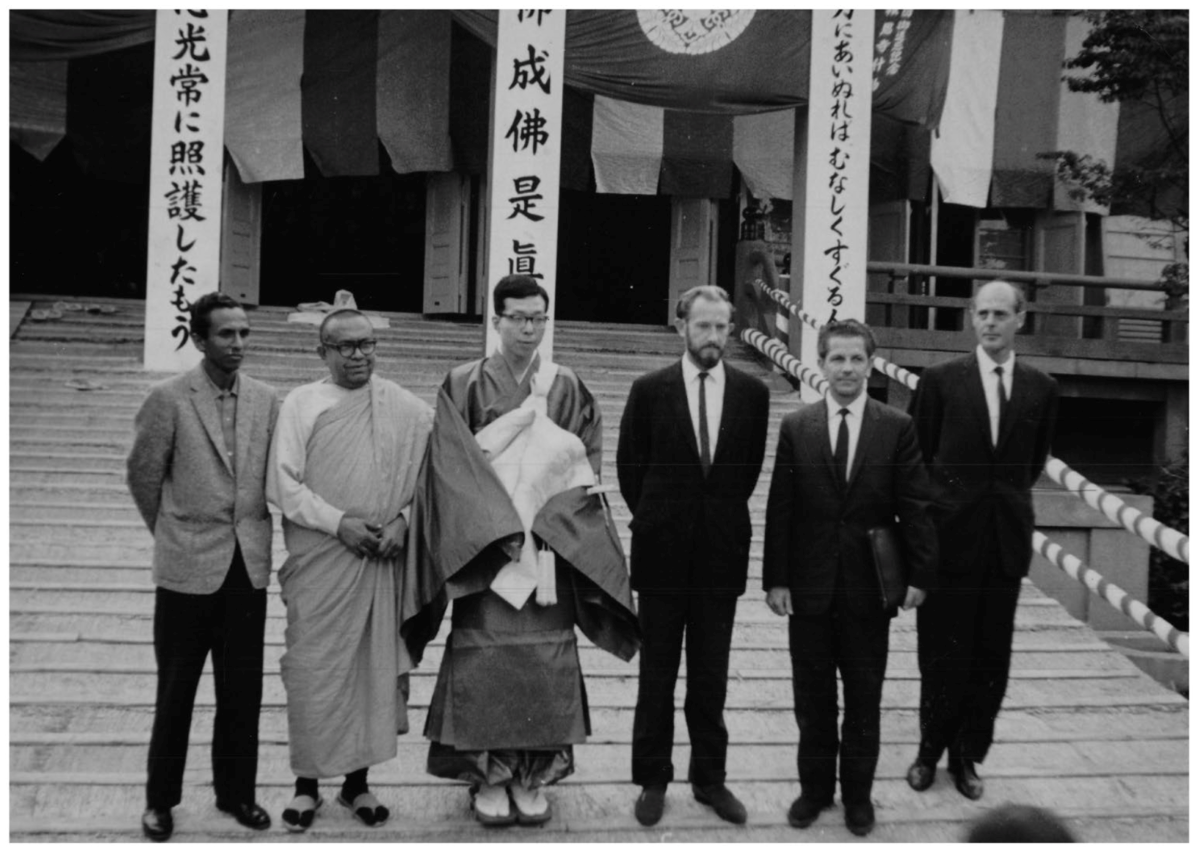
It traces Snodgrass’s engagement with Hindu and Buddhist thought in Ceylon and Japan, Gilbert’s commissions in Hong Kong and China, and Muller’s collaborations in Bali and beyond. It also captures their engagement with local collaborators, and the equally valuable contribution of their wives and partners, including Judith Snodgrass, Sarah Lo and Carole Muller.
Together they wrote surveys on local handicrafts, performed anthropological fieldwork, and collaborated on design research, subsequently founding the unique design consultancy Regional Design and Research (RDR) in 1978.
Dr Srivastava said the project grew out of a long-running interest in Australia’s complex relationship with Asia.
“As a migrant from India based in Australia, I was always struck by the paradox of a country geographically adjacent to Asia but culturally oriented towards Europe and America,” he said.
“The turning point came when we met Adrian Snodgrass and began to understand the extraordinary life he had lived, with years in Ceylon and Japan, deeply immersed in Hindu and Buddhist philosophy.”
Among the most striking findings were the depth of these architects’ cultural immersion. Snodgrass lived for years as a Hindu ascetic in Ceylon (now Sri Lanka), walking the length of the island on foot on pilgrimages of many hundreds of kilometres. Gilbert became one of the first foreigners to document the Chinese Cultural Revolution, with his photograph of Red Guards appearing on the cover of LIFE magazine in 1967.
That immersion produced a lasting scholarly interest, with Snodgrass serving as a Japan Foundation lecturer at the University of Sydney and curating the 2001 exhibition Buddha: Radiant Awakening at the Art Gallery of NSW, and Gilbert’s films on China and Japan being housed in the National Film and Sound Archive of Australia (NFSAA).
The research also suggests these encounters influenced more than the architects’ thinking. They can be seen in the way these architects approached planning, materials and spatial organisation.
Muller, who was born in Adelaide and became the first Australian recipient of a Fulbright Scholarship in Architecture, incorporated Japanese-inspired planning, shoji screens, and sunken living room seating into his design for the Michell House in Medindie. The house was nominated for inclusion on the SA Heritage Register in 2023 and is the subject of a forthcoming monograph by Dr James Curry, Director of Architecture Museum at Adelaide University, featuring photography by John Gollings.
In Sydney, Adrian Snodgrass’s houses were recognised at the time as drawing on Asian design influences, with The Australian Women’s Weekly describing his Rose House in Point Piper as having Asian-inspired design.
Dr Srivastava said the findings deepen insights into Australia’s relationship with Asia.
“A generation of Australian architects built genuine, deep, transformative relationships with Asia long before it became a political priority, and that work has gone largely unrecognised,” he said.
“At a moment when Australia is strengthening economic and cultural ties across the region — from the Southeast Asia Economic Strategy to the India-Australia trade agreement — this history has much to offer. It shows that the cultural foundations for a meaningful Australia-Asia relationship already exist.
“This paper is just the tip of the iceberg. There is an entire archive at the State Library of New South Wales waiting to be properly explored, and many more figures in this network whose stories are yet to be told.”
The researchers are now calling for further primary material – letters, drawings, photographs and personal accounts – connected to Australian architects working across Asia from the 1950s to the 1980s to be shared and potentially deposited with institutional archives such as the State Library of NSW or the Architecture Museum in South Australia where they can be copied and professionally cared for and catalogued by specialists.
Those in NSW are encouraged to contact Specialist Librarian Anna Dearnley at the State Library of NSW. Those in South Australia can contact Dr Srivastava or the Architecture Museum at Adelaide University.

