Sign In



 Australia; International; VIC

News release
From:
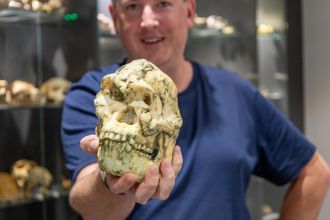
An international study led by researchers from Australia’s La Trobe University and the University of Cambridge has challenged the classification of one of the world's most complete human ancestral fossils, raising the possibility of a new human species.
The fossil, found in South Africa’s Sterkfontein Caves in 1998 and dubbed "Little Foot", has been widely believed to be a member of the Australopithecus genus, a lineage of ape-like upright walkers that lived in South Africa between 3 million and 1.95 million years ago.
Paleoanthropologist Ronald Clarke, who led the team that took 20 years to excavate and analyse the skeleton, attributed Little Foot to the species Australopithecus prometheuswhen the fossil was first revealed to the world in 2017. Others maintained it was Australopithecus africanus, a species first described by Australian anatomist Raymond Dart in 1925 and which was already known from the same site and South Africa more broadly.
But in a peer-reviewed article published in the American Journal of Biological Anthropology, a team led by La Trobe University adjunct Dr Jesse Martin found that Little Foot does not share a unique suite of traits with either species, raising the possibility that it may represent a new species altogether.
“This fossil remains one of the most important discoveries in the hominin record and its true identity is key to understanding our evolutionary past,” Dr Martin said.
“We think it's demonstrably not the case that it’s A.prometheusor A. africanus. This is more likely a previously unidentified, human relative.
“Dr Clarke deserves credit for the discovery of Little Foot, and being one of the only people to maintain there were two species of hominin at Sterkfontein. Little Foot demonstrates in all likelihood he's right about that. There are two species.”
Little Foot, known formally as StW 573, remains the most complete ancient hominin in the fossil record.
Dr Martin’s team is the first to have challenged the species attribution of Little Foot since it was unveiled in 2017.
“Our findings challenge the current classification of Little Foot and highlight the need for further careful, evidence-based taxonomy in human evolution,” Dr Martin said.
Dr Martin, who is an adjunct at La Trobe and a postdoctoral research fellow at Cambridge, and students from La Trobe University will now work to clarify which species Little Foot represents and where that species sits in the human family tree.
The research was carried out under the auspice of an Australian Research Council grant directed by Professor Andy Herries at La Trobe.
Professor Herries said Little Foot was one of the most complete and important fossils ever discovered in terms of what it could tell us about early human diversity and how our ancestors adapted to the different environments of southern Africa.
"It is clearly different from the type specimen of Australopithecus prometheus, which was a name defined on the idea these early humans made fire, which we now know they didn’t. Its importance and difference to other contemporary fossils clearly show the need for defining it as its own unique species.”
The research involved collaboration between institutions in the United Kingdom, Australia, South Africa and the United States.
Multimedia