Sign In



 Australia; NT; ACT
News release
From:
Scientists have shown that genomics can help identify which wild populations are most vulnerable to climate change - offering practical guidance for conserving threatened species before declines become irreversible.
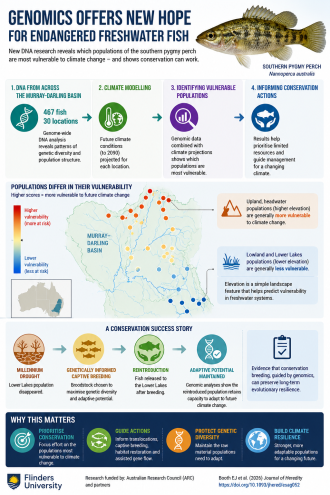
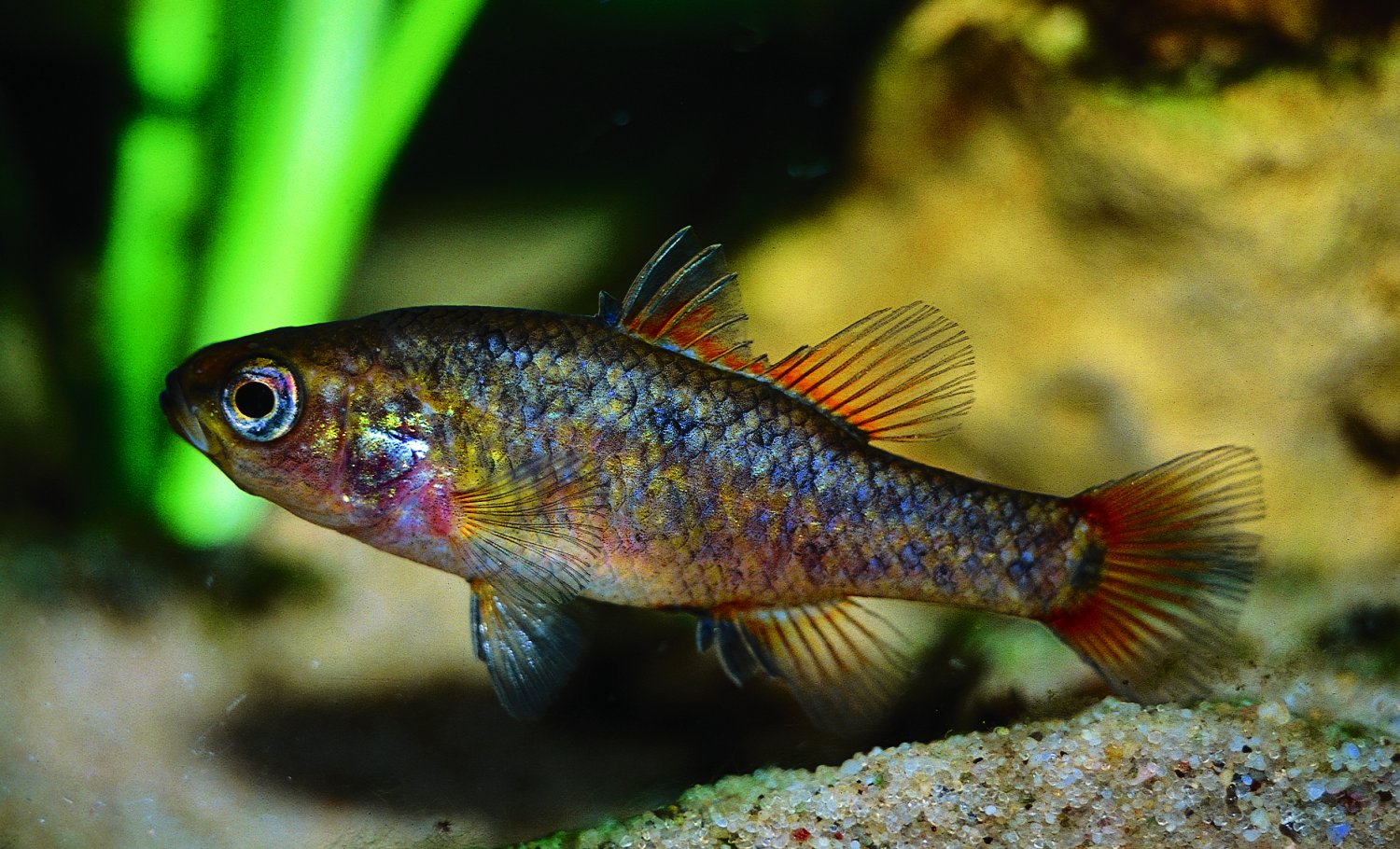
The study, led by researchers from Flinders University's Molecular Ecology Laboratory and published in the Journal of Heredity, examined the endangered southern pygmy perch across Australia's Murray–Darling Basin.
By combining climate modelling with genome-wide data from hundreds of fish, the researchers identified the populations most likely to struggle as the climate continues to warm. They also showed that carefully managed conservation breeding can preserve a species' capacity to adapt to future warming.
Lead author Dr Emily Booth says the research demonstrates how genomics is becoming an increasingly powerful tool for conservation.
"Climate change doesn't affect all populations equally. By combining genomic data with climate modelling, we can identify the populations most at risk and help conservation managers prioritise where actions are likely to have the greatest impact."
The southern pygmy perch is a small freshwater fish native to south-eastern Australia that has suffered major declines due to habitat loss, river regulation and prolonged droughts. In the Murray–Darling Basin, it now survives in small, isolated populations, many with limited genetic diversity and reduced capacity to adapt to environmental change.
To assess its future prospects, the researchers analysed thousands of DNA markers from 467 fish collected at 30 sites across the species' remaining range in the basin.
The study found that populations in upland streams are generally more vulnerable to future climate change than those in lowland wetlands and rivers.
Elevation on its own proved to be a strong predictor of this vulnerability - a finding that suggests conservation managers could use this simple landscape feature to flag high-risk populations in other freshwater ecosystems, without needing detailed genomic data for every case.
The researchers also evaluated one of Australia's best-known freshwater fish recovery programs.
During the Millennium Drought, the southern pygmy perch disappeared from the Lower Lakes region of the Murray River, prompting a genetically informed captive breeding and reintroduction program.
The new study found that the restored population retained its capacity to adapt to future climate change — rare empirical evidence that conservation breeding guided by genomic information can preserve long-term evolutionary resilience.
Senior author Professor Luciano Beheregaray says the findings show how conservation genomics can directly inform management decisions.
"This is another study showing that genomics has moved beyond describing biodiversity to actively helping conserve it. We can now identify the populations most vulnerable to climate change and use that information to guide actions such as captive breeding, assisted gene flow and habitat restoration," he says.
The researchers say the findings have implications well beyond the southern pygmy perch and Australia.
Freshwater fishes are among the world's most threatened vertebrates, yet receive far less conservation attention than many other animal groups.
The study offers a framework for using genomic data to identify vulnerable populations and prioritise conservation investment in freshwater ecosystems facing rapid environmental change.
The article - Booth EJ, Brauer CJ, Sandoval-Castillo J, Wedderburn SD, Whiterod NS, Unmack PJ, Hammer MP & Beheregaray LB (2026). 'Genomic vulnerability to climate change of a poorly dispersing and threatened fish, the southern pygmy perch (Nannoperca australis)' - has been published in the Journal of Heredity. https://doi.org/10.1093/jhered/esag052.
Multimedia