 Sign In



 Australia; NSW; VIC; QLD; WA; ACT
Expert Reaction
These comments have been collated by the Science Media Centre to provide a variety of expert perspectives on this issue. Feel free to use these quotes in your stories. Views expressed are the personal opinions of the experts named. They do not represent the views of the SMC or any other organisation unless specifically stated.
Dr Paul Cheng is an Associate Professor in Livestock Nutrition and Grazing Management at The University of Melbourne
"Floods, fires and heatwaves are extreme weather events that majorly affect livestock directly and can disrupt the supply of feed. After bushfires, grazing can become limited for weeks or even months, meaning that livestock must rely almost entirely on fodder. Further, heatwaves increase pressure on feed systems, lowering voluntary feed intake of livestock by 10–30%, especially when temperatures exceed livestock heat-stress thresholds. In these conditions, access to quality hay is critical to maintain animals’ welfare and body conditions.
These risks are amplified when extreme events occur across multiple regions altogether at once, limiting the ability to source fodder from unaffected areas.
Traditionally, producers relied on regional variability to balance feed shortages, but that buffer is becoming less reliable.
While climate variability has always shaped Australian agriculture, recent decades have seen an increase in the frequency and intensity of extreme heat, and it becomes a less predictable event. This makes reliance on ‘just-in-time’ fodder supply increasingly risky. Planning protected fodder reserves ahead of extreme weather is one of the most practical and effective ways to safeguard livestock welfare under current and future conditions."

Dr. Maximilien Desservettaz is a Research Fellow at the NSW Bushfire and Natural Hazards Research Centre and an expert in atmospheric chemistry, bushfire smoke, fire management and backburning. He is affiliated with the University of Wollongong and is a member of the international Commission on Atmospheric Chemistry and Global Pollution (iCACGP)
"The current La Nina phase (Pacific Ocean climatic state) is weak and has failed to deliver much rainfall. Furthermore, we have not had any significant large-scale fires in this region since the Black Summer (2019/20) season, which were followed by a prolonged period of above-average rainfall. This has allowed significant regrowth in much of the burnt forests. Therefore, the conditions are now set for a fire season of comparable severity to the Black Summer (see also this article in the conversation).
In my capacity of ‘bushfire smoke’ scientist, I invite people to be particularly careful with smoke exposure. Close windows, doors, and air intakes if your area is affected by smoke and reopen them as soon as air quality improves (some air pollution might have slowly leaked in). Keep an eye on your state EPA website for air quality in your area."
Professor Melissa Haswell, Discipline of Health, Safety and Environment, School of Public Health and Social Work, Queensland University of Technology
"Since the 1970’s, scientists have warned governments and the public that continued burning of fossil fuels – coal, oil and gas – will have extreme consequences on our climate, resulting in increasing extreme storms, floods, heatwaves, droughts and bushfires. Despite Australia being particularly susceptible to all these disasters, our leaders are still green-lighting rapid expansion of Australia’s already huge contribution to global coal and gas supplies through exports.
The costs of this behaviour are borne by communities, particularly those who have contributed the least but unable to afford protection. Developing countries, Aboriginal and Torres Strait Islander people, rural communities, and especially children and future generations will suffer most from increasingly devastating events.
The National Climate Risk Assessment (https://www.dcceew.gov.au/climate-change/policy/adaptation/ncra) must be required reading for all Australians. Its sobering reading confirms that the events we see as extreme today will be frequent and even more severe in coming decades. All our systems, from health to national security, are facing high to extreme risk. State and federal governments must put people first now – stop fuelling climate change with fossil fuel developments and urgently start working together to build the protections we will need to survive the consequences of complacency."
Dr Joe Fontaine is a lecturer specialising in fire science and ecology within the environmental and conservation sciences discipline at Murdoch University in Perth, Western Australia
"Too often we think about the change in averages. A one degree change in the average more than doubles the days over 40C in Perth, for example. Such massive changes in the likelihood of extreme events point a big, fat arrow at preparedness.
Multiple, simultaneous events unfortunately are becoming more frequent making preparedness all the more crucial. There is a profound need to help the community understand risk, fund government preparedness, and resource scientists to highlight the where and when risks are greatest. Risks such as flammability and fire behaviour change in a non-linear fashion with temperature."
Adjunct Professor Andrew Watkins is a climate expert in the School of Earth, Atmosphere and Environment at Monash University
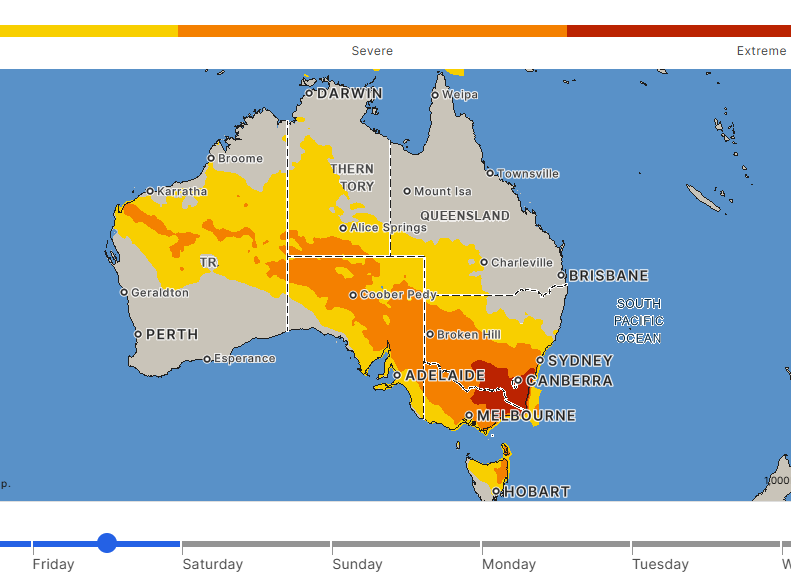
“Friday is shaping up to be the most extreme fire day in south east Australia since the Black Summer bushfires, with extremely high temperatures accompanied by strong winds. Several regions are listed as having catastrophic fire conditions, so people should leave early, especially tourists on summer holidays. You won’t make a friend of the local fire captain if you get in their way.
What’s unusual is having such extreme heat and fire conditions during a La Niña summer, and following a strong negative Indian Ocean Dipole. Normally we would be more worried about floods with those climate drivers. But two factors have played a big role in 2025/26, including the strongest stratospheric warming above Antarctica since 2019, and climate change. Both of these climate drivers dry and heat southern Australia. Recent rains in some areas mean vegetation grew quickly but has since dried, meaning fast moving grassfires in some areas, which can kill.
The National Climate Risk Assessment showed that bushfire risk will continue to increase in southern areas over the coming decades until fire, drought and extreme heat kill many of the tall forests and reduce fuel loads. Our forests have evolved to regenerate at a steady pace after extreme events. They simply won’t be able to recover fast enough from the extremes our new climate is throwing at us. Ongoing assessments of our future climate and fire risk are needed to track and forecast such critical changes.”
Associate Professor Rachael Nolan is a Research Fellow at the Hawkesbury Institute for the Environment at Western Sydney University, and is Director of the NSW Bushfire and Natural Hazards Research Centre.
"Bushfires are a feature of Australia, particularly in Summer.
Current heatwave conditions make fires more likely, particularly if winds are strong. However, heatwaves don’t always trigger bushfires, other factors need to line up too.
Fires need fuel to burn, think of dead grass, or fallen leaves and twigs on the forest floor.
Those fuels also need to be dry enough to burn – in the same way that it’s hard to get a campfire going with wet leaves, bushfires need dry fuels to burn.
Finally, fires need a spark to ignite, such as lightning during a thunderstorm that doesn’t produce rain. Dry lighting was responsible for the ignition of many of the megafires during the devastating 2019/20 fire season, and has been forecast again for coming days.
During current conditions, heatwaves can rapidly dry fine fuels such as leaves and twigs. Fuel loads have also rebounded in many areas following the 2019/20 bushfires. This growth has been pushed along by a succession of wet years which has promoted vegetation growth.
Forecast catastrophic fire conditions, combined with the potential for dry lightning storms, pose a real risk for bushfires.
While fires are a feature of Australia, particularly in summer, southern Australia has experienced more climatic volatility in recent years – with rapid swings between wet and dry conditions. This volatility is making it harder to predict when and where severe bushfires might occur.
Over the coming days, people should tune into their local fire services, and download a mobile phone app relevant for their state, such as Hazards Near Me in NSW and VicEmergency in Victoria."
Professor Ollie Jay is Academic Director, Heat and Health Research Centre, Faculty of Medicine and Health at the University of Sydney. His expertise is in the impact of heat on human health, including heat stress and stroke
"High temperatures and humidity across the Southern Hemisphere are posing a serious threat to human health, increasing the risk of heat stroke, heart attacks, and kidney failure. More and more, these extreme conditions are disrupting major sporting events, such as the Australian Open in Melbourne, starting next week.
“Dehydration remains one of the most common causes of hospitalisation in the heat and is a potent aggravator of other secondary impacts like heart attacks and kidney failure. Use fans to cool yourself, but turn fans off when it is above 40˚C as they can paradoxically make heat stress worse.
“Instead of just drinking water, also apply water to the skin with a spray bottle or wet cloth. If you have AC but are worrying about the cost, use a “fan-first” strategy, which involves using an indoor fan and setting the thermostat of your AC to switch on at 27˚C instead of the typical 22˚C. You will feel just as cool and save ~70% on your electricity bill.”
Dr Amy Peden is a Senior Research Fellow in the School of Population Health at UNSW. Her expertise is in injury prevention, drowning prevention and risk factor identification
"The extreme weather Australia is currently experiencing is dramatically increasing drowning risk at a time when Australia is recording all-time record drowning deaths.
Floods cause immediate risk to life from drowning, with people driving into floodwaters or being swept away, the most common threats to safety. Evacuate early and never enter floodwaters, even if your vehicle is large, has 4WD capacity, or you’ve successfully navigated floodwaters in the past.
Heatwaves increase our exposure to the risk of drowning as we are more likely to visit beaches, pools and rivers, spending longer in the water in a bid to cool off. During a heatwave, the risk of drowning increases, with the risk up to 26% higher during severe heatwaves. That risk is even greater for men and people aged 65+. To reduce risk, swim between the flags at patrolled beaches, always actively supervise young children around the water, and wear a lifejacket when boating or rock fishing."
Mr Andrew Gissing is the CEO at Natural Hazards Research Australia
"Compounding flood, bushfire and heatwave emergencies present a very real risk to life and property.
Catastrophic and extreme fire conditions exist across Southern Australia this week. Catastrophic is the highest fire danger level. Much of Australia’s bushfire losses have occurred under similar conditions.
Research shows the safest thing to do during bushfires is to leave early. Homes are not designed to withstand fires burning during catastrophic conditions. It is not safe to stay and defend - properties close to bushland are most at risk.
Heatwaves are Australia's biggest killer. Now is the time to check on those who are most vulnerable and make sure they are ok. Please also have a plan to keep your pets safe.
Northern Queensland is already experiencing major flooding with the possibility of developing cyclones. Conditions are a reminder to not enter floodwater. Research shows that entering floodwater is the main cause of death during floods.
Australia is experiencing worsening natural hazard risk due to climate change, increasing development in at-risk areas and environmental degradation. Given the escalating threat amongst other measures Australia should consider developing a National Resilience Strategy for housing stock."
Dr Philip Zylstra is a fire behaviour scientist and Adjunct Associate Professor at Curtin University and the Australian National University
"The heatwave means that many places that might have been too moist to burn can now burn. This makes it more likely that a fire will start, but it also breaks down the natural defences that forests have against fire, because natural firebreaks may now burn, and fires can keep spreading. It’s like opening all the gates.
The dense regrowth from the Black Summer fires means that many forests will now burn much more intensely than they did before. This means that flames will be bigger and harder to put out, even in conditions with no wind, but when the wind picks up, any fire burning in that country will be more likely to create a firestorm.
In a few more years, that fire risk will start to die down as the forest recovers, but there are two takeaways for the meantime. Firstly, forest burnt five years ago is not ‘safer’ because of low fuel loads. Secondly, preventing or catching fire while it’s still small is more important than ever because we don’t want to restart that regrowth cycle."
Dr Tom Mortlock is Head of Climate Analytics Asia-Pacific at Aon, and Adjunct Fellow in the Climate Change Research Centre at UNSW
"On days like today, it’s perhaps worth remembering that Australia is one of the most multi-peril environments on the planet. Looking at the top 10 disasters in Australia’s history by insured loss, we have cyclones, floods, bushfires, hailstorms, storms and an earthquake in there. By comparison, many other regions in the world only have one or two dominant perils leading to insured and economic loss – for example, hurricanes in the US, or storms in Europe.
The current weather conditions in Australia – with heatwaves and bushfires in the south, and floods in the north – show the importance of considering “cascading” or “compounding” weather extremes when it comes to emergency preparedness and risk management for these events. These refer to extreme weather events that occur either at the same time or sequentially in different parts of the country. The existing body of research shows that heatwaves in the south and heavy rainfall in the north can and do “temporally compound”, as we are seeing at the moment.
We also know that as global temperatures continue to warm, the frequency of extreme weather events – in particular heatwaves – will increase. Current projections suggest that a 1-in-50-year heatwave event will occur roughly every 3-4 years by 2100 at 2 degrees of warming, which is approximately the trajectory we are on at the moment."
Dr Andrew King is an Associate Professor in Climate Science at the University of Melbourne and the ARC Centre of Excellence for 21st Century Weather
"Summer is Australia's extreme weather season, and this summer is proving no exception with severe heat, fires and floods in different parts of the country. As the world warms due to our continuing high greenhouse gas emissions, we are seeing some of these extremes becoming more frequent and more intense.
Our emissions are causing worsening heatwaves and fire weather in particular. The longer we delay real action to greatly reduce our greenhouse gas emissions, we can expect even more intense heatwaves and fire weather for years to come. This should be a powerful incentive to decarbonise, but until then, we need to learn to live with these extreme weather events getting more common and more intense as much as we can."
Dr Nichola Tyler is an arson and fire behaviour expert at Swinburne University of Technology
“With Australia experiencing its most significant heatwave in six years, extreme temperatures are creating the perfect conditions for bushfires to ignite and spread rapidly, particularly those caused by human behaviour. The overwhelming majority of bush and wildfires are not sparked by lightning, but by people through unsafe fire behaviours, negligence and, in some cases, deliberate arson.
Research shows that more than 84% of bush and wildfires worldwide are attributed to human activities. The devastating Black Saturday fires in 2009 demonstrated just how catastrophic these behaviours can be, especially during periods of extreme heat. Heatwaves significantly elevate fire danger and reduce the margin for error.
Periods of extreme heat demand heightened awareness and responsibility from individuals. It is critical that people comply with total fire bans, fire restrictions and official warnings, and carefully consider the consequences of their actions. Failing to do so can recklessly place lives, property and communities at risk and may result in serious criminal penalties.
Communities should remain vigilant during these conditions. If there are concerns about suspicious fire behaviours, this information can be shared anonymously with Crime Stoppers Victoria.”
