Early human remains found in Morocco support Africa as our origin

Publicly released:
International
Credit: Hamza Mehimdate, Programme Préhistoire de Casablanca. Story by Dr Joe Milton, Australian Science Media Centre

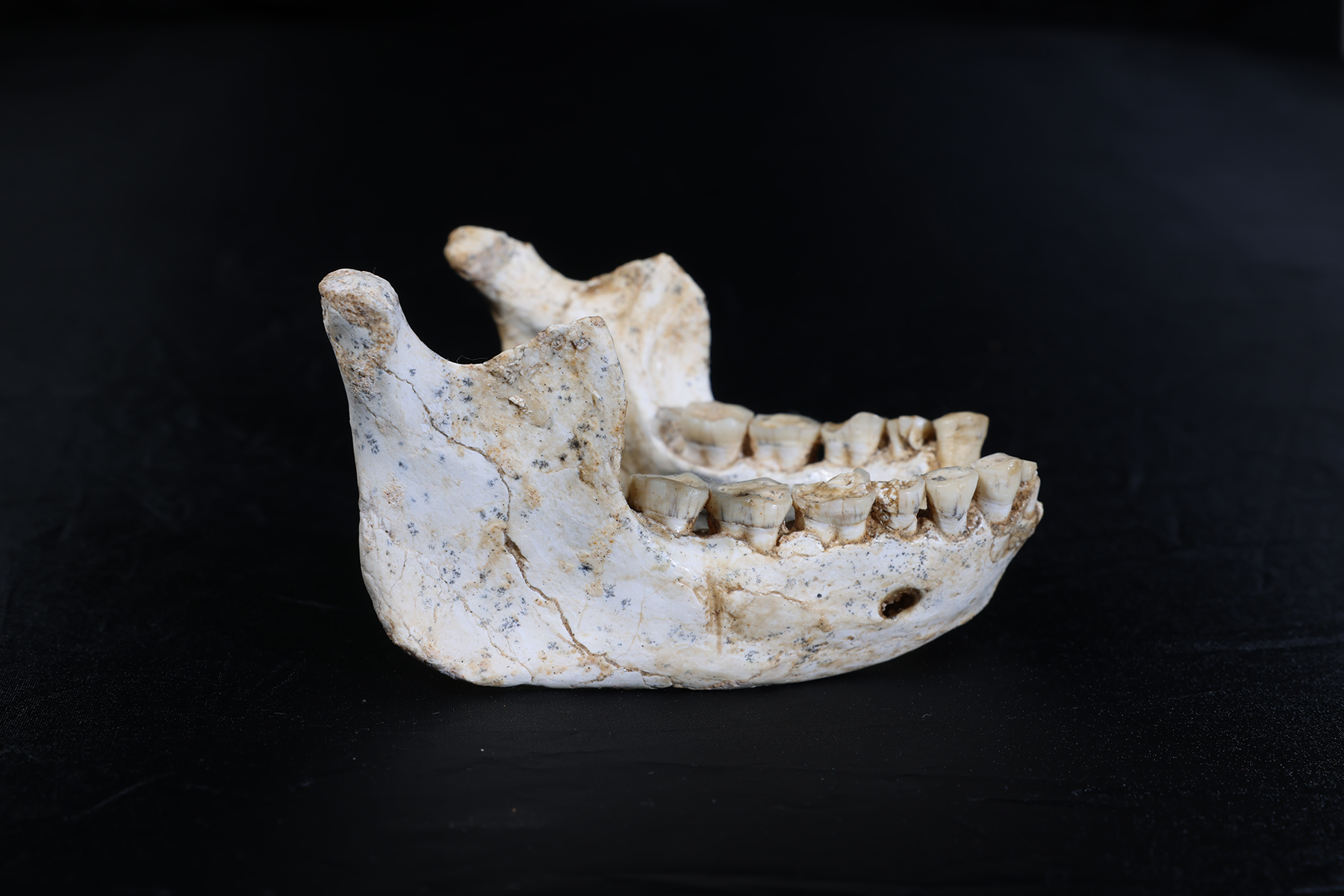
International scientists say roughly 773,000-year-old fossilised remains of an early human ancestor found in a cave in Morocco support the idea that humans originated in Africa before spreading to Eurasia. The team found two partial mandibles, numerous teeth, and vertebrae, and say that analysing these found the teeth are similar to modern humans and Neanderthals, but the mandibles are similar to more archaic African human ancestors, such as Homo erectus. The remains are not the same as previously discovered fossils of an early human called Homo antecessor, which were found in Spain and are around the same age, the team says. That suggests early humans in Africa and Europe had started to diverge by the late Early Pleistocene (around 1.8 million to 780,000 years ago), and that modern humans emerged in Africa rather than in Eurasia, the authors conclude.

News release

From: Springer Nature

Moroccan hominin fossils shed light on the emergence of modern humans (N&V) *IMAGES*

Hominin fossils discovered in Casablanca, Morocco, which have been dated to about 773,000 years ago, may be close ancestors of modern humans. These remains show a mix of old and modern features, potentially placing them near the point where African and Eurasian human lineages began to diverge. The findings, published in Nature, provide insights into African populations before the earliest known Homo sapiens and provide evidence for an African origin of our species.

The last common ancestor of modern humans, Neanderthals and Denisovans, are thought to have lived around 765–550 thousand years ago. However, there have been debates about where these ancestors first appeared. Previous discoveries, such as Homo antecessor in Spain, suggested possible ancestral links in Europe, but well-dated African fossils of similar ages have been rare, leaving a gap in the African record.

Jean-Jacques Hublin and colleagues analysed fossils unearthed from a cave called “Grotte à Hominidés” at Thomas Quarry I in Morocco, including two partial mandibles, numerous teeth and vertebrae. Analysis of the surrounding sediments shows that the fossils are from a time close to a major shift in the Earth’s magnetic field, about 773,000 years ago, giving them a similar age to H. antecessor. However, the new fossils are morphologically different from H. antecessor, suggesting that regional differentiation between Europe and North Africa was already present by the late Early Pleistocene (around 1.8 million to 780,000 years ago). The Moroccan fossils combine ancient features seen in species such as Homo erectus with more modern traits found in H. sapiens and Neanderthals. For example, their molar size patterns resemble those of early H. sapiens and Neanderthals, whereas their mandible shape is closer to those of Homo erectus and other African archaic humans.

The Moroccan fossils may not be the last common ancestors to modern humans, Neanderthals and Denisovans, but may be close ancestors, the authors note. The findings support an African rather than Eurasian ancestry for H. sapiens, the authors conclude.

Multimedia
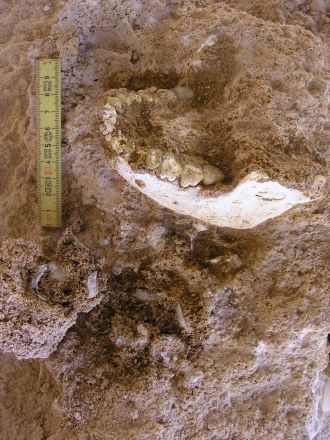
The mandible ThI-GH-10717 during the excavation
773,000 years old mandible ThI-GH-10717 from Thomas Quarry in Morocco
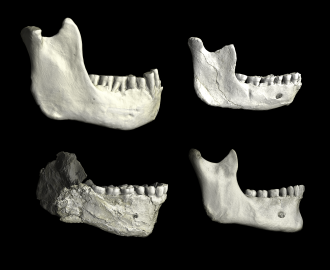
Lower jaws (mandibles) from North Africa, illustrating variation

Attachments

Note: Not all attachments are visible to the general public. Research URLs will go live after the embargo ends.

Research Springer Nature, Web page The URL will go live after the embargo ends
Journal/
conference:
Nature
Research:Paper
Organisation/s: Max Planck Institute for Evolutionary Anthropology, Germany, National Museum of Natural Sciences (CSIC), Spain
Funder: The study of ThI-GH is currently part of the Préhistoire de Casablanca Moroccan-French programme led and supported by the Institut National des Sciences de l’Archéologie et du Patrimoine (INSAP) of the Ministère de la Jeunesse, de la Culture et de la Communication/Département de la Culture of the Kingdom of Morocco and the Ministère de l’Europe et des Affaires Étrangères of France within the framework of the Mission archéologique Casablanca. Excavations and studies before 2016 were co-funded by the University of Bordeaux (France), the Région Aquitaine (France) through the Origines projects, the Muséum National d’Histoire Naturelle in Paris (France) as well as by the Department of Human Evolution of the Max-Planck Institute Evolutionary Anthropology (Germany). Recent research after 2016 has been also supported by the Laboratoire d’Excellence Archimède— Programme I.A. ANR-11-LABX-0032-01, through the Origines project, and the European Research Council (ERC) under the European Union’s Horizon 2020 research and innovation programme (grant agreement no. 819960). Magnetostratigraphic analyses are supported by the Ministero dell’Istruzione, dell’Università e della Ricerca of Italy, through the project ‘Dipartimenti di Eccellenza 2018–2022’ awarded to the Dipartimento di Scienze della Terra ‘A. Desio’ of the Università di Milano. Research permit no. 01/2020-2021 granted on 22 December 2020 was issued by INSAP letter 458. G.M. and S.P. benefited from financial support provided by the 2020 PRIN (Progetti di Rilevante Interesse Nazionale) project ‘Dynasty’ (PRIN202022GMUTT_01), funded by the Italian Ministry of University and Research. A.G.O. was supported by a Ramon y Cajal fellowship (RYC-2017-22558), by the Spanish Ministerio de Ciencia, Innovacion y Universidades (project PID2021122355NB-C31, MCIN/AEI/10.13039/ 501100011033/FEDER, UE) and by the research group IT1485-22 (Eusko Jaurlaritza/Gobierno Vasco). Open access funding provided by Max Planck Society.
Media Contact/s
Contact details are only visible to registered journalists.