Can AI predict an embryo's sex before we can?

Publicly released:
International
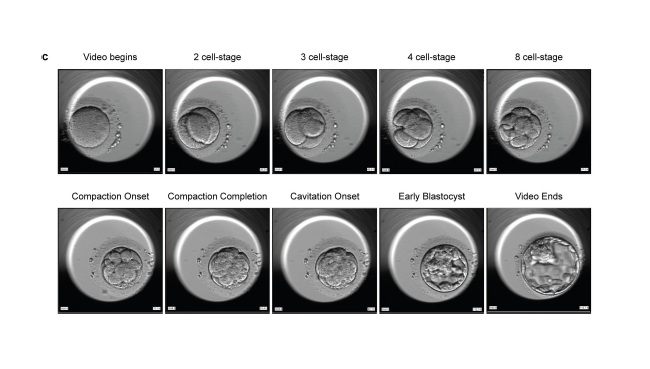
Figure 1. Overview of study to detect sex differences from embryoscope movies. (c) Depiction of the different time points used during manual annotation, with corresponding embryoscope snapshot. CREDIT: Liang, et al. (2026)

Artificial intelligence (AI) could help predict the sex of an embryo after just three days of development, according to international researchers. The team trained the AI using over 500 videos of pre-implantation human embryos, and it successfully predicted the sex of embryos after the eight-cell stage (which happens around day three of development) with 60% accuracy. The research is still at an early stage, but the team says the AI could help researchers investigate early stage sex differences, and understand why sex ratios are skewed in IVF.

News release

From: The Royal Society

Using deep learning to predict sex of human embryos

It’s (possibly) a girl – A deep learning model may be able to detect subtle differences between male and female embryos long before humans can - possibly after just three days of development. The early stage model, trained on over 500 videos of pre-implantation human embryos annotated with birth sex, predicted the sex of an embryo after the eight-cell stage with 61% accuracy. While the research is still early stage, the model could help researchers investigate early-stage sex differences and understand why sex ratios are skewed in IVF. Open Biology

Attachments

Note: Not all attachments are visible to the general public. Research URLs will go live after the embargo ends.

Research The Royal Society, Web page The URL will go live after the embargo lifts.
Journal/
conference:
Open Biology
Research:Paper
Organisation/s: University of Cambridge, UK
Funder: We thank all funding sources: Wellcome Trust (098287/Z/12/Z) (M.Z.-G.), Leverhulme Trust (RPG-2018-085) (M.Z.-G), Open Philanthropy (M.Z.-G), Heritage Research Institute for the Advancement of Medicine and Science at Caltech (award no. HMRI-15-09-01) (C.Y.), Merkin Institute for Translational Research Grant (award no. 13520291) (C.Y., M.Z.-G.), Medical Research Council (A.L.), Cambridge Vice Chancellor’s Award Fund (A.L.).
Media Contact/s
Contact details are only visible to registered journalists.