 Sign In



 Australia; SA
News release
From:
Honey bees have long been the model species for studying insect vision. However, new research shows that several smaller bee species might actually have sharper eyesight.
The honey bee has held a special place in vision research. It is one of the best-studied insects, and much of what scientists know about how bees perceive the world is based on studies of honey bees.
The honey bee is only one of the world's roughly 20,000 bee species. A new study by researchers at Lund University and Adelaide University reveals a much more nuanced picture when scientists turned their attention to other species.
The researchers examined the visual abilities of bumblebees and three species of solitary bees, insects that live alone rather than in the large colonies headed by a queen that characterise honey bees.
By recording electrical signals from individual light-sensitive cells in the bees’ eyes, the researchers were able to estimate how small an object the insects can detect and how fine their visual resolution is.
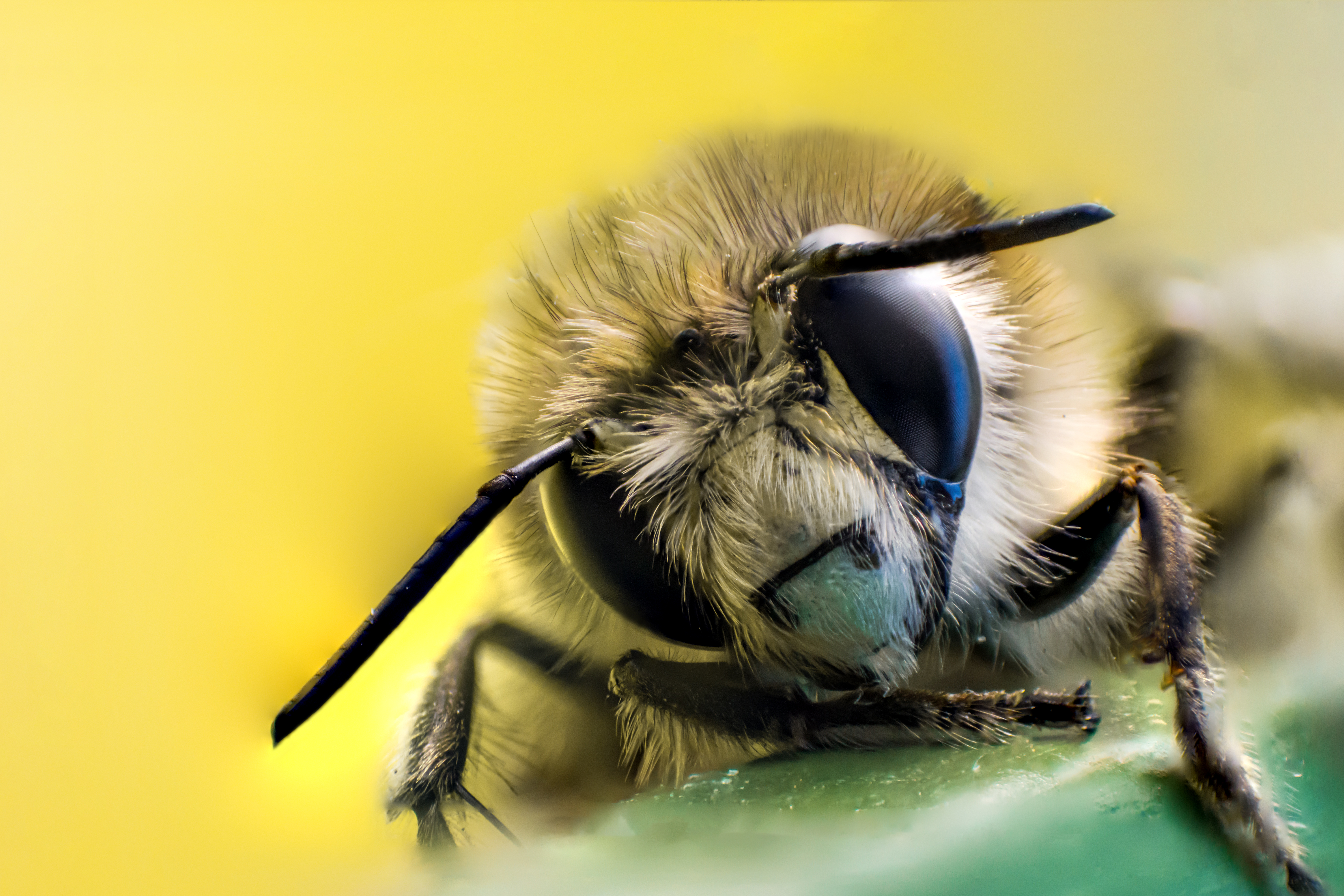
All four species showed higher visual resolution in the examined photoreceptor cells than worker honey bees. One species stood out in particular: the small Australian blue-banded bee, Amegilla murrayensis, which is easily distinguished from honey bees by the blue or bluish-grey bands across its abdomen.
“We were especially surprised that the small blue-banded bee could detect objects just as well as honey bee drones, despite being much smaller,” said Elisa Rigosi, biology researcher at Lund University.
Honey bee drones are known for their exceptional eyesight. One of their key tasks is locating and pursuing queens during mating flights, which places high demands on their ability to detect moving objects.
The fact that a much smaller solitary bee can match this level of visual performance provides important insights into the relationship between eye size and vision. Large eyes are not the only route to sharp sight.
The researchers therefore also investigated how visual performance is linked to the structure of the eye. They analysed lens size, the organisation of light-sensitive cells, and the way compound eyes map visual space. The findings suggest that bees have evolved several different solutions for achieving high-quality vision
“There is no single recipe for good vision in bees. Different species have arrived at different combinations of traits that produce high visual performance,” said David O’Carroll, Professor of Biology at Lund University.
The study contributes to a broader understanding of how vision has evolved in bees and other pollinators. It also highlights what may be missed when research focuses on only a handful of species.
The findings could be relevant beyond biology. Evolution’s various solutions to the challenge of seeing clearly could inspire the development of artificial vision systems and bio-inspired robotics. These fields increasingly require small, energy-efficient sensors capable of detecting and processing visual information.
Adelaide University’s Associate Professor Steven Wiederman said bee vision is far more diverse than previously thought.
“Honey bees have shaped much of what we know about insect vision, but they are only one of thousands of bee species,” said Assoc Prof Steven Wiederman.
“By studying a greater diversity of bees, we’re finding that there is no single blueprint for good vision – even very small bees can have remarkably sophisticated visual systems.”
Notes to editors:
The study was carried out by researchers from Lund University in Sweden and Adelaide University in Australia. The team investigated four bee species: bumblebees and three species of solitary bees. By recording electrical signals from light-sensitive cells in the bees' eyes, the researchers measured the smallest visual details the insects could detect. They also examined lens size, cellular structure, and the architecture of the compound eyes to understand how eye design influences visual sharpness.

