 Sign In



 Australia; TAS
News release
From:
New Antarctic research shows the deepest layer of the Southern Ocean is shrinking faster than scientists realised, with the rate of change accelerating over the past decade.
This is of world-wide significance because as it sinks and fills up to 40% of the global ocean volume, the cold dense water known as Antarctic Bottom Water (AABW) drives the Earth’s system of currents and regulates our climate.
By carrying oxygen to the abyss and locking away heat and carbon, it provides a buffer against global heating. However, as the deepest water mass in the global ocean, AABW is notoriously difficult to observe.
The paper “The Observed Circumpolar Decline of Antarctic Bottom Water Volume” is published in the American Geophysical Union journal Geophysical Research Letters.
Lead author Dr James Wyatt, with the Australian Antarctic Program Partnership at the University of Tasmania, said this study is the first to provide a comprehensive circumpolar picture of AABW from 2002 to 2023.
“We reconstruct changes in AABW volume around the entire Antarctic continent, by combining satellite measurements with direct measurements from the ocean, and building a model called SatGEM-2.”
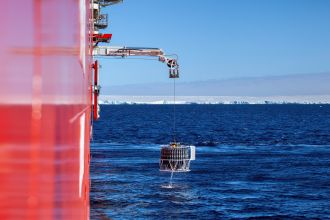
SatGEM-2 is a new data product that combines satellite measurements of sea surface height with temperature and salinity profiles of the full ocean depth collected by research ships and in the upper 2000 metres by Argo floats.
Comparisons with independent Deep Argo profiles and repeat ship transects confirm that the estimates of AABW volume are reliable, with SatGEM-2 reproducing their observations to within ∼0.04°C of temperature and ∼0.003 g/kg of salinity.
“Our dataset brings together satellite observations and the sustained observations of the ocean interior from ships and floats over the last century. We need these observations to continue to keep SatGEM-2 calibrated and reliable,” he said.
“We find that AABW has steadily shrunk in volume since 2002, with the rate of decline increasing fourfold after 2015, compared to the long term trend. By 2023, this corresponds to an overall cumulative reduction of about 3% of the 2002 circumpolar volume.”
“We show the recent increase in AABW loss coincides with a rapid decline in Antarctic sea ice since 2016, and AABW volume anomalies are strongly correlated with variability in sea ice extent,” said Dr Wyatt.
Where AABW comes from
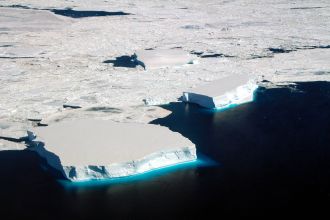
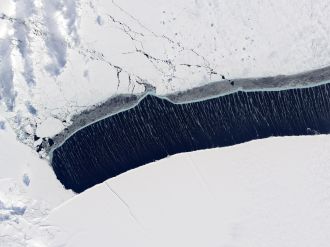
AABW results from the formation of sea ice in four key areas around Antarctica – Weddell Sea (the largest producer), Ross Sea, Adélie Coast and Cape Darnley – that produce a vast supply of cold, salty water every winter.
As the ocean’s surface freezes and sea ice forms, the salt is left behind, making the surrounding seawater extremely dense.
That cold dense water sinks to the seafloor, flows down the continental shelf and slowly spreads northward into the Atlantic, Indian and Pacific Oceans as AABW, eventually filling about 40% of the world's ocean volume.
This circulation transports oxygen to the deep ocean, locks away heat, stores carbon dioxide for centuries to millennia, and drives part of the global ‘conveyor belt’ of ocean circulation.
There is unambiguous observational evidence that over recent decades AABW is also warming, freshening (becoming less salty), and carrying less oxygen to the abyss.
The most likely cause is an increase in freshwater entering the Southern Ocean from melting ice shelves and changes in sea-ice formation.
Freshwater makes surface waters less salty and therefore less dense, causing less sinking to the ocean floor to create AABW, thus reducing its volume.
Continent-wide
Dr Wyatt said the decline in AABW is occurring around the Antarctic continent as a whole, although some regions are changing faster than others, with the largest reduction in the Weddell Sector.
“One of Earth's most important climate-regulating systems is measurably weakening in response to increased freshwater from a warming Antarctic and reduced sea-ice formation.”
“The methods we’ve developed with SatGEM-2 allow us to monitor near real-time changes throughout the entire water column of the Southern Ocean, even in areas with few direct measurements, helping us to infer how the Earth's climate system is changing.”
“For example, it can provide regular updates on how much heat is being stored in the Southern Ocean and to track exactly where warming is occurring, which helps us better understand how these shifts influence Antarctic ice melt and future sea-level rise,” he said.
While this tracking already encompasses most of the region, future work will extend these estimates into areas covered by sea ice, where satellites cannot yet observe sea surface height directly.
Circulation slowdown
Co-author Prof Nathan Bindoff, ARC Australian Laureate Fellow at the Institute for Marine and Antarctic Studies, said the emerging changes in the deep ocean will influence climate and sea level for many centuries.
“The simultaneous warming, freshening, loss of oxygen and shrinking volume all point to a slowdown of deep-ocean overturning.”
“These multiple signs provide strong evidence that climate change is already altering the deepest parts of the world's oceans, with long-term consequences for ocean circulation, heat transport and carbon storage.”
“The clearest evidence of climate-driven change in the deep ocean is currently emerging in the under-observed Southern Ocean,” Prof Bindoff said.
Multimedia

Attachments
Note: Not all attachments are visible to the general public. Research URLs will go live after the embargo ends.


