 Sign In



 Australia; New Zealand; International
News release
From:
NASA mission is first to change a celestial body’s heliocentric orbit
Science Advances
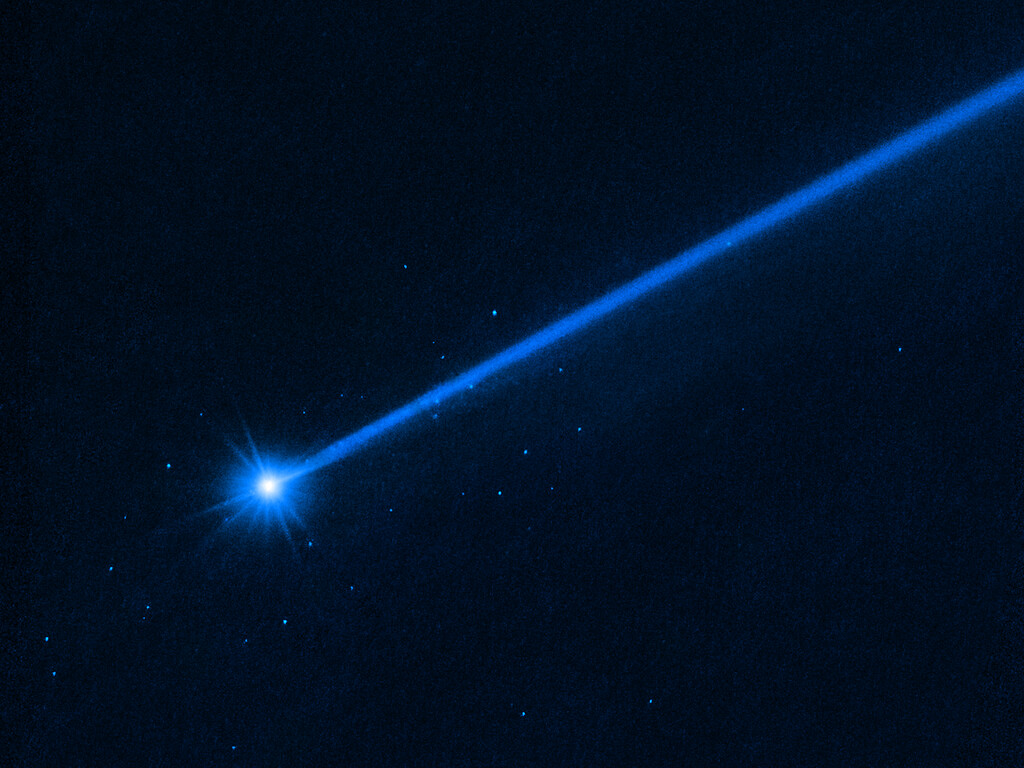
Researchers have determined that NASA’s 2022 Double Asteroid Redirection Test (DART) mission is the first to cause a deliberate change in the heliocentric orbit of a celestial body – in this case, a binary asteroid system. The DART mission intentionally crashed a spacecraft into the asteroid Dimorphos, which orbits the larger asteroid Didymos as the pair orbits the sun. The mission’s goal was to determine whether human intervention could result in the deflection of asteroids away from Earth. The new research follows up on initial results, which showed that DART was able to slow and alter the orbit of Dimorphos around Didymos; now, the researchers have concluded that the impact also slowed the heliocentric orbit of the entire Didymos system by more than 10 micrometers per second. Rahil Makadia and colleagues analyzed 22 stellar occultation measurements taken since the DART impact, 5,955 ground-based right ascension and declination pairs, and other data to determine the full extent of the deflection. The results showed two main causes for the orbital change: the spacecraft’s impact itself and additional momentum from debris ejected outside of the binary system. Both the impact on Dimorphos and the escaped ejecta altered the trajectory and speed of Didymos system’s barycenter, or central orbital point, which also determines the system’s orbital path around the sun. The full extent of the heliocentric momentum enhancement from DART has not yet been determined, but should be measurable with future data. To that end, the European Space Agency’s Hera mission is now en route to the Didymos system, set to arrive in November 2026. “By demonstrating that asteroid deflection missions such as DART can effect change in the heliocentric orbit of a celestial body, this study marks a notable step forward in our ability to prevent future asteroid impacts on Earth,” Makadia et al. write.
Expert Reaction
These comments have been collated by the Science Media Centre to provide a variety of expert perspectives on this issue. Feel free to use these quotes in your stories. Views expressed are the personal opinions of the experts named. They do not represent the views of the SMC or any other organisation unless specifically stated.
Dr Preeti Cowan is a Research Fellow in the Department of Physics, University of Auckland
"The DART mission was already a success story. An asteroid system that poses no threat to Earth was carefully selected and NASA crashed a spacecraft into the smaller “moon”, causing it to orbit its parent asteroid more quickly.
"This new analysis reveals an even more remarkable - and still safe - outcome. The combined “kick” from the impact of the spacecraft and the material blasted off the tiny asteroid moon was enough to measurably change the path of the binary system around the Sun. The shift may seem small, but where orbits are concerned, even a tiny change applied early enough can have profound consequences.
"Imagine Earth as the eye of a needle and an incoming asteroid as the thread. The asteroid only needs to be nudged slightly to miss us, and we can both continue safely on our journey. The careful measurements reported here show that such a nudge is not just theoretical - it can be achieved.
"This marks the beginning of an exciting new chapter in planetary defence. The next step is to understand how this technique works for asteroids with very different composition and density. That will require sustained investment in planetary science and follow-up missions, so we can build a reliable and well-tested strategy for protecting our planet."

Professor Roberto Armellin of the Auckland Space Institute, University of Auckland
“NASA’s DART mission in 2022 was the first full-scale test of whether we could deliberately change the motion of an asteroid by crashing a spacecraft into it. Previous studies showed that the impact changed the orbit of Dimorphos, the small moon of the asteroid Didymos, around its parent body. What this new study demonstrates is even more striking: the impact also produced a tiny but measurable change in the motion of the entire asteroid system around the Sun.
"Using radar observations and stellar occultations, the researchers detected a velocity change of only a few micrometres per second in the trajectory of the Didymos system. Even though the effect is extremely small, it marks the first time humans have measurably altered the heliocentric orbit of a natural celestial body.
"This is an important milestone for planetary defence. In a real hazard scenario, even a very small change applied early enough could cause a potentially dangerous asteroid to miss Earth. The next step will come with the European Space Agency’s Hera mission, launched in 2024, which will visit the Didymos system later this year to measure the crater, the asteroid’s mass and structure, and the efficiency of the impact. These measurements will help turn this historic experiment into a reliable planetary defence technique."
David Herald, Trans Tasman Occultation Alliance & International Occultation Timing Association
"The Australasian group of amateur astronomers involved in this activity belong to the Trans Tasman Occultation Association, a section of the Royal Astronomical Society of New Zealand."
Attachments
Note: Not all attachments are visible to the general public. Research URLs will go live after the embargo ends.

