 Sign In



 Australia; QLD
News release
From:
Toxic evolution: how wasps and frogs mimic pain molecules to deter predators
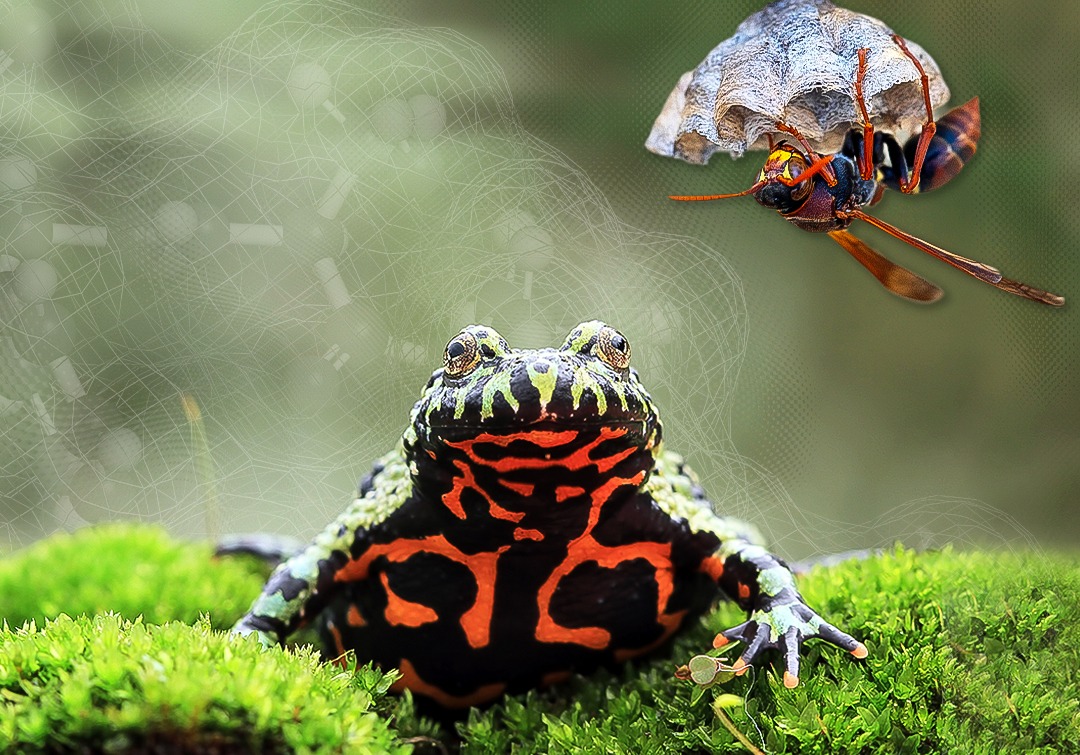
Certain species of wasps and frogs share a pain and inflammation peptide similar to one found in vertebrates to help defend against predators – a discovery researchers say contributes to a shifting view of how evolution works.
Scientists at The University of Queensland’s Institute for Molecular Bioscience led an international study showing the peptide – known in vertebrates as bradykinin – evolved independently in animals that did not share any common ancestry.
“The findings overturn decades of assumptions about the origins of these peptides,” lead author Dr Sam Robinson said.
“Scientists previously believed bradykinin‑like peptides in wasp venom and frog skin secretions were simply their versions of the vertebrate peptide.
“Instead, our research shows they are evolutionary doppelgängers – molecules that look the same but evolved independently.”
In vertebrates, bradykinin plays a role in wound healing and pain signalling.
The research demonstrated the bradykinin‑like peptides in wasps and frogs are derived from toxin gene families, not from the vertebrate kininogen gene that produces bradykinin.
Each lineage across multiple wasp and frog families evolved these molecules separately, often multiple times, to deter predators.
While many vertebrates prey on insects, various wasp species rely on venom for defence.
The study found that bradykinin-like toxins in wasps strongly activate bradykinin receptors in mammals and birds, triggering pain responses similar to the natural peptide.
Frog species appear to use a similar strategy.
Their skin secretions contain bradykinin mimics that match the peptide of various mammal, bird and fish predators.
Experiments showed that frog bradykinin receptors do not respond to these mimics, confirming the peptides evolved as a defensive weapon.
Dr Robinson said the research highlights the surprising ‘ease’ by which natural selection can result in the same evolutionary outcome.
“The study shows convergent evolution – when different species develop similar features – plays a critical and previously underestimated role in the evolution of life,” he said.
“Convergent evolution demonstrates that life is not a random, unpredictable, muddle of improbable outcomes but is in fact progressing in an ordered, constrained, predictable, perhaps even inevitable, way.
“Our ability to predict evolutionary outcomes has important practical applications.
“In agriculture, pest- and weed-resistance management strategies can be designed proactively rather than reactively.
“Similarly, doctors can anticipate resistance routes for various infections and diseases to design combination or adaptive treatments.
“Convergent evolution could even allow us to predict what extraterrestrial life might look like and design detection methods accordingly.”
The research is published in Science.
Collaboration and acknowledgements:
French National Centre for Scientific Research, University of Copenhagen, University of Utah.
Attachments
Note: Not all attachments are visible to the general public. Research URLs will go live after the embargo ends.


