WOH! In 2014 something strange happened to one of the largest stars in the Universe

Publicly released:
International
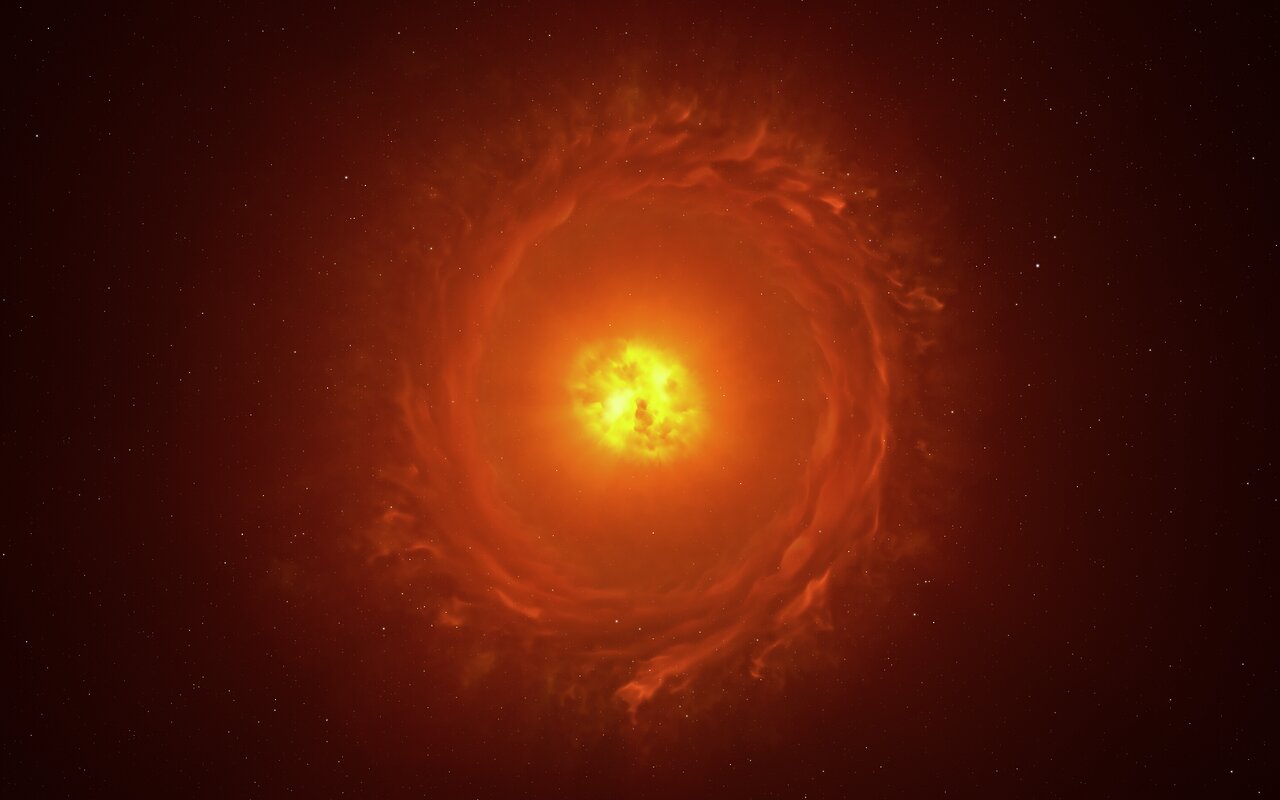
Artists impression of WOH G64 Credit: ESO/L. Calçada

In 2014 one of the largest red stars in the Universe suddenly turned yellow, and scientists are only just beginning to piece together the cause, according to an international research paper. The team say the star, called WOH G64, seems to have transitioned from being a red supergiant into a yellow hypergiant star between 2013 and 2014. They say that in 2011 the red supergiant dimmed, and then after recovering its brightness, it grew 1000 degrees hotter and turned yellow by 2014. Intriguingly, it also dimmed again in 2025, they add. The team suggest two possible explanations for this odd behaviour: Either WOH G64 could be a part of a binary star system (a system with two stars) in which the red supergiant transitioned into a yellow hypergiant due to an interaction that triggered the ejection of a part of its atmosphere, or it was originally a yellow hypergiant, and it experienced an eruption of material that made it appear red for several decades, ending in 2014.

News release

From: Springer Nature

1.  Astronomy: Tracing a supergiant star’s evolutionary journey
One of the largest known stars in the Universe, WOH G64, may have transitioned into a yellow hypergiant between 2013–2014, according to research published in Nature Astronomy. This change offers a rare opportunity to observe stellar evolution in real time and investigate how different processes may shape the final stages of massive stars and their resulting supernovae.
Red supergiants are stars more than 8 times the mass of the Sun and have relatively short lifespans, lasting just 1–10 million years, before they eventually explode as supernovae. However, the evolution and fate of the most luminous red supergiants remains uncertain. Since its discovery in the 1980s, WOH G64 has been considered one of the most luminous, largest (with a radius 1,540 times that of the Sun), and coolest red supergiants in the nearby Large Magellanic Cloud, making it a unique test case to study stellar evolution.
To investigate the evolution of WOH G64, Gonzalo Muñoz-Sanchez and colleagues reviewed more than 30 years of brightness measurements beginning in 1992, combining them with new and archived electromagnetic spectra. They found that the star underwent rapid changes, initially dimming in 2011 before recovering and becoming more yellow and warmer (by more than 1,000 degrees Celsius) in 2013–2014. In 2025, it faded considerably. It also experienced changes to its atmospheric chemistry.
To explain these developments, the authors suggest two potential scenarios. Firstly, WOH G64 could be a part of a binary star system in which the red supergiant transitioned into a yellow hypergiant due to an interaction that triggered the ejection of a part of its atmosphere. In an alternative scenario, a yellow hypergiant may have experienced an eruption of material that made it appear red for several decades, ending in 2014.
The findings raise the question of whether extreme red supergiants, such as WHO G64, exist because they are interacting binaries, and therefore would not reach these extreme states if they were single stars. Future interactions will determine whether this star explodes as a supernova, collapses into a black hole, or merges with its companion.

Journal/
conference:
Nature Astronomy
Research:Paper
Organisation/s: National Observatory of Athens, Greece
Funder: G.M.-S., M.K., S.d.W., K.A., A.Z.B., E.C. and G.M. acknowledge funding support from the European Research Council (ERC) under the European Union’s Horizon 2020 research and innovation programme (‘ASSESS’, grant agreement number 772086). E.Z. acknowledges support from the Hellenic Foundation for Research and Innovation (H.F.R.I.) under the ‘3rd Call for H.F.R.I. Research Projects to support Post-Doctoral Researchers’ (project number 7933). This work has been co-funded by the National Science Centre, Poland, grant number 2022/45/B/ST9/00243. We acknowledge helpful discussions with N. Blagorodnova, W.-J. de Wit, A. Ercolino, Y. Götberg, D. Hatzidimitriou, M. Kraus, E. Koumpia, M. Kourniotis, R. Oudmaijer and L. Patrick. The work of K.B. is supported by NOIRLab, which is managed by the Association of Universities for Research in Astronomy (AURA) under a cooperative agreement with the US National Science Foundation. This paper includes data gathered with the 6.5 m Magellan Telescopes located at Las Campanas Observatory, Chile.
Media Contact/s
Contact details are only visible to registered journalists.