 Sign In



 Australia; QLD; WA
News release
From:
Can seagrasses survive extreme heat? Exploring how different seagrass species withstand elevated water temperatures
Extreme heat can have a devastating effect on seagrass, however new research from Edith Cowan University (ECU) could shape how these vitally important marine ecosystems are managed and restored.
In separate studies carried out on both the west and east coasts of Australia, researchers have investigated how seagrasses stand up to marine heatwaves and prolonged ocean warming.
Executive Dean of ECU’s School of Science, Professor Marnie Campbell, conducted the research during her time at Central Queensland University. She noted that insights into how different intertidal species respond to elevated water temperatures are critical for informing future seagrass management.
“The outcomes demonstrate that the way we protect and restore seagrass will need to change as the climate warms,” Professor Campbell said.
PhD candidate Nicole Said from ECU’s Centre for Marine Ecosystem Research said that not all seagrass species faced the same climate risk, with her research findings on Western Australian seagrass ecosystems indicating that subtidal seagrass meadows could be restored with more heat-resistant populations of the same species.
“By identifying and sourcing heat-tolerant populations - sometimes just kilometres away - we can translate this knowledge into on-the-ground action, incorporating resilient populations into restoration to create climate-ready meadows,” Ms Said explained.
West Coast
Ms Said is lead author of the study Seagrasses are most vulnerable to marine heatwaves in tropical zones: local‐scale and broad climatic zone variation in thermal tolerances, which looked at six species along the Western Australian coast, spanning broad thermal gradients from temperate to tropical climates.
“Western Australia is an ideal setting for studying seagrass thermal tolerances, and there is a critical need for this data due to WA being a global hotspot for marine climate impacts,” Ms Said explained.
“We can use this information to look at which species might be vulnerable during future marine heatwaves, and which ones we should focus our conservation value on.”
The study revealed that seagrasses are most vulnerable to marine heatwaves in tropical zones. It also showed that climate risk varied across seagrass species, with a 10-degree Celsius difference in thermal optima, and even neighbouring populations showed different heat tolerances.
“Some populations are better equipped to deal with the heat, and in some cases, the tough ones might be growing next door,” Ms Said explained. “This shows that not all species face the same level of risk from climate change, and a one-size-fits-all approach is not appropriate for management of thermally vulnerable seagrass species.”
The findings could also benefit restoration of seagrass meadows that have already suffered from thermal warming and marine heatwave events.
“We can use this information to help build climate-ready meadows, by migrating plants or seeds from more heat-resistant populations into thermally vulnerable areas.”
East Coast
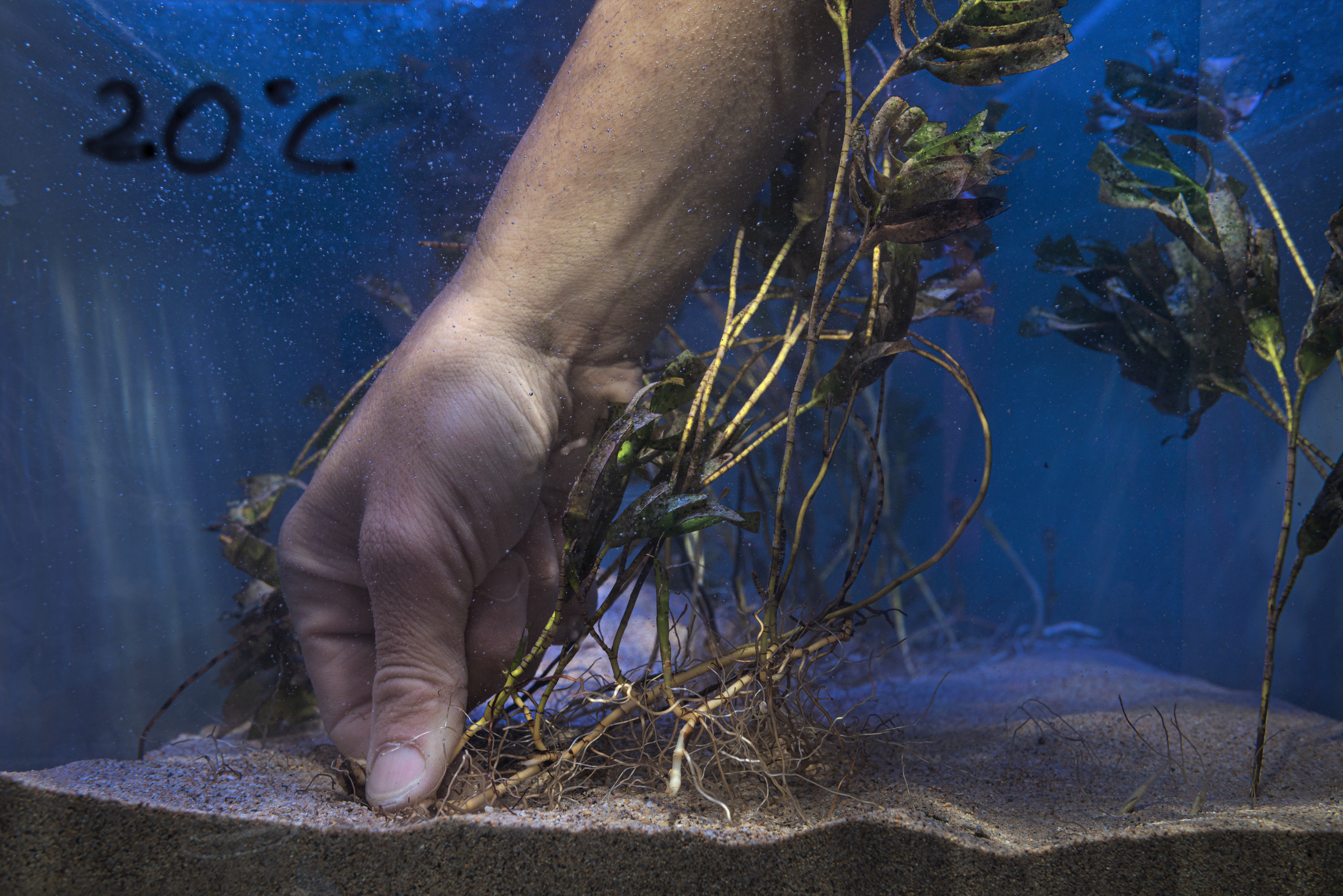
Professor Campbell’s study Varying vulnerabilities: Seagrass species under threat from prolonged ocean warming - Campbell - 2025 - Limnology and Oceanography - Wiley Online Library is a recent paper in a series that examined the impacts of elevated water temperatures on five intertidal species in Gladstone, Queensland, with a focus on improving seagrass restoration.
“This study offers an understanding of how climate change might impact these seagrasses, whose ecological functions are not easily replaced once lost,” Professor Campbell said.
“Seagrasses are a critically important ecosystem that provides food, shelter and nursery areas for a wide variety of marine life, so with changing climate it is at risk in different ways. We wanted to understand how these species react when temperatures reach dangerous extremes, which is becoming more common with climate change.”
Professor Campbell said they found intertidal pools where the water was more than 40 degrees for weeks on end.
“The tide would go out, and the seagrass would be left high and dry, quite often in little, tiny pockets of water which would reach massive temperatures,” Professor Campbell said. “To restore or manage the species, you have to look at the distinct thermal thresholds of the different species – you can’t treat them all as one.
“This knowledge helps us to decide which species to plant where – including the best substrate and water depth; so we can restore these ecosystems more effectively.”
Professor Campbell said the species she studied were commonly found in Australia and other parts of the world, with the outcomes leading to global impact.
“There were two species that were really good candidates for future-proofing restoration in regions that are warming up,” Professor Campbell said.
“Two were highly vulnerable and will require more protection from heat stress, or if you’re going to restore them you need to find micro-climates that are cooler for them - for example if they are in the sub-tropics, you would look at temperate areas to restore them.”

