 Sign In



 Australia; New Zealand; International; NSW; VIC; QLD; ACT

News release
From:
Earth’s climate swings increasingly out of balance
- WMO State of Climate report confirms 2015-2025 hottest 11 years on record
- Earth’s energy imbalance is highest in sixty five-year record
- The ocean has been absorbing about eighteen times the annual human energy use each year for the past two decades.
- Extreme weather impacts millions and costs billions
- World Meteorological Day: observing today to protect tomorrow
Geneva, Switzerland, 23 March 2026 (WMO) – The Earth’s climate is more out of balance than at any time in observed history, as greenhouse gas concentrations drive continued warming of the atmosphere and ocean and melting of ice, according to the World Meteorological Organization (WMO). These rapid and large-scale changes have occurred within a few decades but will have harmful repercussions for hundreds – and potentially thousands – of years.
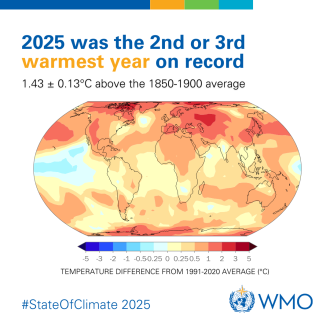
WMO’s State of the Global Climate report 2025 confirms that 2015-2025 are the hottest 11-years on record, and that 2025 was the second or third hottest year on record, at about 1.43 °C above the 1850-1900 average. Extreme events around the world, including intense heat, heavy rainfall and tropical cyclones, caused disruption and devastation and highlighted the vulnerability of our inter-connected economies and societies.
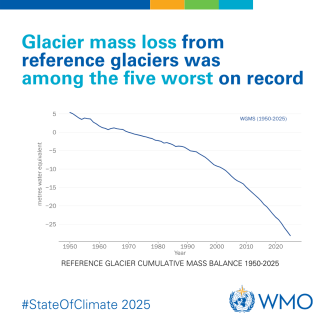
The ocean continues to warm and absorb carbon dioxide. It has been absorbing the equivalent of about eighteen times the annual human energy use each year for the past two decades. Annual sea ice extent in the Arctic was at or near a record low, Antarctic sea ice extent was the third lowest on record, and glacier melt continued unabated, according to the report.
“The State of the Global Climate is in a state of emergency. Planet Earth is being pushed beyond its limits. Every key climate indicator is flashing red,” said UN Secretary-General António Guterres.
“Humanity has just endured the eleven hottest years on record. When history repeats itself eleven times, it is no longer a coincidence. It is a call to act,” said Mr Guterres.
WMO’s flagship State of the Global Climate report was released on World Meteorological Day on 23 March, which has the theme Observing Today, Protecting Tomorrow.
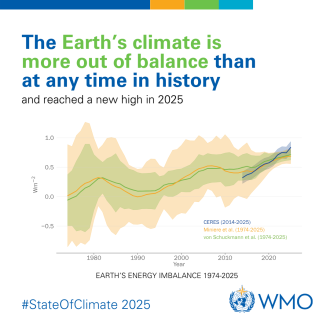
For the first time, the report includes the Earth’s energy imbalance as one of the key climate indicators.
The Earth’s energy balance measures the rate at which energy enters and leaves the Earth system. Under a stable climate, incoming energy from the sun is about the same as the amount of outgoing energy.
However, increasing concentrations of heat-trapping greenhouse gases - carbon dioxide, methane and nitrous oxide - to their highest level in at least 800,000 years have upset this equilibrium.
The Earth’s energy imbalance has increased since its observational record began in 1960, particularly in the past 20 years. It reached a new high in 2025.
“Scientific advances have improved our understanding of the Earth’s energy imbalance and of the reality facing our planet and our climate right now,” said WMO Secretary-General Celeste Saulo. “Human activities are increasingly disrupting the natural equilibrium and we will live with these consequences for hundreds and thousands of years.”
“On a day-to-day basis, our weather has become more extreme. In 2025, heatwaves, wildfires, drought, tropical cyclones, storms and flooding caused thousands of deaths, impacted millions of people and caused billions in economic losses,” said Celeste Saulo.
The warming of the atmosphere including near the Earth’s surface (the temperatures that humans feel) represents just 1% of the excess energy, whilst about 5% is stored in the continental land masses.
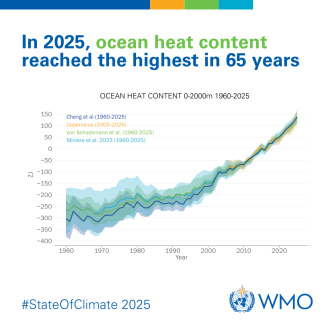
More than 91% of the excess heat is stored in the ocean, which acts as a major buffer against higher temperatures on land. Ocean heat content reached a new record high in 2025 and its rate of warming more than doubled from 1960-2005 to 2005-2025.
Another 3% of the excess energy warms and melts ice. The ice sheets on Antarctica and Greenland have both lost significant mass and the annual average Arctic sea-ice extent for 2025 was the lowest or second lowest on record in the satellite era. Exceptional glacier mass loss occurred in Iceland and along the Pacific coast of North America in 2025.
The warming ocean and melting ice are driving the long-term rise in global mean sea level, which has accelerated since satellite measurements began in 1993.
Ocean warming and sea level rise will continue for centuries, according to projections by the Intergovernmental Panel on Climate Change (IPCC). Changes in ocean warming, and deep ocean pH are irreversible on centennial to millennial time scales.
The report is accompanied by an interactive story map. It has a dedicated supplement on extreme events, highlighting their cascading impacts, including on food insecurity and displacement.
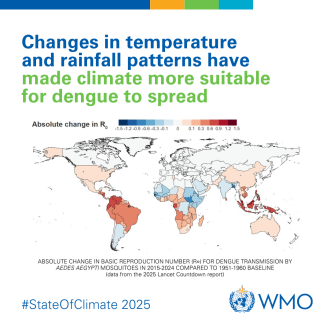
It includes a chapter on climate and health, showing how rising temperatures, shifting rainfall patterns and changes in extremes are affecting where and when health risks emerge, how severe they become and who is most exposed.
It highlights the examples of the mosquito-borne dengue disease and of heat stress – and illustrates how climate data, early warning systems and integrated climate services for health can protect people in a warming world.
“And in this age of war, climate stress is also exposing another truth: our addiction to fossil fuels is destabilizing both the climate and global security. Today’s report should come with a warning label: climate chaos is accelerating and delay is deadly,” said Mr Guterres.
The State of the Global Climate report 2025 is based on scientific contributions from National Meteorological and Hydrological Services, WMO Regional Climate Centres, United Nations partners and dozens of experts.
“WMO’s State of the Global Climate report seeks to inform decision-making. It is in keeping with the theme of World Meteorological Day because when we observe today, we don’t just predict the weather, we protect tomorrow. Tomorrow’s people. Tomorrow’s planet,” said Celeste Saulo.
[Full media release attached below]
Expert Reaction
These comments have been collated by the Science Media Centre to provide a variety of expert perspectives on this issue. Feel free to use these quotes in your stories. Views expressed are the personal opinions of the experts named. They do not represent the views of the SMC or any other organisation unless specifically stated.
Professor Scott Heron is UNESCO Chair on Climate Change Vulnerability of Natural and Cultural Heritage and Head of Physics at James Cook University
On ocean impacts:
"The WMO Report provides a timely update on the dire state of Earth's climate system in an era where impacts are rapidly increasing. Whilst natural Greenhouse gases provide our planet with liveable conditions by trapping energy within the Earth system, anthropogenic emissions, such as from fossil fuel usage, have increased energy in the system which has led to accelerated warming. That warming and the associated impacts will continue for decades – and unless we act to reduce emissions, for centuries.
Over 90% of the additional energy trapped by increased Greenhouse gases has been absorbed by the ocean, causing around 1ºC of warming. This has reduced sea ice that reflects solar energy, so further increases the rate of warming, and influences major ocean currents – both of those factors can have wide-reaching effects on the ocean. Intensifying marine heatwaves have already impacted ocean systems through coral bleaching and mortality across the tropics, seagrass death and catastrophic marine disease outbreaks in tropical and temperate zones, as well as episodes of salmon lice in polar aquaculture. If rainforests are thought of as the lungs of our planet, the ocean provides the heart and circulation – and human-induced climate change is giving us all heart disease."
On heritage impacts:
"Impacts from climate change are recognised as the greatest threat to our shared heritage. Climate change is now understood to represent the greatest threat to World Heritage properties, recognised internationally as among the most important locations to humanity. The changes outlined in the WMO report – including land and sea warming, rising sea levels and increases in heavy rainfall events – have resulted in unprecedented forest fires, erosion of coastal cultural sites, impacts on built heritage and cityscapes, and diminishing glaciers.
The United Nations climate change body has recognised the importance of culture and heritage through indicators around implementation of adaptation responses for tangible and intangible heritage, emergency preparedness, community engagement and the importance of Indigenous and local knowledge in all aspects of response. The physical impacts outlined in the WMO report have a very clear link to people – both through the potential loss to heritage and the impacts on communities from climate-driven disturbances. If not for the wellbeing of the planet’s natural systems, our global community must act to stop the causes of continuing climate change to preserve our heritage – and ourselves."

Ian Lowe is Emeritus professor of science, technology and society at Griffith University, Qld and former President of the Australian Conservation Foundation.
"As the Northern Territory deals with unprecedented flooding and Cape York braces for a powerful cyclone, this report reminds us of the root cause of extreme events. We have not seen the emissions reductions agreed at the 2015 Paris conference. Carbon dioxide levels in the atmosphere are still increasing, now at the highest level for two million years.
It is clear that we face an increasingly urgent climate emergency. So we now need concerted action by all levels of government to accelerate the closure of fossil fuel power stations by investing in storage for solar and wind, to avert the crisis caused by war in the Middle East by modernising our transport system and to prohibit proposed extension of gas projects.
The 2003 report to the Howard government, National Framework for Energy Efficiency, estimated we could reduce emissions by 30 per cent, simply by using cost-effective technology. Cleaning up after extreme weather events is already costing us billions. We need to be investing now in a clean future and urging other nations also to take concerted action."
Dr Tom Mortlock is Head of Climate Analytics Asia-Pacific at Aon, and Adjunct Fellow in the Climate Change Research Centre at UNSW
“The World Meteorological Organization’s State of the Climate report confirms that the period from 2015 to 2025 represents the hottest 11 years on record. With a potentially significant El Niño event forming later this year, there is a real chance that 2026 and 2027 could be among the hottest years ever recorded. Most research now suggests we may have already crossed the 1.5 degree warming threshold set under the Paris Agreement more than a decade ago, a critical tipping point linked to risks such as ice sheet collapse, permafrost thaw and failure of the Amazon rainforest.
“Even seemingly small increases in temperature can have outsized effects on extreme weather. The frequency and intensity of bushfires, floods, cyclones and hailstorms are all linked to the warming of the atmosphere. At the same time, more people are living in harm’s way. The global insurance industry, operating at the intersection of climate change and the built environment, has just recorded its ninth consecutive year of above average insured losses, with extreme weather events costing the industry around $127 billion in 2025.”
Clive Hamilton is Professor of Public Ethics at Charles Sturt University in Canberra and the author of several books about climate change
“Australians know the climate system is entering unknown territory. It’s becoming hotter and life is more disrupted by extreme weather events. The WMO report confirms it. Yet Australia refuses to face up to the urgent need to build a society and an economy more resilient to climate change, ones better able to withstand the threats we know are coming.
Cutting Australia’s emissions rapidly is necessary but doing so will not change the climatic conditions future Australians will have to live through. We can’t change the global climate but we can build defences against the far-reaching and enduring damage climate change will surely bring.”
Dr Andrew King is an Associate Professor in Climate Science at the University of Melbourne and the ARC Centre of Excellence for 21st Century Weather
"Every year, humanity keeps emitting huge amounts of greenhouse gases into the atmosphere from our continued reliance on fossil fuels. These emissions, at record high levels in 2025, are pushing the planet further away from its natural state and into a new, hotter, more dangerous state.
We are causing worsening heatwaves, acidification of our oceans, rising sea levels and many other changes that will be hard to reverse even if we achieve net zero down the track. Every year of delaying strong climate action, causes more problems for the next generations."
Martina Linnenluecke is the Director of the Centre for Climate Risk and Resilience at UTS Business School and is a Professor of Environmental Finance
"From a business climate risk and resilience perspective, this report reinforces that businesses are operating in a system that is becoming progressively more unstable. The introduction of Earth’s energy imbalance as a key indicator is particularly significant because it highlights that warming is not just continuing but accelerating at a systems level, driven by persistent excess energy accumulation. For businesses, the implications are material. Mitigation is becoming more urgent, because delaying emissions reductions locks in greater long-term risks. Rising ocean heat and sea levels increase physical risks to coastal assets, ports and supply chains, while more frequent and intense extreme events disrupt operations and logistics.
A critical point is that this is not a temporary shock. The persistence of warming over decades means that adaptation has to move from the margins of business strategy to its core. Firms that treat climate risk as a compliance issue and fail to integrate climate risk into their strategic planning will face growing financial and operational exposure. Importantly, many of these risks are tied to shared resilience assets such as infrastructure and public services that individual firms do not control but depend on, which will require systemic approaches to adaptation."
Associate Professor Daniel Kingston, School of Geography |Te Iho Whenua, University of Otago|Ōtākou Whakaihu Waka, comments:
"A report that further confirms that global temperatures have increased is not particularly surprising. Climate scientists have been giving similar messages about global warming for decades now. However, these messages get more and more stark each time, and records continue to be broken.
"Some of the more startling details of global climate in 2025 include:
- The past 11 years are the 11 hottest years in the instrumental record.
- 2025 was the second or third warmest year on record (depending on data set used) – despite the occurrence of a La Niña event, which typically depresses global temperatures.
- Energy is accumulating in the Earth system. Although the atmosphere is clearly warming, only 1% of this excess energy is stored in the atmosphere. Over 90% has been absorbed by the planet’s oceans – and they are warming accordingly. Because oceans respond much slower to energy input compared to the atmosphere, these changes will persist for hundreds (and maybe thousands) of years, even in the case of emission reductions.
"Although this report is not written to provide policy advice, the evidence is clear that human action is increasingly destabilizing our climate. With each year that passes without more concerted action on emission reductions, we add to the problems that future generations will face. With the timing of this report coinciding with the ongoing troubles in the Middle East and rapid rises in oil prices, how much more evidence do we need to push individuals, communities and governments to accelerate our transition away from fossil fuels?"
Dr Lauren Vargo, climate scientist & glaciologist, Victoria University of Wellington, comments:
"This report continues to confirm what climate scientists have been warning about for decades: as greenhouse gases build up in the atmosphere, the planet is warming. While slightly warmer weather might sound pleasant to some of us in New Zealand, the overall costs and risks hugely outweigh any benefits.
"Warmer ocean temperatures together with melting ice is driving sea level rise, now at a rate of almost 5 mm per year (global average). But what concerns me the most is the increase in frequency and intensity of extreme weather and climate events (e.g. flooding, heatwaves, wildfires). These events destroy ecosystems and infrastructure, and impact human health and livelihoods, making them costly both financially and to society.
"One of the report’s indicators is glacier mass balance (the gain or loss of ice each year). Data show that eight of the ten largest mass loss years have occurred since 2016. These measurements come from ~170 glaciers worldwide, including two here in New Zealand. Glaciers are more than just climate indicators. The nearly 3,000 glaciers in Aotearoa are important taonga and are important for tourism, and their melt may impact freshwater resources and increase hazard risks."
James Renwick, Professor of Climate Science, Victoria University of Wellington, comments:
"“Every key climate indicator is flashing red” said the U.N. Secretary General António Guterres. Exactly. The warmest years on record are the ones we’re in right now, all aspects of the climate system are warming, and all the cold bits are melting. This is all because an increase in atmospheric greenhouse gases is changing the earth’s energy budget, we now have more energy coming in than going out. Increased warming goes with increased extreme events, that have consequences for communities everywhere. As is documented in the latest WMO State of the Climate report, the global community is collectively eating away at our life support system.
"The science of climate change has been well understood for a century or more and we know what we have to do to stop it. Stop burning fossil fuels. Policymakers have been advised on this for decades, yet emissions of carbon dioxide and other greenhouse gases keep increasing. I hope this latest report moves the dial with the policymaking community and encourages action to reduce emissions. The costs of inaction are already astronomical, lets not make them overwhelming."
Drew Bingham, Principal Science Advisor, Department of Conservation, comments:
"The WMO Global Climate Report highlights the pressing need to do what we can to prepare our species and ecosystems, visitor experiences, and cultural heritage sites for the impacts they’re already facing from climate change. The report’s finding that the past 11 years were the warmest 11 years in the 176-year record underlines the urgency to build resilience now and plan for increased impacts down the line as climate change continues to intensify.
"More than 4000 of Aotearoa New Zealand’s native species are threatened with extinction or are at risk of becoming threatened. Climate change impacts – the increasingly frequent severe storms and floods, droughts, and increased fire risk – are putting many of our taonga species under even more pressure. DOC’s visitor infrastructure is already being affected and more than 400 archaeological sites and 300 of DOC's coastal assets including campgrounds and bridges are at risk from rising sea levels and coastal flooding.
"At DOC we’re taking action, for example, by building shelters for tarapirohe/black-fronted tern chicks at risk from extreme temperatures. These low-cost shelters have successfully protected fledgling chicks from temperatures over 40 degrees at their Canterbury braided river habitat. New bridges on the Heaphy Track (to replace ones that were damaged by floods) were designed to be resilient to future climate change-driven floods.
"As the record-hot climate documented in the WMO report becomes increasingly normal, DOC’s climate change adaption action plan will help to prepare for climate change risks. The report reinforces the urgency to build on our adaptation work, and highlights that adaptation is no longer optional or nice-to-have."
Multimedia

Attachments
Note: Not all attachments are visible to the general public. Research URLs will go live after the embargo ends.

