We've been keeping dogs as pets for over 14,000 years

Publicly released:
Australia; International; QLD
Image: Kathryn Killackey - Artistic reconstruction of Pınarbaşı c. 15,800 years ago based on evidence from archaeological excavations by University of Liverpool

Dogs were likely living as human pets across western Eurasia at least 14,200 years ago, according to international and Australian researchers analysing archaeological evidence across two studies. In the first study, researchers analysed dog-like remains from across Europe dating back to the Palaeolithic and Mesolithic eras, sorting the wolves from the dogs using their DNA. The oldest dog remains they found were from a site in Switzerland dating back 14,200 years ago, and they say this dog shared genetic similarities with the dogs we have in our homes today. In the second study, researchers analysed remains from sites in Türkiye and the UK, and say they found evidence of a specific dog population with similar genetics spread across the continent during the during the Late Upper Palaeolithic. They say there appears to be an influx of eastern Eurasian dog ancestry coinciding with human hunter-gatherer migration from the same reason, suggesting these dogs migrated alongside humans.

News release

From: Springer Nature

Palaeontology: Genetics reveals history of the earliest dogs in Europe

Domesticated dogs were already widely distributed in western Eurasia at least 14,200 years ago, according to two studies published in Nature. The papers report the oldest known dog genomes to date, earlier than the previous genetic record of around 10,900 years ago. The findings also reveal that a genetically similar dog population had spread widely across western Eurasia by this time. Together, these results shed light on the early history of dogs in Europe.

Dogs were the only domesticated animals present in Europe before agriculture, but the exact timing of their origin remains unclear. Archaeological evidence suggests that dogs diverged from wolves during the Palaeolithic, over 15,000 years ago, and the earliest recognizable dog remains in Europe date to at least 14,000 years ago. However, without genome‑wide data, the origins of these early European dogs were difficult to confirm.

In the first study, Anders Bergström and colleagues analysed the genomes of 216 dog and wolf remains found in Europe and its vicinity. The oldest specimen is an early dog from the Kesslerloch site in Switzerland, which is radiocarbon‑dated to 14,200 years ago. Analysis of the genome shows that the Kesslerloch dog shared ancestry with dogs from other regions, indicating that the genetic diversification of domesticated dogs had started more than 14,200 years ago and that Palaeolithic dogs in Europe did not derive from an independent domestication process. The authors also found an influx of Southwest Asian ancestry into some Neolithic European dogs, reflecting the migration of people during the spread of farming into Europe. However, this genetic effect was smaller in dogs than in humans, suggesting that dogs from local hunter‑gatherer groups made a substantial contribution to Neolithic, and probably also modern, European dogs.

In a separate study, Laurent Frantz and colleagues examined genomes from dog remains found at Pınarbaşı in Türkiye (dating to around 15,800 years ago), Gough’s Cave in the UK (around 14,300 years ago) and two Mesolithic sites in Serbia (11,500–7,900 years ago and 8,900 years ago, respectively). The results show that domesticated dogs were already widely distributed across western Eurasia by at least 14,300 years ago. These Palaeolithic dogs were genetically similar and were members of a population that expanded across the region between 18,500 and 14,000 years ago. The remains were associated with several human hunter-gatherer populations that were genetically and culturally different, suggesting that the spread of dogs may have been linked to the migration and interaction of these groups.

Together, the studies provide strong genetic evidence for the early presence and spread of dogs in Europe. They push genetically confirmed dog presence in Europe back to the late Upper Palaeolithic (around 15,800–14,200 years ago). In addition, the studies offer new insights into how ancient human populations migrated, interacted and shared their lives with the first dogs.

Multimedia

Artistic reconstruction of Pınarbaşı c. 15,800 years ago
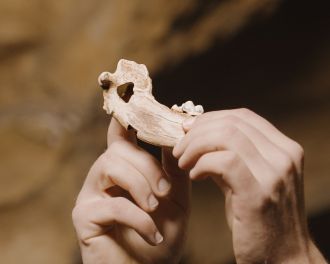
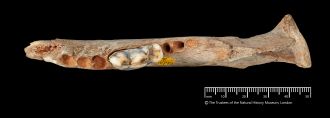
Reconstruction of 14,3000-year-old dog jawbone from Gough's Cave
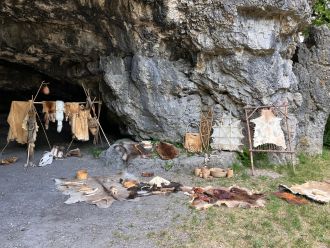
Reenactment scene in front of the Kesslerloch cave in Thayngen, Switzerland.
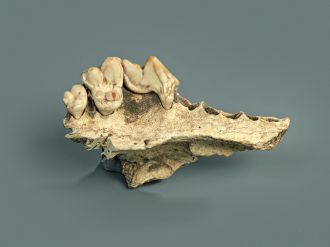
Maxilla of the domesticated dog from the Kesslerloch cave
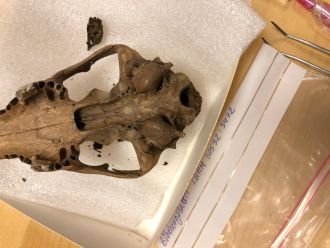
Sampling of a Swedish dog in the study from the Bökebergsslät site
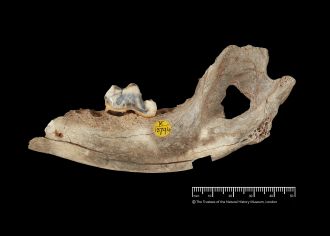
14,3000-year-old dog jawbone from Gough's Cave - 3
14,3000-year-old dog jawbone from Gough's Cave

Attachments

Note: Not all attachments are visible to the general public. Research URLs will go live after the embargo ends.

Research Springer Nature, Web page Paper 1. The URL will go live after the embargo ends
Research Springer Nature, Web page Paper 2. The URL will go live after the embargo ends
Journal/
conference:
Nature
Research: Link to Paper 1 | Paper 2
Organisation/s: The University of Queensland, University of East Anglia, Crick Institute, UK (Paper 1), Natural History Museum, University of Oxford, UK (Paper 2)
Funder: Paper 1: A. Bergström was supported by the Leverhulme Trust (grant no. PLP- 2023-281). P.S. was supported by a UKRI Horizon guarantee/ERC Consolidator award (grant no. UKRI338), the European Molecular Biology Organisation, the Vallee Foundation, the European Research Council (grant no. 852558), the Wellcome Trust (grant no. 217223/Z/19/Z) and Francis Crick Institute core funding (grant no. FC001595) from Cancer Research UK, the UK Medical Research Council and the Wellcome Trust. Paper 2: We thank the Calleva Foundation for funding the work of W.A.M., S.B., S.M.B., I.B., S.A.P. and C.S. at the Natural History Museum (NHM) (London). We thank the curators (in particular R. Pappa, R. Ives and E. Tilby) at the NHM for their assistance accessing specimens, the NHM Trustees for granting image permissions, and to the Longleat Estate for their long-term loan of the Gough’s Cave Palaeolithic assemblage. We thank the Bioarchaeology Laboratory, Central Laboratory, University of Tehran for access to and curation of material from Wezmeh Cave. We acknowledge R. Grifoni Cremonesi for her contribution as director of excavations at Grotte Continenza. We also thank the National Environmental Isotope Facility for funding radiocarbon dating of Pınarbaşı material (NF/2016/2/4). L.A.F.F. and L.S. were supported by the German Research Foundation (DFG; grant no. 524207393). L.A.F.F., G.L. and O.L. were supported by European Research Council grants (nos ERC-2013-StG-337574-UNDEAD and ERC-2019-StG-853272-PALAEOFARM) and Natural Environmental Research Council grants (nos NE/K005243/1 and NE/K003259/1). G.L. was supported by Brasenose College, Oxford. L.S. was supported by Merton and Somerville Colleges, Oxford. M.G.T. was supported by European Research Council grants (nos 951385-COREX, 865515-SUSTAIN, 324202-NeoMilk and 788616-YMPACT), a Wellcome Senior Research Fellowship grant (no. 100719/Z/12/Z) and a Natural Environmental Research Council grant (no. NE/X01469X/1). High-performance computing was performed on the BioHPC (DFG INST 86/2050-1 FUGG) and Linux-Cluster of the Leibniz Supercomputing Centre (LRZ Munich), the Smithsonian High-Performance Computing Cluster (Smithsonian Institution), the NHM internal HPC cluster and the CropDiversity HPC (James Hutton Institute).
Media Contact/s
Contact details are only visible to registered journalists.