Vast scale of whale graveyard tells a tale

Publicly released:
New Zealand; International
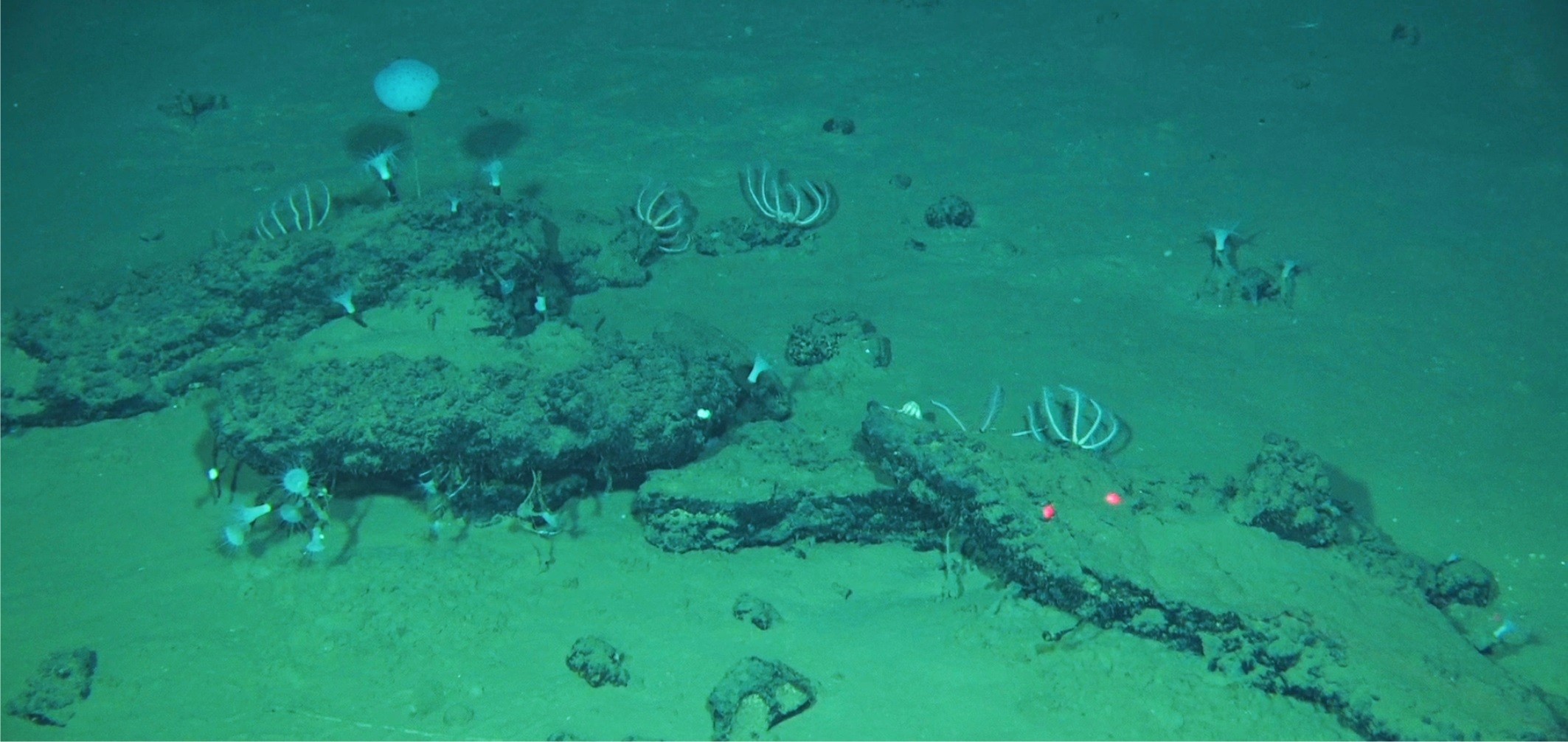
Fragmentary whale skeletal remains are abundant on the deep seafloor of the Diamantina Zone, reflecting long-term exposure and slow carcass degradation. These bones are typically colonised by hard-substrate animals, including stalked sea anemones, sponges, and sea stars. Photographs taken from the Chinese submersible Fendouzhe. Global TREnD, IDSSE

Scientists have found a large whale graveyard stretching 1,200 kilometres along the bed of the Indian Ocean off the coast of Perth, at depths up to 7 kilometres. This newly discovered necropolis contains nearly 500 whale-fossil sites (mostly remains of deep-diving beaked whales), including fossils dating back 5.3 million years, and 5 active whale falls. A whale fall - when a carcass sinks to the sea floor - can become a biodiversity oasis, and researchers found that these whale-fall communities are home to diverse animals like brittle stars, bone-boring worms, and bivalves that can live without sunlight. They say that many of the species may be new to science, and they have also identified one new extinct whale species.

News release

From: Springer Nature

A vast whale graveyard found on the bed of the Indian Ocean may represent the deepest and most extensive known accumulation of whale fossils, carcasses, and communities supported by the whale falls. The graveyard, reported in Nature this week, stretches 1,200 km along the sea floor at depths of between 4,200 and 7,000 m, with some fossils dating back to around 5.3 million years ago.

Whale falls — when whale carcasses sink to the ocean floor — can create complex localised ecosystems that support a wide range of organisms. However, their record is sparse and uneven, and most known whale falls are found at depths ranging from tens of metres to around 4,000 m, leaving deeper environments poorly understood.

Xiaotong Peng and colleagues report a large whale necropolis extending about 1,200 km along the sea floor in the Diamantina Zone in the southeastern Indian Ocean. They identified 485 whale-fossil sites and 5 active whale falls at depths of between 4,200 and 7,000 m. The density of whale remains reaches up to 759.5 individuals per km2. Isotopic dating reveals that the oldest fossils are about 5.3 million years old, indicating that whale falls may have occurred in the region since at least the Early Pliocene. The carcasses host distinct communities dominated by diverse species such as jellyfish, brittle stars, bone-boring worms and chemosynthesis-based bivalves, many of which may be new to science, the authors suggest. Most fossils in this area are from deep-diving beaked whales, both living and extinct, including one extinct whale identified as a new species, Pterocetus diamantinae.

The findings reshape our understanding of deep-sea ecosystems and shed light on the distribution, ecology and evolution of beaked whales.

Multimedia

12
12
8
8
cover suggestion
cover suggestion

Attachments

Note: Not all attachments are visible to the general public. Research URLs will go live after the embargo ends.

Research Springer Nature, Web page
Journal/
conference:
Nature
Research:Paper
Organisation/s: Earth Sciences New Zealand, Chinese Academy of Sciences - China, Università di Pisa - Italy
Funder: This work was under the scheme of the Global Trench Exploration and Dive Programme (Global TREnD). Funding statements: X.P. discloses support for the research of this work from the National Key R&D Program of China (grant no. 2022YFC2805400) and the Program for Fostering International Mega-Science of the Chinese Academy of Sciences (grant no. 183446KY SB20210002). M.D. discloses support for the research of this work from the National Key R&D Program of China (grant no. 2025YFE0214500). X.S. discloses support for the research of this work from the National Natural Science Foundation of China (grant no. 42276090).
Media Contact/s
Contact details are only visible to registered journalists.