 Sign In



 International
News release
From:
All five nucleobases detected in Ryugu samples
The complete set of nucleobases found in terrestrial DNA and RNA — adenine, guanine, cytosine, thymine and uracil — have been detected in samples returned from the asteroid Ryugu, according to research published in Nature Astronomy. The findings offer new insights into the early Solar System's chemistry.
Nucleobases are essential components of DNA and RNA, which underpin life on Earth. Detecting them in uncontaminated extraterrestrial material helps researchers to understand how such compounds can form in the absence of life and be transported across the Solar System. Previous analyses of Ryugu have reported the presence of uracil, whereas samples from meteorites and the near-Earth asteroid Bennu have revealed a wider diversity.
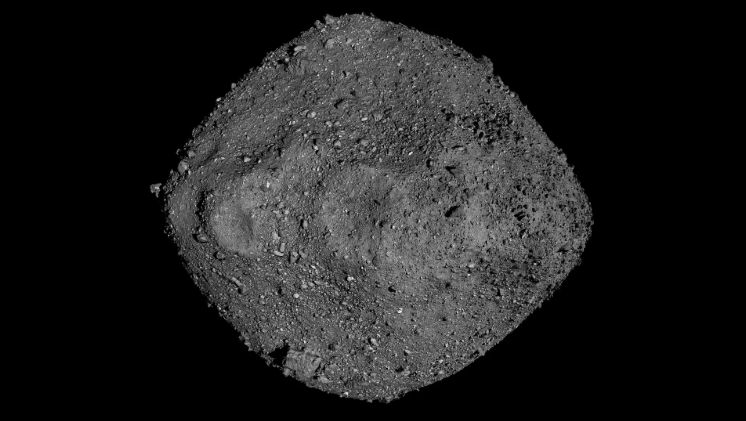
Toshiki Koga and colleagues analysed two Ryugu samples collected by the Hayabusa 2 mission and detected all five canonical nucleobases — adenine, guanine, cytosine, thymine, and uracil — in both samples. They compared the results with those obtained from the Murchison and Orgueil meteorites and with the returned samples from the asteroid Bennu. They found significant differences in the relative abundances of the nucleobases. More specifically, Ryugu contains roughly comparable amounts of purine nucleobases (adenine and guanine) and pyrimidine nucleobases (cytosine, thymine and uracil), while Murchison has more purine nucleobases while samples from Bennu and Orgeuil are richer in pyrimidine nucleobases. These results reflect the different chemical, environmental, and evolutionary histories of their respective parent bodies.
The detection of these nucleobases in asteroid and meteorite materials, despite their chemical differences, implies that they are widespread throughout the Solar System. The findings also suggest that carbonaceous asteroids may have contributed to the chemical inventory of early Earth, the authors conclude.
Expert Reaction
These comments have been collated by the Science Media Centre to provide a variety of expert perspectives on this issue. Feel free to use these quotes in your stories. Views expressed are the personal opinions of the experts named. They do not represent the views of the SMC or any other organisation unless specifically stated.
Dr Morgan Cable, Senior Lecturer in Space Science, Victoria University of Wellington
Summary:
"This paper reports the definitive detection of all five canonical nucleobases (adenine, guanine, cytosine, thymine and uracil) in samples returned from the asteroid Ryugu by JAXA’s Hayabusa 2 mission. Nucleobases are biomolecules that are important for life on Earth because they form the building blocks of the information-carrying molecules DNA and RNA. Some of them also combine with sugars and phosphates to form other bioessential molecules such as adenosine triphosphate (ATP), the energy currency of all known life. Nucleobases have also been invoked as being critical in the origin of life, whether through the ‘RNA world’ hypothesis or other
mechanisms.
"While this is not the first time nucleobases have been detected in a meteorite or asteroid, this report is unique because the authors were able to identify a correlation between nucleobase ratios and the concentration of another nitrogen-containing molecule – ammonia – that is consistent across three similar asteroids/meteorites, suggesting a shared chemical pathway. This discovery has important implications for how biologically-important molecules may have originally formed and promoted the genesis of life on Earth. Such meaningful work has only been possible due to the return of multiple pristine samples from primitive asteroids via OSIRIS-REx and Hayabusa 2."
Additional points:
"The authors of this work compared nucleobase levels in Ryugu to previous studies of Bennu (a carbonaceous asteroid sampled by the NASA OSIRIS-REx mission in 2020), as well as the Orgueil and Murchison meteorites. Based on this comparison the authors suggest that the purine/pyrimidine ratio can yield insights into different nucleobase chemistry among different types of asteroids and meteorites. In the asteroid Bennu samples, the pyrimidines (cytosine, thymine and uracil) were found to be more abundant than purines (adenine and guanine). In the Murchison meteorite, the opposite was found – more purines. The authors posit that the lower purine/pyrimidine ratios in the Ryugu, Bennu and Orgueil samples may indicate alternative synthetic pathways to the standard HCN polymerization route, which is known to form purines under prebiotic reaction conditions. Given that Bennu likely experienced more alkaline and ammonia-rich aqueous alteration than Ryugu, analysing both purines and pyrimidines in Ryugu samples is crucial for understanding how nucleobase distributions reflect the chemical history and formation processes in different primitive parent bodies.
"Ryugu is very similar to most CI chondrites in terms of its elemental, chemical and mineralogical properties. CI chondrites are, water-rich, stony meteorites that are a rare form of carbonaceous chondrites. They represent the most chemically primitive meteorites, meaning they likely have a similar elemental composition to that of the early solar system. Hence, by studying CI chondrites, we can learn about what was around during the time life might have been forming on Earth.
"The authors hypothesize that variations in ammonia availability—delivered via accreted ices from an outer Solar System reservoir—combined with differences in reactant abundances, modulated nucleobase synthesis on the parent bodies of Ryugu, Bennu and Orgueil.
"Overall, the universal detection of all five nucleobases in samples from the carbonaceous asteroids Ryugu and Bennu highlights the potential contribution of these exogenous molecules to the organic inventory that supported prebiotic molecular evolution and ultimately enabled the emergence of RNA and DNA on the early Earth."

Attachments
Note: Not all attachments are visible to the general public. Research URLs will go live after the embargo ends.

