The little red dots of our cosmos might hide something big

Publicly released:
Australia; International; WA; ACT
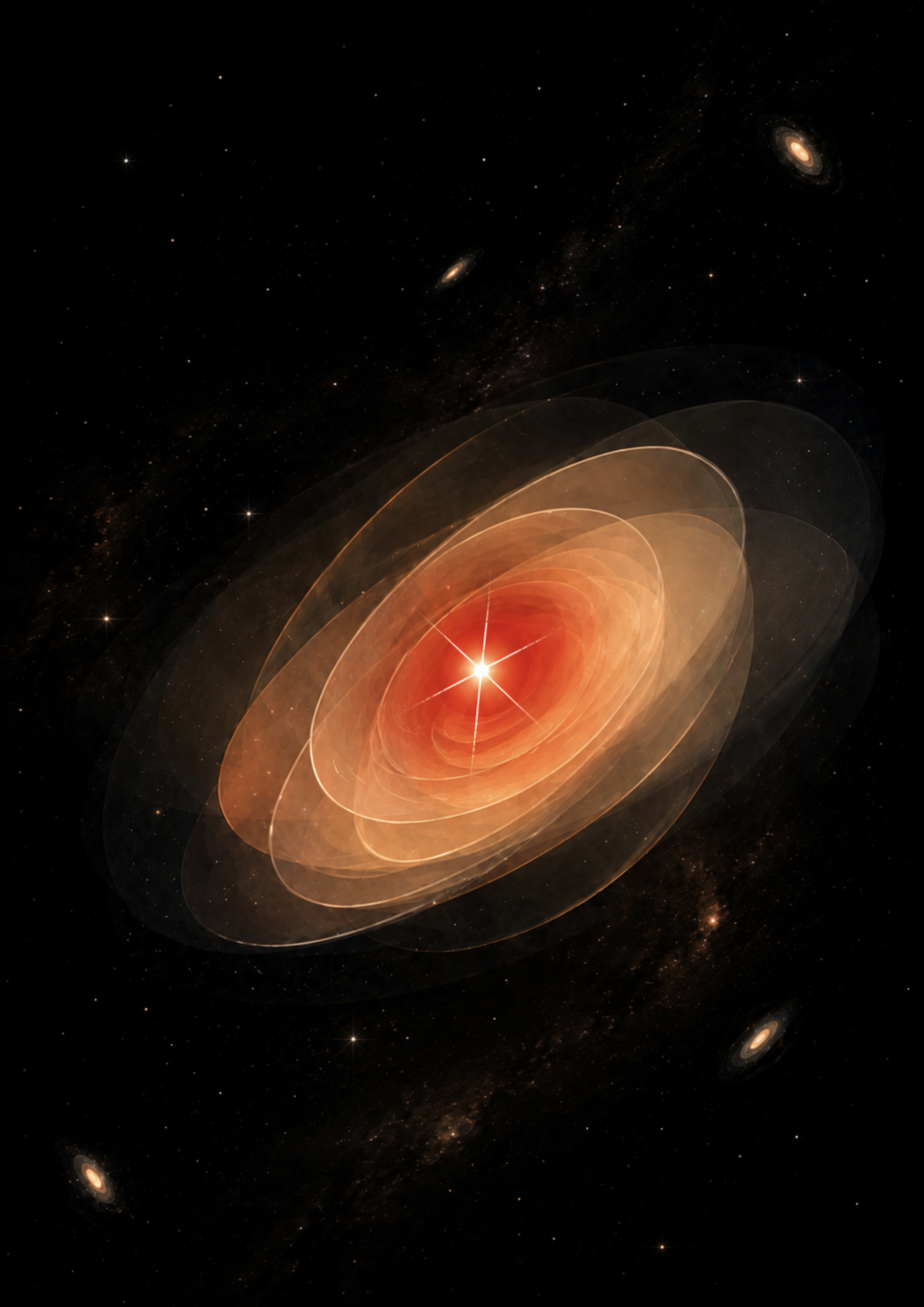
An artist’s impression of a Little Red Dot in the early Universe, showing a bright, compact central source embedded within a faint host galaxy. The morphology and size of the host galaxy are artistically exaggerated for visualisation, while JWST observations reveal that these seemingly point-like objects can contain an extended component. Credit: Ruiyuan Guo (denisehpp@163.com) & Xuheng Ding

Astronomers from Australia and across the globe say the little red dots that have been spotted in our scans of distant galaxies might actually be evidence of supermassive black holes. The researchers looked at 217 little red dots using the James Webb Space Telescope and say there is some extra light creeping out around the dots, which their modelling suggests hides a supermassive black hole in the centre of a star-forming galaxy, with an average radius of around 685 light-years.

News release

From: Springer Nature

Little red dots may reside in small, dense galaxies with total masses equivalent to around one billion times that of the Sun, according to research published in Nature Astronomy. The findings offer new clues about how these mysterious objects developed within the first billion years after the Big Bang.

Little red dots are small, red objects seen at far distances from Earth. However, the nature of little red dots and the source of their light remains unclear. Previous research has found signs of material around some of these objects at ultraviolet wavelengths, possibly indicating the presence of galaxies. However, there has been little evidence of this material in optical light (light that human eyes can see), which gives a clearer view of stellar mass.

Xuheng Ding, Lilan Yang, and colleagues combined James Webb Space Telescope images of 217 little red dots to reveal faint optical emission, meaning light extending beyond the central objects, that could not be clearly detected in individual images. Modelling of the data indicates that this emission likely comes from star-forming galaxies, with little red dots residing in their centres as supermassive black holes. The galaxies have average radii of just 210 parsecs (about 685 light years), making them about 2.5 times more compact than other star-forming galaxies of a similar mass seen at a comparable period in the Universe’s history.

The findings suggest that little red dots are not simply single points of light but likely exist within compact star-forming galaxies, which helps to explain their origin. However, the authors note that the results describe the average properties of the full sample, as the extended emission is too faint to be detected around most individual objects. Further work is needed to confirm the sample spectroscopically, by analysing the objects’ light to verify their distances.

Attachments

Note: Not all attachments are visible to the general public. Research URLs will go live after the embargo ends.

Research Springer Nature, Web page The URL will go live after the embargo ends
Journal/
conference:
Nature Astronomy
Research:Paper
Organisation/s: The Australian National University, The University of Western Australia, Wuhan University, Wuhan, China
Funder: This work was supported by National Natural Science Foundation of China (grant no. 12573017). X.D. and K.L acknowledge the National Key R&D Program of China (grant no. 2024YFC2207400). M.F. acknowledges funding from the European Union’s Horizon 2020 research and innovation program under the Marie Sklodowska-Curie grant agreement no. 101148925. L.C.H. was supported by the National Science Foundation of China (grant no. 12233001) and the China Manned Space Program (grant no. CMS-CSST-2025-A09). K.I. acknowledges support from the National Natural Science Foundation of China (grant nos. 12573015 and W2532003), the Beijing Natural Science Foundation (grant no. IS25003) and the China Manned Space Program (grant no. CMS-CSST-2025-A09). The Cosmic Dawn Center (DAWN) is funded by the Danish National Research Foundation under grant no. DNRF140. S.J. acknowledges the Villum Fonden research grant nos. 37440 and 13160. K.L acknowledges the National Natural Science Foundation of China (NSFC) grant no. 12222302. M.O. is supported by the Japan Society for the Promotion of Science (JSPS) KAKENHI grant no. 24K22894. T.T. is supported by the Japan Society for the Promotion of Science (JSPS) KAKENHI grant no. JP25KJ0750. B.Y. is supported by Xiaomi Foundation/Xiaomi Young Talents Program.
Media Contact/s
Contact details are only visible to registered journalists.