Sign In



 Australia; SA
News release
From:
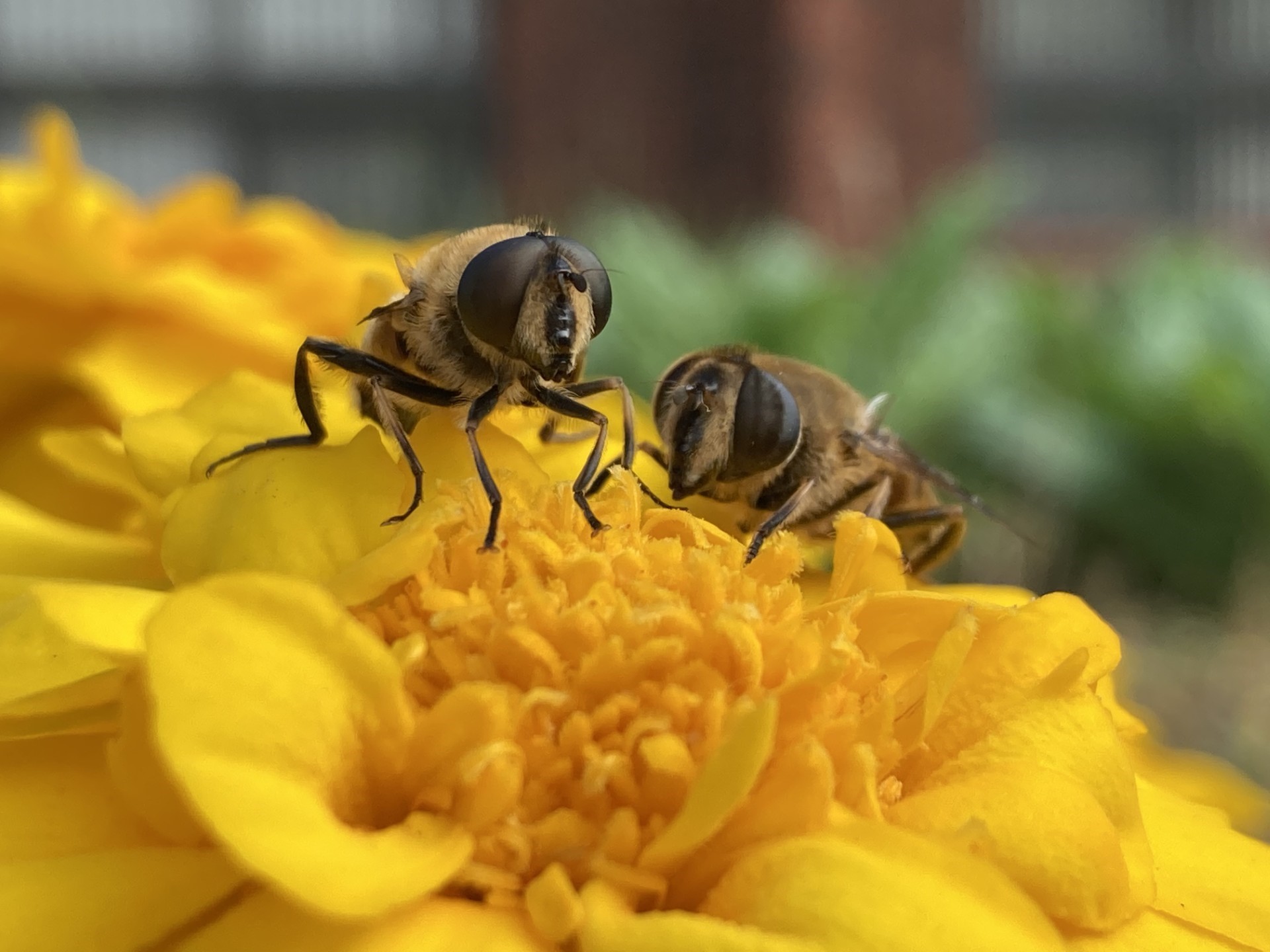
Many male hoverflies have bigger eyes than females, giving them the advantage of better optics and faster photoreceptors in high-speed pursuits to find a preferred partner to breed.
New research led by Flinders University – aimed at understanding the deft flying skills of these fast and dexterous native flies – compared different flight speeds between the sexes as key attributes for their survival success.
The study reveals a complex interplay between the key functions of both sexes and their regular cruising speeds.
This reflects the biomechanical qualities, multisensory integration and circuit-level differences in their ‘Top Gun’-style high-speed pursuits.
“We knowmales fly much faster than females during courtship and territorial encounters, but that males fly as slow as females when looking for flowers to feed from,” says Professor of Neuroscience Karin Nordström, co-senior author of the article published in the journal eLife.
“We found that the velocity response functions of the neurons that detect optic flow were sexually dimorphic,” says Professor Nordström, Professor in Neuroscience, Flinders Health and Medical Research Institute (FHMRI).
“As the neurons project to the areas that control wing beat amplitude, we next recorded their response in tethered flight.”
By contrast, researchers found no difference in wing beat amplitude in response to similar stimuli in tethered hoverflies.
Hoverflies are the second most important pollinators of plants and flowers after bees. Their ability to navigate in the natural world, including finding suitable flowers to feed from, depends on their visual systems.
Sarah Nicholson, Research Associate in the Neuroscience of Insect Vision Laboratory, says the differences between male and female optic flow sensitive neurons match the males’ bigger eyes.
“At the same time, smaller body size of male hoverflies compared to females gives them an advantage for faster acceleration and more agile flight responses,” she explains.
Senior co-author Dr Yuri Ogawa, also part of the Hoverfly Vision neuroscience research group at the College of Medicine and Public Health, says: “We are learning a lot about how these complex visual-motor skills, rapid photoreceptor and network-level brain systems work, both on a neural and behavioural level.
“In turn, science, engineering and human flight can benefit from new insights into how these visual systems create such exquisite flight behaviours,” says Dr Ogawa.
The research article – ‘Sexual dimorphism in sensorimotor transformation of optic flow’ (2026) by Sarah Nicholas, Katja Sporar Klinge, Luke Turnbull, Annabel Moran, Aika Young, Yuri Ogawa and Karin Nordström – has been peer reviewed published in preprint (30 April) in the journal eLife. DOI: 10.7554/eLife.109795.2.
Videos and captions (go to) Sexual dimorphism paper - Google Drive
Youtube: https://youtu.be/00QdZnYBjog shows female behavioural response to sideslip optic flow
Multimedia