Scientists spill scorpions' stingy secrets

Publicly released:
International
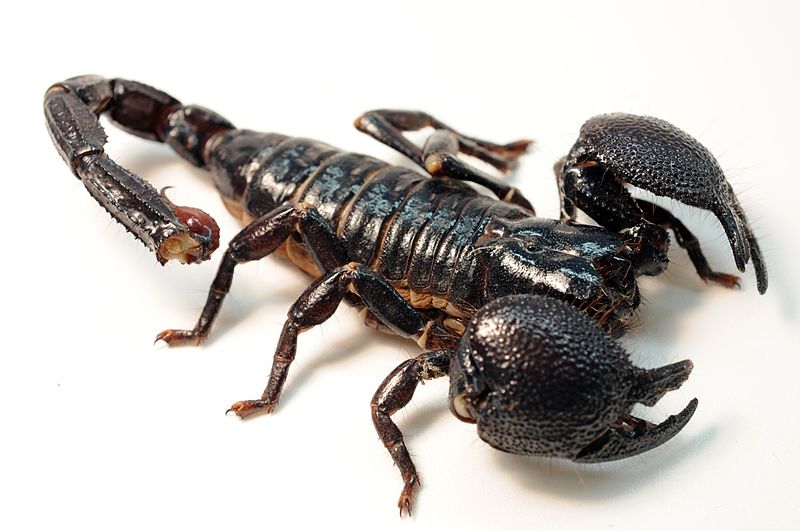
Female_Emperor_Scorpion By Rosa Pineda - Own work, CC BY-SA 3.0

Scorpions are famous for the dexterity and accuracy of their tails when it comes to delivering their sting, and now German and Swiss scientists have figured out how they do it. They say scorpion tails are a unique type of joint made up of five tubular segments that are connected in a particular and peculiar way that allows the critters to twist and bend them, despite the fact these segments also contain their gut. The researchers suggest their findings could be used in robot design, because scorpions can achieve precise movement, although the geometry of the joint itself is not very precise.

News release

From: The Royal Society

A unique yet technically simple type of joint allows for the high mobility of scorpion tails

The dexterity of scorpion tails (metasoma) is well known for precisely maneuvering the notorious sting quickly and with precision. Five tubular segments, that also contain the gut, are connected in a peculiar way that allows for twisting and bending. The unique joint type facilitating both movements is described here for the first time from a biological and engineering perspective. Insights can also be interesting e.g. for robotics, since the joint geometry must not be very precise, but still precise movement can be achieved. 

Pivot and sting - The ‘unique joints’ that lets scorpion tails manoeuvre and sting with precision have been described for the first time. The joints connect five tubular tail segments in a ‘peculiar way’ that allows for twisting and bending. This unique joint mechanism could inspire technical applications in robotics.

Attachments

Note: Not all attachments are visible to the general public. Research URLs will go live after the embargo ends.

Research The Royal Society, Web page The URL will go live at some point after the embargo ends
Journal/
conference:
Royal Society Interface
Research:Paper
Organisation/s: Universität Rostock, Germany
Funder: The μCT machine at Universität Rostock (grant no. DFG INST264/38-1 FUGG) was jointly sponsored by the Deutsche Forschungsgemeinschaft and the Land Mecklenburg-Vorpommern.
Media Contact/s
Contact details are only visible to registered journalists.