Sign In



 Australia; QLD
News release
From:
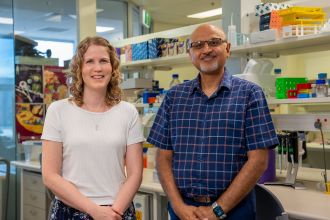
A powerful immunotherapy that targets out-of-control viral infections has saved the lives of dozens of critically-ill immunocompromised Australians who received the treatment on compassionate grounds.
The therapy, developed by QIMR Berghofer’s Professor Rajiv Khanna and his team, is being supplied under the Therapeutic Goods Administration’s (TGA) Special Access Scheme, which allows patients to access unapproved therapeutic goods as a last resort for treatment.
The Queensland research team collaborates with leading clinicians around Australia to supply the cellular immunotherapy. An analysis of their long-term experience over 15 years has been published today in the journal Nature Communications.
See VIDEO explainer here. (And VNR available to download here).
Professor Khanna said the analysis details the clinical improvement in 46 of the 71 patients who received the therapy, showing it can successfully treat complex disease in seriously ill patients.
“This clinical experience demonstrates our breakthrough cellular therapy to target viruses has minimal side effects and has been effective in saving the lives of many children and adults who had otherwise run out of options,” Professor Khanna said.
“Many patients are coming to us at a very late stage of disease and have undergone multiple treatments, so the success rate is around 65 per cent. We believe more lives could be saved if patients received the therapy earlier.”
QIMR Berghofer Tumour Immunology Group Clinical Trials Manager Dr Michelle Neller said the therapy targets uncontrolled viral infections stemming from common viruses, such as Epstein–Barr virus (EBV), cytomegalovirus (CMV), BK polyomavirus, John Cunningham virus, and adenovirus.
“These viruses usually cause mild or no symptoms in healthy people, but can quickly become life-threatening in immunocompromised patients, where standard treatments cause either significant side-effects, fail to work, or do not exist,” Dr Neller said.
Viral complications are a leading cause of death in patients such as children who have had a stem cell transplant to treat leukaemia, organ transplant recipients, and anyone born with a genetic disorder that reduces their ability to fight infection.
One recipient to benefit from the QIMR Berghofer therapy is Perth boy Koby who was just eight years old when his mum, Jodi, learned he had a less than 10 per cent chance of surviving a severe viral infection.
“Koby breezed through his bone marrow transplant, but then he caught adenovirus. It just got worse and worse. He was riddled with it, and we couldn’t get on top of it,” Jodi recalls.
“He had the first infusion of the therapy and in a week, he was a different child. In two weeks, they were talking about discharging him from hospital. The virus was just gone.”
Dr Shanti Ramachandran, Consultant Paediatric Oncologist at Perth Children's Hospital, and Director of the WA Paediatric and Adolescent Transplantation and Cellular Therapy program, was amazed by Koby’s dramatic improvement.
“Koby had no more pain and he was able to eat and mobilise. It was unbelievable. In the era where we didn’t have this therapy, we would lose these children. And the cost is so relatively cheap compared to the cost of hospitalisation,” Dr Ramachandran said.
Cellular therapy, also known as adoptive immunotherapy, has emerged as a highly effective tool to treat cancer, autoimmune diseases, and infectious diseases. However, it has not yet been approved for the treatment of severe viral infections.
QIMR Berghofer is the sole supplier of this therapy for compassionate use in Australia. The therapy is manufactured at the Institute’s cell therapy manufacturing facility, Q-Gen Cell Therapeutics, in Brisbane.
Professor Khanna said dedicated funding is needed to sustain this immunotherapy access program given increased demand. He also hopes that this funding will support further investment in cellular therapy development facilities at QIMR Berghofer to meet demand for this and other promising new treatments from clinicians and patients around the country.
This investment could also enable randomised clinical trials to collect the data needed to gain TGA approval, so the therapy can be made more widely available to critically-ill Australians.
The paper will be available at this link https://www.nature.com/articles/s41467-024-54595-2 on publication in Nature Communications with DOI 10.1038/s41467-024-54595-2. An embargoed copy is available on request.
**EDITORS PLEASE NOTE**
Case studies of clinicians and patients available.
Please visit https://spaces.hightail.com/space/LhkAPxLzLG to download clean, high resolution clips (VNR) for news stories about this research, including:
- TV grabs with scientists, clinicians, patient
- TV video overlay
- Audio Grabs
- Images
TV PRODUCERS PLEASE NOTE - QIMR Berghofer has a live broadcast capability via a TVU. Professor Rajiv Khanna is available for interview LIVE from the lab (& pre-recorded).
Multimedia