Sign In



 Australia; International; SA

News release
From:
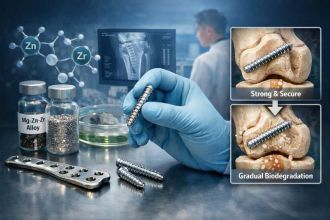
Researchers at Flinders University have developed a new class of biodegradable magnesium-based alloys with improved strength and corrosion resistance, marking an important step forward for next-generation medical implants.
Published in Emergent Materials, the study shows how carefully tuning alloy composition, particularly with elements such as zinc and zirconium, can produce materials that more closely match the mechanical properties of human bone while offering enhanced durability in biological environments.
“These new alloys not only improve mechanical performance but also enhance corrosion resistance which is critical for implants designed to safely degrade inside the body over time” says Dr Reza Hashemi, a Senior Lecturer in Mechanical Engineering at Flinders University's College of Science and Engineering.
“By refining the microstructure of the material, we were able to control how quickly the alloy breaks down, reducing the risks associated with premature degradation or loss of structural integrity. This balance between strength and controlled biodegradability is a key step toward safer, more reliable implant technologies.”
The findings, based on research by Master of Mechanical Engineering graduate Win Ken Look, contribute to the growing field of advanced biomaterials where the aim is to develop implants that naturally dissolve after healing, eliminating the need for follow-up surgeries.
By demonstrating how material design can directly influence performance and safety, the study highlights a pathway to improved patient outcomes and reduced healthcare costs, researchers say.
The article, Effect of zinc and zirconium on the microstructure, mechanical properties and corrosion resistance of Mg-xZn-yZr-1Y alloys for biomedical applications
(2026) by Win K Look, Lisseth KR Antolinez, Mohsen Feyzi, Wenlong Xiao and Reza Hashemi, has been published in Emergent Materials.
https://doi.org/10.1007/s42247-026-01332-8
Multimedia