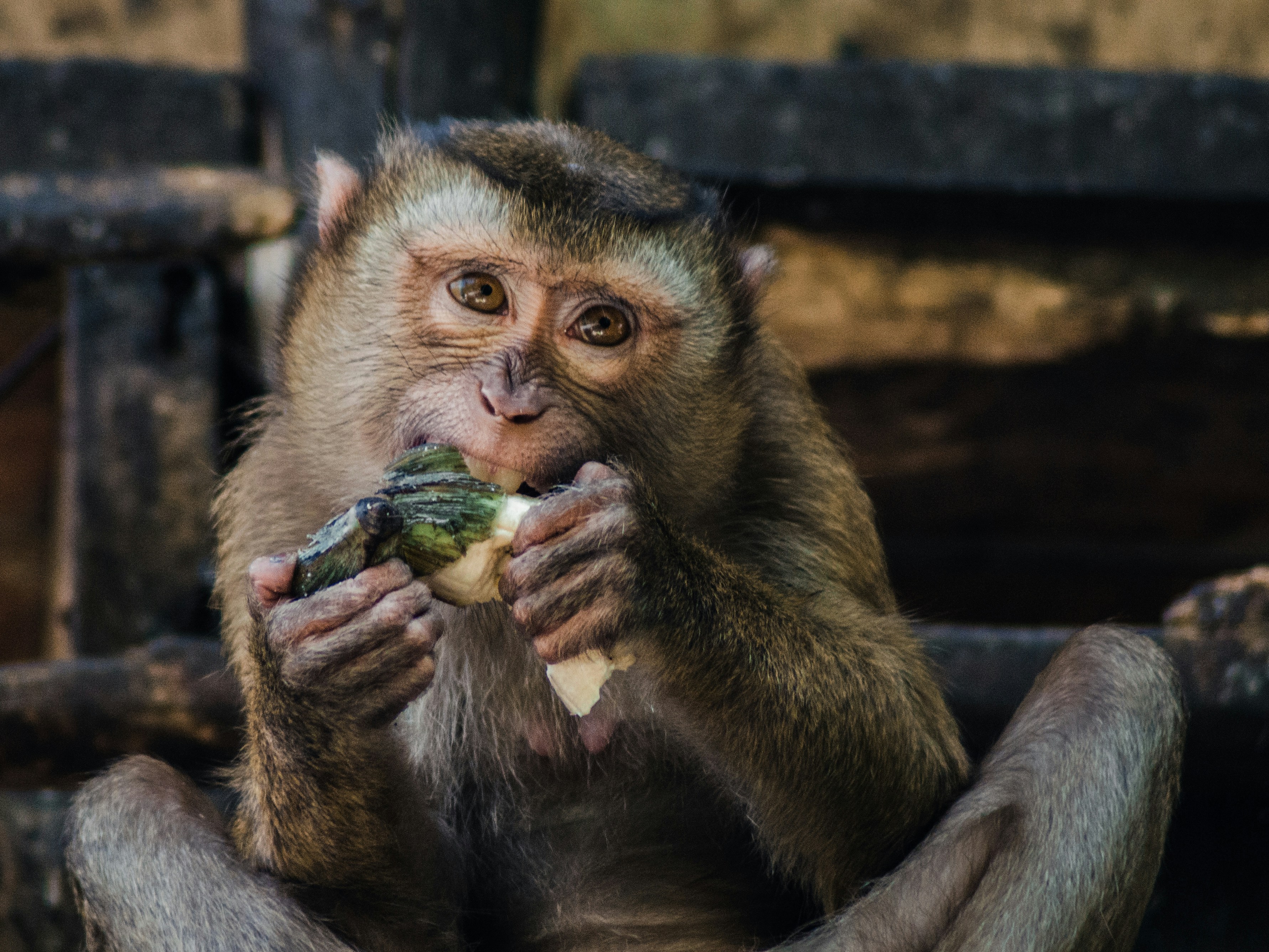
Monkey peer pressure: capuchins prefer pre-used tools

Publicly released:
International
Photo by alexey turenkov on Unsplash

When cracking palm nuts, capuchin monkeys prefer using stones that have already been used, a study shows. Researchers found that when only unused stones were available, monkeys picked softer stones to put the nut onto and harder stones to hit it with. However, when stones were worn from previous nut-cracking use, the monkeys were more likely to pick used stones to put the nut onto, regardless of hardness. The researchers say this may provide insights into how tool use evolved in humans, as people may have learned what materials to use by seeing what others had previously done.

News release

From: The Royal Society

Social cues on stone tools outweigh raw material properties in wild primates

This study uncovers how different cues influence how capuchin monkeys choose stone tools for cracking nuts. Researchers gave two groups of monkeys nut-cracking tasks using stones that differed in quality and signs of prior use. When stones were unused, monkeys chose tools based on hardness. However, when stones showed wear from previous nut-cracking, monkeys preferred those—regardless of their hardness. This work shows that capuchins can favor social cues created by the previous use of the tools by others. The findings highlight how socially embedded information sharing may shape the development of tool use, offering insights into the evolution of our own technology.

Attachments

Note: Not all attachments are visible to the general public. Research URLs will go live after the embargo ends.

Research The Royal Society, Web page URL will go live after embargo ends.
Journal/
conference:
Proceedings of the Royal Society B
Research:Paper
Organisation/s: Max-Planck-Institute for Evolutionary Anthropology, Germany
Funder: This work was supported by the Max Planck Society and the São Paulo Research Foundation (FAPESP 2018/01292-9; 2019/00716-2). During writing T.P. and J.S.R. were supported by grant CEECINST/00052/2021 funded by the Portuguese Foundation for Science and Technology (FCT).
Media Contact/s
Contact details are only visible to registered journalists.