 Sign In



 International

News release
From:
The human sense of smell evolved with diets and lifestyle
From the ability to detect the smell of wet soil to the scent of ripe fruit, the human olfactory system has evolved over thousands of years in response to how people live and what they eat, according to a new genetic study of Indigenous populations in Malaysia.
Publishing April 16 in the Cell Press journal Cell Reports, a new study suggests that the human sense of smell may have played a bigger role in shaping evolution than previously thought, adapting alongside major cultural changes such as the rise of agriculture.
“People tend to think humans rely very little on our sense of smell to survive, and that it has deteriorated as we evolved and diverged from other animals,” says Lian Deng, the study’s corresponding author at Fudan University in Shanghai. “Our study suggests that our sense of smell has been shaped as a result of the interplay of genetics, environment, and behavior.”
Olfaction, or the sense of smell, is one of the most ancient sensory systems in the animal kingdom. But as humans evolved from primates, they lost more than 60% of the functional genes that code olfactory receptors, which are chemical sensors responsible for detecting odors. As a result, many think olfaction is a less crucial sensory system in humans.
Deng and her team were curious about how olfactory receptor genes have evolved in humans. Previous studies have found that populations with different subsistence lifestyles, like hunter-gathers versus agriculturalists, have different languages describing scents.
“Particularly among hunter-gatherers, they have really specific vocabulary to describe certain smells, whereas we usually describe a smell by comparing it to something else we’re familiar with, like ‘it smells like flowers,’” she says.
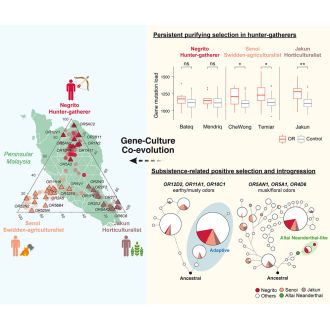
Deng and her team studied the genes of the Orang Asli, Indigenous peoples of the Malay Peninsula in Malaysia with diverse traditional lifestyles. The Orang Asli consist of three main groups: Negritos, the hunter-gatherers, Senoi, who largely practice rotational farming, and Proto-Malay, predominantly traditional agriculturalists.
The team analyzed the genes of 50 Orang Asli people from all three groups and compared them with genomic data from people around the world.
They found that Negritos, the hunter-gatherer group, had unusually well-preserved olfactory receptor genes. While most people around the world carry olfactory receptor genes with large numbers of mutations that likely impair gene function, the Negrito hunter-gatherers carried significantly fewer of these damaging mutations. Many Negritos also carried more ancestral versions of certain olfactory receptor genes, which might have retained stronger function.
The findings suggest there is a strong evolutionary pressure to maintain these genes among Negritos compared with other populations, likely because smell plays a crucial role in foraging and hunting.
In addition, Negritos were more likely to carry genes associated with detecting earthy, fruity, and herbal smells, scents common in rainforest environments and often associated with edible plants and ripe fruit.
Meanwhile, populations that rely more on agriculture showed greater changes in their olfactory receptor genes, possibly because some of those genes also affect other functions in the body.
For example, the Jakun people, a subgroup of Proto-Malays, are more likely to carry a version of the OR12D3 gene that is different from the other Orang Asli populations. Previous studies have linked this gene to insulin metabolism. Deng’s team suspects that the Jakuns’ unique OR12D3 gene might be related to their need to tightly regulate their glucose levels, because their lifestyle relies more on carbohydrate-rich agricultural foods.
“Our study showed that the human sense of smell has been shaped by the way people live. This is the first time we are showing this relationship on a genetic level,” Deng says. “By looking at smell genes, we can begin to see how culture, environment, and biology evolved together.”
Multimedia

Attachments
Note: Not all attachments are visible to the general public. Research URLs will go live after the embargo ends.


