 Sign In



 Australia; NSW; VIC; SA; ACT
News release
From:
Expert Reaction
These comments have been collated by the Science Media Centre to provide a variety of expert perspectives on this issue. Feel free to use these quotes in your stories. Views expressed are the personal opinions of the experts named. They do not represent the views of the SMC or any other organisation unless specifically stated.
Professor Carolyn Sue is Executive Director of the Kolling Institute and Professor and Director of Neurogenetics at the University of Sydney
I am thrilled to hear that Maeve’s Law Reform has been passed. This Legislation now paves the way for families affected with mitochondrial DNA disease to have the greatest hope of having biologically related children that can be free of severe disease.
The passing of the Bill has been due to the combined efforts of many, including the patients, their families, their doctors and the community who all have worked in Government to allow access to this new approach to minimise the chance of affected patients to have children unaffected by this devastating disease.

Professor David Thorburn is Co-Group Leader, Brain and Mitochondrial Research at Murdoch Children's Research Institute and Honorary Professorial Fellow, Department of Paediatrics at The University of Melbourne
I applaud the Senate for their conscience vote passing Maeve’s Law without amendments on Wednesday night. This will make Australia only the second country after the UK to develop a robustly regulated approach to offering this new form of assisted reproductive technology to women at high risk for having a child with mitochondrial DNA disease. Mitochondrial diseases impact on at least one child born in Australia each week and lack effective treatments. Affected patients typically suffer severe disease affecting their brain, heart or other organ systems and early death, ranging from infancy to middle age.
The legislation was informed by hundreds of submissions considered by two Senate Inquiries, an NHMRC Expert Committee review and a Department of Health Consultation paper. There were extensive approaches to public engagement including an NHMRC video, public meetings, webinars and a citizen’s panel. The Bill was supported by the Australian Academy of Science, the Australian Academy of Health and Medical Sciences and many leading Australian experts in medical research, bioethics and health policy.
Maeve’s Law will enable affected families to greatly increase their chance of having a healthy child unaffected by mitochondrial DNA disease. The regulatory environment has safeguards that will ensure it can only be used for the intended purpose and the reforms are consistent with international standards and best practice. This outcome provides hope to many hundreds of Australian families impacted by mitochondrial disease.
Professor Jus St. John leads the Mitochondrial Genetics Group in the School of Biomedicine at The University of Adelaide
The Australian Parliament has taken a large step into the unknown. Previously, the House of Representatives and now the Senate have allowed the introduction of Mitochondrial Donation into clinical assisted reproduction for those who are carriers of mitochondrial DNA mutations that can give rise to severe cases of mitochondrial DNA disease.
Although the progression to the full integration of this technology into clinical medicine will be strictly regulated including a series of milestones that have to be achieved, as things stand at present, we are enabling a technology to be introduced that has not been fully tested and we do not know how safe this technology is or what the potential side effects might be. There are some research programs currently running in Australia including one in my laboratory that are seeking to determine how safe and efficient the technology is.
The passing of this legislation is at least five years too early and we should wait until the data are available to validate or otherwise the technology. Ultimately, our responsibility is to ensure that any children born using this technology would be healthy and lead a normal life and not be hindered by other disorders.
Professor Jackie Leach Scully is Professor of Bioethics at the University of New South Wales
This decision is an important step for many reasons. For those families affected by mitochondrial disease, it offers some hope for a future where they can have children without the fear that they might inherit a devastating condition. More generally, it means a number of laws and regulations that currently control the use of reproductive technology will have to be modified: for example, the law preventing anyone altering the DNA of an embryo that will be used in pregnancy, since this treatment aims to change mitochondrial DNA.
So this decision doesn’t end the debate about mitochondrial replacement, but will lead to discussions about where and how we limit our manipulation of the genetic makeup of human beings. We also need to consider the role of the women who donate their mitochondria to another woman’s embryo: what kind of relationship exists between the donor and the child? How do we protect donors from being exploited? Could children born by this technology be stigmatized? Important questions like these will need to be discussed on a societal level by all stakeholders.
Professor John Christodoulou is Co-Lead of the Brain and Mitochondrial Research Group at Murdoch Children’s Research Institute and Chair of Genomic Medicine, Dept of Paediatrics, at the University of Melbourne.
The Senate vote in favour of Maeve’s Law is a great leap forward for the families of individuals suffering with severe mitochondrial disorders. Treatment options for mitochondrial disease sufferers are extremely limited. When the disorder is due to a genetic mistake in mitochondrial DNA (mtDNA), reproductive options for couples to prevent severe disease in their children are extremely limited.
The carriage of this Bill gives families real hope that they will be able to have what most of us take for granted, namely being able to have a happy and healthy baby.
The detailed and respectful discussion by both Houses of Parliament has been admirable, and coupled with the very rigorous scientific, ethical and public discussion both here in Australia and in the UK in recent years, the Australian community can be confident that in establishing mitochondrial donation here in Australia, the highest possible standards will be applied.
I look forward to the next steps in making mitochondrial donation a reality in Australia.
Professor Catherine Mills is Director of the Monash Bioethics Centre at Monash University
This is an important step forward for families affected by mitochondrial diseases, allowing them to have genetically related children without passing on the mutations in mitochondrial DNA that can cause devastating diseases. This outcome recognises the significant benefit that this technology may bring to some families in Australia. At the same time, we also need to keep in mind that there is still a lot of work to be done to ensure that the actual implementation of mitochondrial donation in Australia is done in an ethically robust way. It is important to ensure that this appropriately balances the interests of all stakeholders, including oocyte donors and the children that may be born using this technology.
Professor Mike Ryan is Pro Vice-Chancellor (Research) and Head of the Mitochondrial biology and Disease lab at the Monash Biomedicine Discovery Institute
I am delighted that Maeve’s law has now been passed. Mothers will be able to have the opportunity to use highly regulated IVF techniques to give birth to babies without passing down genetic defects through their mitochondria.
This gives Australian families who have a history of mitochondrial disease the potential to stop passing this disorder to their children and their children’s children
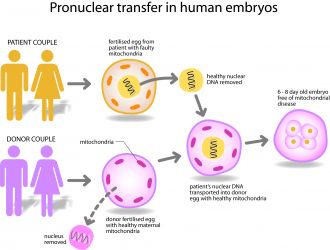
The babies born using this technique will still have all the genetic features from their mum and dad except for the tiny amount of healthy DNA that comes from the donated mitochondria.The donated mitochondrial DNA helps to encode some of the machinery needed to power our cells.
This is wonderful news for Australia, and I thank the major parties for allowing members to have a conscience vote to pass this law.
Multimedia

Attachments
Note: Not all attachments are visible to the general public. Research URLs will go live after the embargo ends.

