News release
From:
Springer Nature
A direct black-hole mass measurement in a little red dot at high redshift
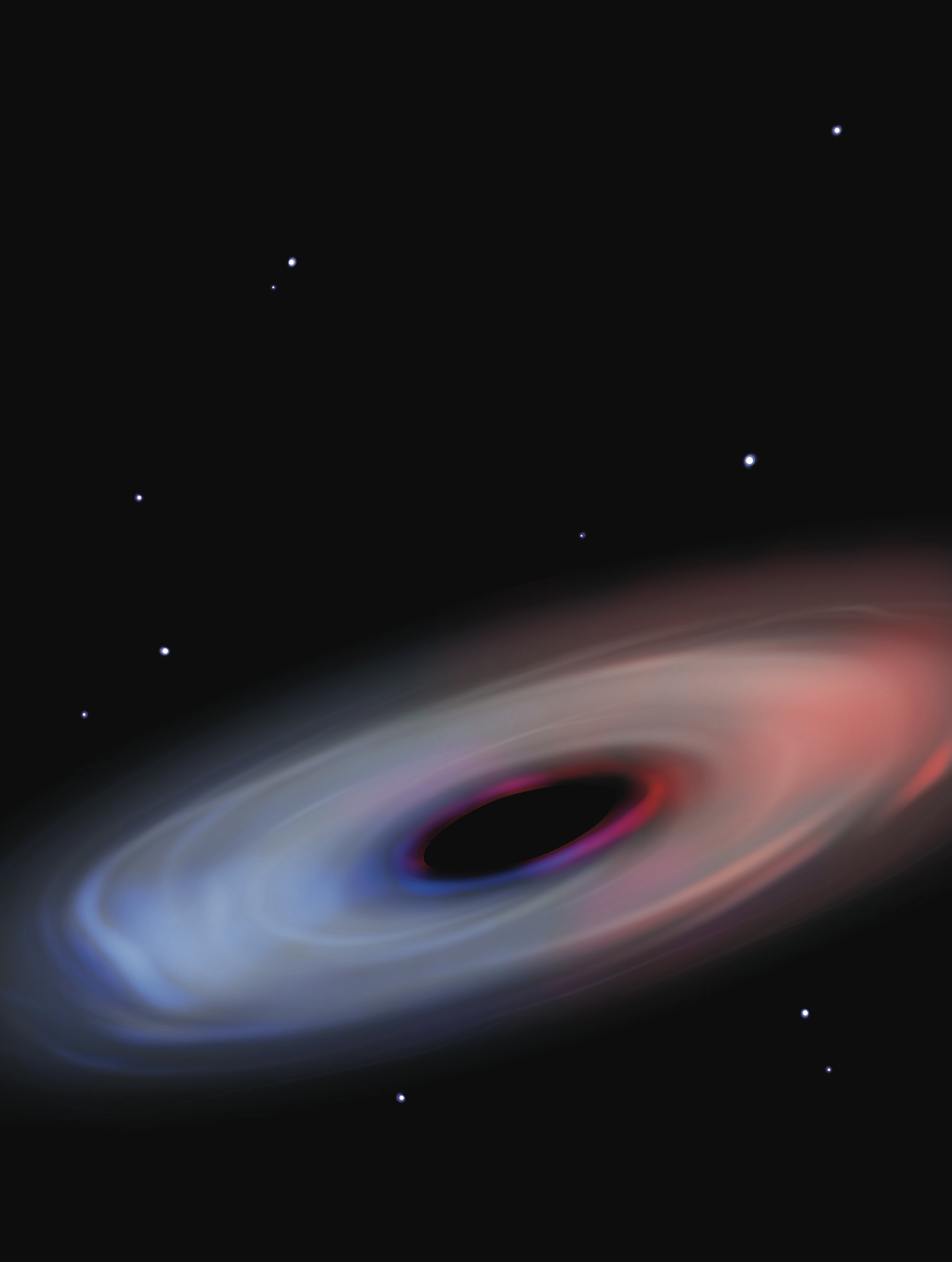
A direct measurement of a black hole mass in a distant object known as a little red dot, found in a galaxy dating back to when the Universe was just 700 million years old, is reported in Nature. The findings indicate that some black holes may form and grow before the stars in their host galaxies, providing insight into the earliest stages of black hole evolution.
Astronomers have been debating the identity of a collection of little red dots, detected during early experiments using the James Webb Space Telescope. Previous research has suggested that the little red dots are supermassive black holes, but models may have overestimated the mass of those black holes.
Ignas Juodžbalis and colleagues analysed Abell2744-QSO1, a celestial object detected by the James Webb Space Telescope and classified as a little red dot hosting a black hole. Observations reveal how fast gas rotates at different distances from the black hole, offering information about the amount of gravitational acceleration, which enables the authors to estimate that the black hole hosted by the little red dot has a mass of 50 million solar masses. The host galaxy contains very little stellar mass — less than half the mass of the black hole — suggesting that this black hole is at an early stage of formation and may have begun forming before its host galaxy.
The findings provide some of the first direct measurements of a black hole’s mass at such an early stage in the Universe. The authors note that further work is needed to refine the model and analysis.
Journal/
conference:
Nature
Organisation/s:
University of Cambridge, UK
Funder:
We thank P. Natarajan for comments. I.J. acknowledges support by the
Huo Family Foundation through a P.C. Ho PhD Studentship. This work is based on observations
made with the National Aeronautics and Space Administration (NASA)/European Space
Agency (ESA)/Canadian Space Agency (CSA) JWST. The data were obtained from the Mikulski
Archive for Space Telescopes at the STScI, which is operated by the Association of Universities
for Research in Astronomy, Inc., under NASA contract NAS 5-03127 for JWST. These
observations are associated with programme PID 5015. R.M., F.D’E., J.S., I.J. and G.C.J.
acknowledge support from the Science and Technology Facilities Council (STFC), by the
European Research Council (ERC) through Advanced Grant 695671 ‘QUENCH’, by the UK
Research and Innovation (UKRI) Frontier Research grant RISEandFALL. R.M. also acknowledges
support from a Royal Society Research Professorship grant. S.A. acknowledges grant PID2021-
127718NB-I00 funded by the Spanish Ministry of Science and Innovation/State Agency of
Research (MICIN/AEI/ 10.13039/501100011033). H.Ü. acknowledges funding by the European
Union (ERC APEX, 101164796). Views and opinions expressed are however those of the authors
only and do not necessarily reflect those of the European Union or the European Research
Council Executive Agency. Neither the European Union nor the granting authority can be held
responsible for them. A.J.B. acknowledges funding from the ‘FirstGalaxies’ Advanced Grant
from the European Research Council (ERC) under the European Union’s Horizon 2020 research
and innovation programme (grant agreement number 789056). S. Carniani acknowledges
support by European Union’s HE ERC Starting Grant No. 101040227 - WINGS. S.K. has been
supported by a Junior Research Fellowship from St Catharine’s College, Cambridge and a
Research Fellowship from the Royal Commission for the Exhibition of 1851. R.S. acknowledges
support from the PRIN2022 MUR project 2022CB3PJ3 - First Light And Galaxy aSsembly
(FLAGS) funded by the European Union - Next Generation EU and from the EU-Recovery Fund
PNRR - National Centre for HPC, Big Data and Quantum Computing. V.B., B.L. and S.Z.
acknowledge the Texas Advanced Computing Center (TACC) for providing HPC resources
under allocation AST23026. D.S. acknowledges support from the STFC, grant code ST/
W000997/1. A.T. acknowledges support from the PRIN MUR project 2022935STW, funded by
European Union - Next Generation EU, and from the INAF Fundamental Research 2023 Minigrant
project ’Cosmic Archaeology with the first black hole seeds’. G.C. acknowledges support
from the INAF GO grant 2024 ‘A JWST/MIRI MIRACLE: MidIR Activity of Circumnuclear Line
Emission’. K.I. acknowledges support from the National Natural Science Foundation of China
(12573015, 1251101148, 12233001), the Beijing Natural Science Foundation (IS25003), and the
China Manned Space Program (CMS-CSST-2025-A09). P.G.P.-G. acknowledges support from
grant PID2022-139567NB-I00 funded by Spanish Ministerio de Ciencia e Innovación MCIN/
AEI/10.13039/501100011033, FEDER Una manera de hacer Europa. M.P. acknowledges support
through the grants PID2021-127718NB-I00, PID2024-159902NA-I00 and RYC2023-044853-I,
funded by the Spain Ministry of Science and Innovation/State Agency of Research MCIN/
AEI/10.13039/501100011033 and El Fondo Social Europeo Plus FSE+. R.V. acknowledges
support from PRIN MUR ‘2022935STW’ funded by European Union - Next Generation EU,
Missione 4 Componente 2 CUP C53D23000950006 and from the Bando Ricerca
Fondamentale INAF 2023, Theory Grant ‘Theoretical models for Black Holes Archaeology. J.W.
acknowledges support from the Cosmic Dawn Center through the DAWN Fellowship.
The Cosmic Dawn Center (DAWN) is funded by the Danish National Research Foundation under
grant number 140. I.J. discloses support for the research of this work from the Huo Family
Foundation. The other authors declare no relevant funding.
 Sign In



 International