Little red dots in other galaxies may be black holes wrapped in gas-cloud cocoons

Publicly released:
International
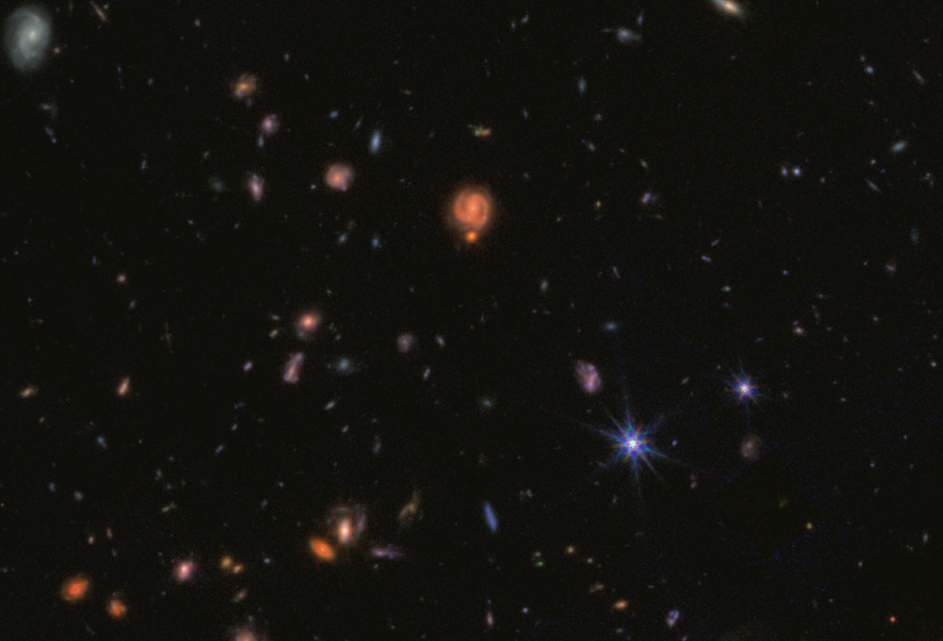
Story by Steven Mew, The Australian Science Media Centre. The Cosmic Evolution Early Release Science Survey 3 (Credit CEERS; Finkelstein et al. 2023)

A family of ‘mysterious’ objects known as little red dots in distant galaxies may be young supermassive black holes hidden by clouds of neutral gas and electrons, according to an analysis of data from the James Webb Space Telescope. Early experiments with the James Webb Space Telescope detected a collection of little red dots across 30 galaxies, which astronomers suspected could be supermassive black holes or stars being formed, but the behaviour of the dots did not neatly fit into either category. The team analysed data from 12 individually studied galaxies, combined with data from another 18 to get a better sense of the little red dots’ behaviour over time. They found that the dots are most likely to be small black holes - one hundred times smaller than previous estimates - and the light from these dots was being scattered by electrons in dense clouds of gas that are cocooning them. The authors suggest that these black holes are in an early stage of development, when they are buried in dense material that blocks X-rays and radio waves and reshapes their light into specific patterns, and the 'cocoon' phase of black hole development may be a previously unknown phase of black hole growth in the early Universe.

News release

From: Springer Nature

Astronomy: Little red dots may be black holes in disguise

A family of ‘mysterious’ objects known as little red dots in distant galaxies may be young supermassive black holes hidden by clouds of neutral gas and electrons, according to an analysis of data from the James Webb Space Telescope published in Nature. This finding suggests a previously unknown phase of black hole growth in the early Universe.

Astronomers have been debating the identity of a collection of little red dots, detected during early experiments using the James Webb Space Telescope. The dots have been thought to be supermassive black holes or signs of star formation, but their behaviour does not fit neatly into either category.

Vadim Rusakov and colleagues analysed data from 12 individually studied galaxies, combined with data from another 18 to get a better sense of the little red dots’ behaviour over time. After studying the emission spectra from the centre of these galaxies, they found that the spectra were caused by photons scattering off electrons in dense clouds of gas at the galactic centre, surrounding the black holes. The authors calculated that the black holes are likely one hundred times smaller than previous estimates suggested. They also suggest that these smaller black holes are enveloped in a cocoon of high-density gas, which could be responsible for the majority of their radiation.

The authors suggest that these black holes are in an early stage of development, when they are buried in dense material that blocks X-rays and radio waves and reshapes their light into specific patterns. Some details, such as why X-rays are so weak, still need further investigation. Future observations could explore whether this “cocoon phase” is common and how it influences the growth of black holes and galaxies.

Multimedia
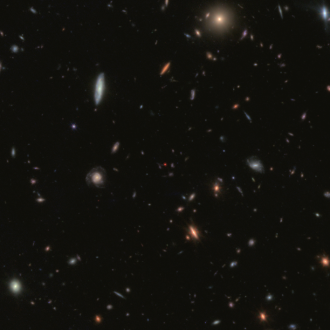
The Cosmic Evolution Early Release Science Survey
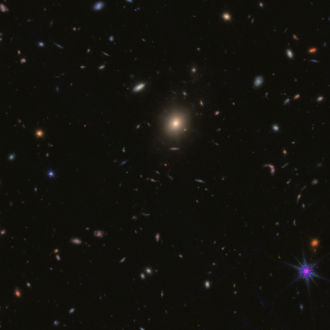
The Cosmic Evolution Early Release Science Survey 2
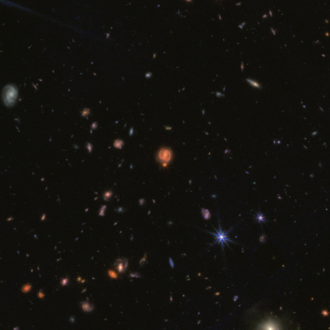
The Cosmic Evolution Early Release Science Survey 3
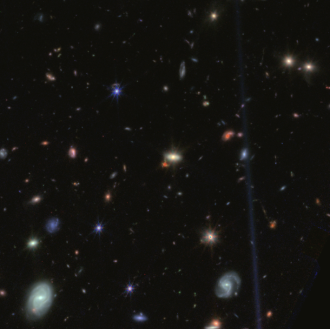
The JWST Advanced Deep Extragalactic Survey
Journal/
conference:
Nature
Research:Paper
Organisation/s: University of Manchester, UK
Funder: We thank G. Mazzolari for the inspiring discussions. We acknowledge support from the Danish National Research Foundation under grant no. DNRF140. V.R., T.H., N.A., D.A., C.J.C. and C.M.G. are funded by the ERC Advanced Investigator Grant EPOCHS (788113). D.W., G.P.N., R.D., S.A.S. and A.S. are co-funded by the European Union (ERC, HEAVYMETAL, 101071865). R.D. is co-funded by the Villum Foundation. K.E.H. acknowledges funding from the Swiss State Secretariat for Education, Research and Innovation under contract no. MB22.00072. S.A.S. acknowledges funding from the UK Science and Technology Facilities Council (grant no. ST/X00094X/1). Views and opinions expressed are, however, those of the authors only and do not necessarily reflect those of the European Union or the European Research Council. Neither the European Union nor the granting authority can be held responsible for them. The data products presented in this study were retrieved from the DAWN JWST Archive (DJA). DJA is an initiative of the Cosmic Dawn Center (DAWN), which is funded by the Danish National Research Foundation under grant DNRF140.
Media Contact/s
Contact details are only visible to registered journalists.