 Sign In



 Australia
News release
From:
In the lead up to Global Handwashing Day, 15 October 2023, the Food Safety Information Council today released research showing a 9% improvement in the number of young Australians who say they always wash their hands before handling food.
Lydia Buchtmann, Council Communication Director, said this is good news as until now there has been a considerable gap between the younger age group and older age groups but now they are on par with 66% of 18 to 34 year-olds saying they always wash their hands before handling food, up from 57% in 2022.
Council Communication Director, Lydia Buchtmann, said good handwashing, using running water, soap and drying hands thoroughly is a critical public health message. The research found that 17% of Australians say they don’t always wash their hands after going to the toilet (compared with 18% last year) and 34% admit they don’t always wash before touching food (compared with 47% last year).
‘Food Standards Australia New Zealand’s report on the Annual Cost of Foodborne Disease in Australia by the Australian National University stated there are an estimated 4.67 million cases of food poisoning in Australia each year that result in 47,900 hospitalisations, 38 deaths and costing the economy $2.1 billion. Poor handwashing could be a major contributor to these figures,’ Ms Buchtmann said.
‘This consumer research continues to show gender differences as men were less likely than women to always wash their hands after going to the toilet (79% of men versus 86% of women) and before touching food (62% of men versus 70% of women). Young people were less likely than older age groups to always wash their hands after going to the toilet (76% under 34 years versus 89% over 65 years) but ages made little difference when washing hands before touching food (67% under 34 versus 66% over 65).
‘For the first time this year we asked cat owners whether they washed their hands after cleaning out cat litter trays with 88% of female cat owners and 80% of male cat owners saying they always did. Cat faeces can pass on the infective stage of Toxoplasma parasites if cats are fed raw red meat or eat wildlife. This can be particularly risky for pregnant women and their unborn babies. Don’t clean out litter trays if you are pregnant but do make sure they are emptied daily.
‘The Food Safety Information Council’s advice is to always wash and dry your hands:
* before handling, preparing and eating food
* after touching raw meat, fish, seafood, shell eggs or poultry
* after using the toilet, attending to children’s (or others’) toileting and changing nappies
* after blowing your nose
* after touching a pet or cleaning cat litter trays, and
* after gardening
‘Follow these 4 simple tips for hand washing correctly:
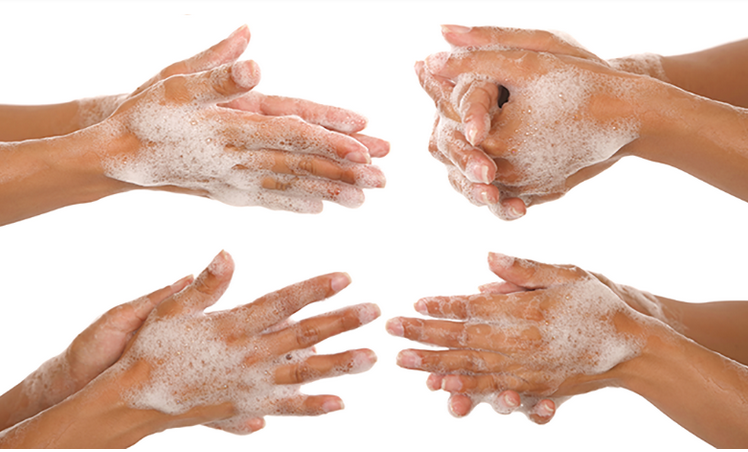
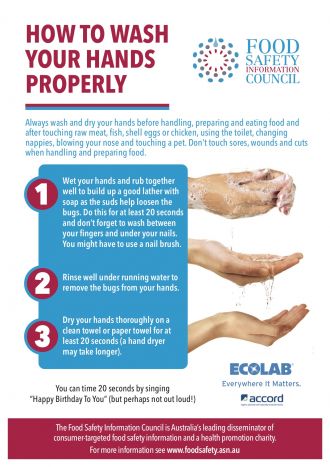
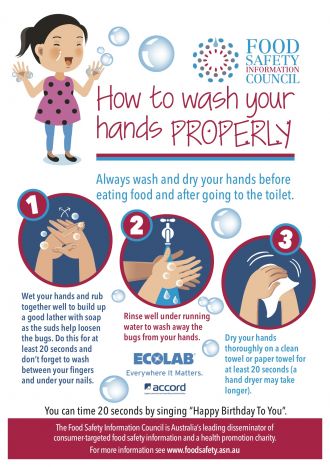
1. Wet your hands and rub them together well to build up a good lather with soap for at least 20 seconds and don’t forget to wash between your fingers and under your nails. You might have to use a nail brush.
2. Rinse well under running water to remove the bugs from your hands.
3. Dry your hands thoroughly on a clean towel for at least 20 seconds. Touching surfaces with moist hands encourages bugs to spread from the surface to your hands.
4. If no running water is available use an alcohol gel hand rub.
‘We have an education package including a video that can be downloaded from our website here and we encourage people to watch the video and to put up the posters at home, in their workplace, or at school,’ Ms Buchtmann concluded.
Multimedia

Attachments
Note: Not all attachments are visible to the general public. Research URLs will go live after the embargo ends.


