 Sign In



 Australia; VIC
News release
From:
JWST measures mass of a dormant black hole from the early universe for the first time
A team of astronomers has made the first direct mass measurement of a dormant black hole lurking at the centre of a galaxy from the early universe.
Researchers were able to determine the behemoth black hole’s mass – 6 billion times the size of our Sun – by using the James Webb Space Telescope (JWST) to detect the motion of stars near the galaxy’s centre, despite the fact it is no longer lighting up its surroundings.
Australian lead author, Distinguished Professor Karl Glazebrook from Swinburne’s Centre for Astrophysics and Supercomputing, was part of the international research published today in Science.
“Supermassive black holes are all around us, lurking in the core of the Milky Way and all other nearby massive galaxies,” he says.
“Until now we could not see such ‘lurking’ black holes in the cores of galaxies in the early universe. We could only see them when they were consuming matter, such as actively feeding and lighting up as ‘quasars’.”
Distinguished Professor Glazebrook is thrilled to have been part of the discovery, as only a handful of dormant black holes this massive have been found before, all in the nearby universe.
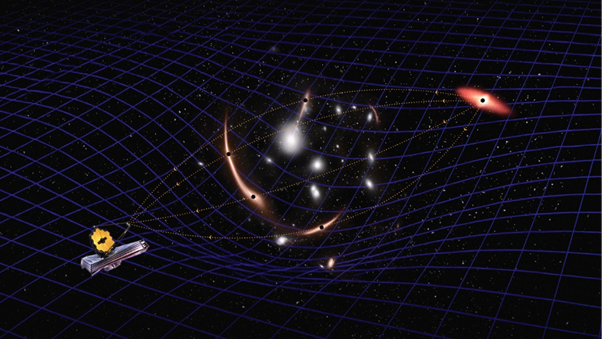
“In this remarkable observation using JWST’s superior resolution and taking advantage of gravitational lensing, we can see for the first time an invisible lurking black hole thanks to its gravitational pull on nearby stars.
“This points to supermassive black holes being ubiquitous even at early times and being a critical ingredient in forming galaxies themselves.
“This is yet another case of an observation I thought would never be possible becoming possible thanks to JWST,” he says.
The black hole sits at the centre of MRG-M0138, a massive galaxy whose light has travelled to JWST from a time when the universe was only about three billion years old.
Prior to this result, astronomers had only successfully used this technique for determining black hole masses in the local universe, to a distance of about 700 million light years.
In 2020, the Nobel Prize was awarded for detecting the black hole at the centre of the Milky Way by tracing the orbits of individual stars.
MRG-M0138 is located behind a massive cluster of galaxies, which magnifies and stretches its appearance. As a result, the distant galaxy appears about 30 times larger than it normally would.
“By combining JWST with gravitational lensing, we could peer inside the black hole’s sphere of influence, where its gravity boosts the speeds of stars,” Carnegie’s Dr Andrew Newman says.
“This is one of the best techniques we have to weigh a black hole, so we were excited to extend it to a much earlier period in cosmic history.”
The researchers expect that applying their methods to more galaxies will help astronomers understand how the most massive black holes formed, grew and shaped the evolution of galaxies.
Distinguished Professor Karl Glazebrook is available for interview.

