 Sign In



 International
News release
From:
Observations of electron acceleration in Jupiter’s magnetic field
Electrons around Jupiter have been caught in the process of being accelerated, revealing a potentially unified mechanism for particle acceleration. The findings, published in Nature, may help constrain how energetic particles are produced throughout the Universe.
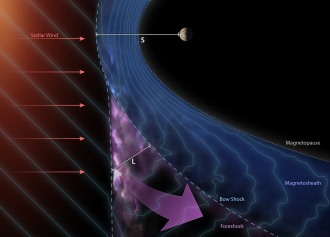
Shocks are disturbances created by a perturber/object/fluid moving through a fluid faster than the local speed of sound, causing an abrupt change in pressure at the boundary between the two. Typical examples are bow shocks where planetary atmospheres and solar winds meet, named after the analogous shocks produced on water by the bow of a ship. Most shocks in space plasma are collisionless, because particle densities are too low for direct collisions between particles to convert the shock's energy into heat. Instead, this is done by electromagnetic forces. Collisionless shocks are thought to be a site in which cosmic rays can accelerate to relativistic speeds (near the speed of light), a process known as relativistic electron acceleration. However, a lack of direct observational evidence has limited scientists’ understanding of how these structures work.
Savvas Raptis and colleagues analysed data from NASA’s Juno spacecraft taken as the probe traversed through a shockwave formed between Jupiter’s magnetosphere and the solar wind (Jupiter's bow shock). The instruments on Juno observed a foreshock, a region upstream of a collisionless shock spanning several of Jupiter's radii. Within this foreshock, transient plasma structures accelerated particles to relativistic speeds. The authors noticed that the size of such foreshocks scales with the overall size of a shock system and sets a practical upper limit on the achievable particle energy. By combining the Jupiter observations with existing measurements from other planets, the authors derive a relationship between foreshock transient size and maximum particle energies.
The study shows that planetary and heliophysics missions can provide crucial, observation-based constraints on particle acceleration theories. The authors note that extending the results to distant astrophysical shocks requires assumptions beyond direct measurement, and that further observations and modelling will be needed to test the universality of the proposed scaling.
Multimedia

Attachments
Note: Not all attachments are visible to the general public. Research URLs will go live after the embargo ends.


