Implant helps paralysed man to feed himself and drink from a cup

Publicly released:
International
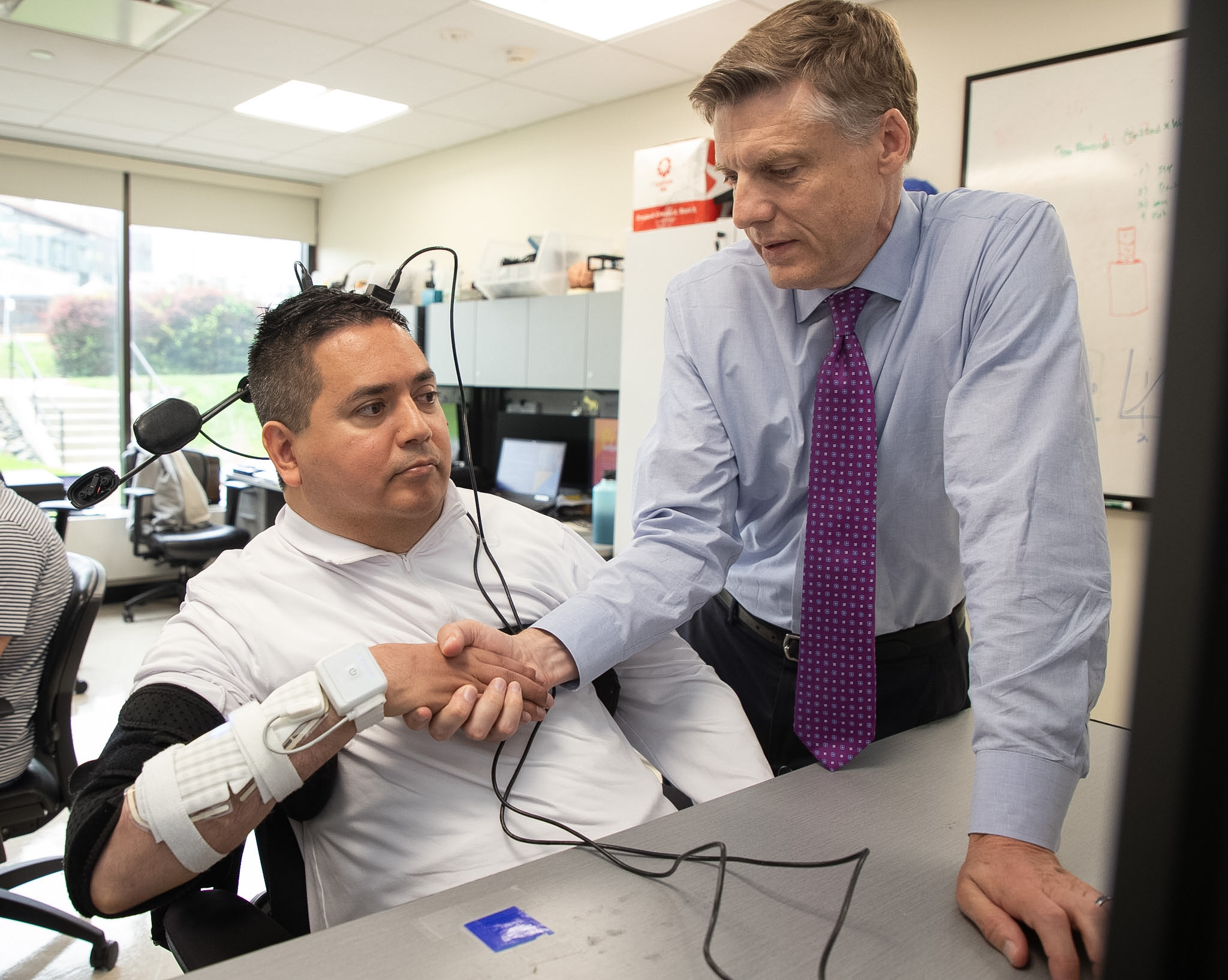
Keith Thomas (left) who lives with paralysis, can now feel touch, as demonstrated by Dr. Chad Bouton of the Feinstein Institutes for Medical Research, thanks to the first-of-its-kind ‘double neural bypass’ systemCredit: Feinstein Institutes for Medical Research

A man with quadriplegia has been able to feed himself and drink from a cup using his own hand, thanks to microchips implanted into the brain that helped to re-link his brain to his body and spinal cord. The system, called a double neural bypass, combines implants with non-invasive wearable stimulation patches on the skin that electrically stimulate the spinal cord and muscles, forming an electronic bridge between the man’s paralysed body and brain. The system has been able to help the man, called Keith Thomas, to move and feel his previously paralysed hand, and some of those effects have remained even when the implant was turned off, suggesting the system may help support longer-term recovery, as well as helping movement in real time.

News release

From: Springer Nature

Restoring hand movement and sensation after paralysis

A neuroprosthetic system has helped a man with paralysis to move his hand and feel touch again following a spinal cord injury, reports research published in Nature Medicine. Some of the benefits of the system were found to continue even when the device was turned off, which suggests that it may support longer-term recovery, as well as helping movement in real time.

Spinal cord injury is a leading cause of paralysis, and more than half of the cases involve tetraplegia, in which movement of the arms and legs is affected. Complete spinal cord injuries, in which there is no voluntary movement or feeling below the level of the injury, are particularly difficult to treat. Previous brain–computer interface systems have helped to restore some movement but have not yet restored a sense of touch or supported longer-term recovery.

Chad Bouton and colleagues developed a “double neural bypass” system, which reads brain signals linked to the person’s intention to move. It then uses these signals to help control a person’s own hand by delivering targeted stimulation to the spinal cord and the part of the brain involved in touch, the primary somatosensory cortex. In a clinical trial, this system was tested on a 42-year-old man with complete tetraplegia after a spinal cord injury. Stimulation of the spinal cord alone was found to improve his ability to bend his elbows, allowing him to bring both hands to his face. The full system also helped him to open and close his hand, drink from a cup, feed himself, and control his grip when handling delicate objects. The system continued to recognise the participant’s intended hand movements for more than 5 months, without needing repeated retraining. The participant also gained some touch sensitivity in his wrist, which persisted for more than 2 months after stimulation had stopped.

The authors suggest that this approach could help restore useful hand movement and touch after severe paralysis. However, further testing in more people with different injuries is needed. The system is also still highly specialised and currently needs trained staff to operate it.

Multimedia

Keith Thomas (left) who lives with paralysis, can now feel touch
Dr. Chad Bouton assists setting up Keith Thomas
Keith Thomas demonstrates the grasp and lifting of empty eggshells
Double neural bypass
Egg Demo trimmed

Attachments

Note: Not all attachments are visible to the general public. Research URLs will go live after the embargo ends.

Other Northwell Health, Web page Mr. Thomas’ story
Research Springer Nature, Web page Please link to the article in online versions of your report (the URL will go live after the embargo ends).
Journal/
conference:
Nature Medicine
Research:Paper
Organisation/s: Northwell Health, USA
Funder: This study was funded by the New York State Department of Health Spinal Cord Injury Research Board (contract no. C37718GG) and the Feinstein Institutes for Medical Research at Northwell Health, with additional support from Blackrock Neurotech and Good Shepherd Rehabilitation Network
Media Contact/s
Contact details are only visible to registered journalists.