The earliest outbreaks: hunter gatherers faced disease epidemics more than 5000 years ago

Publicly released:
International
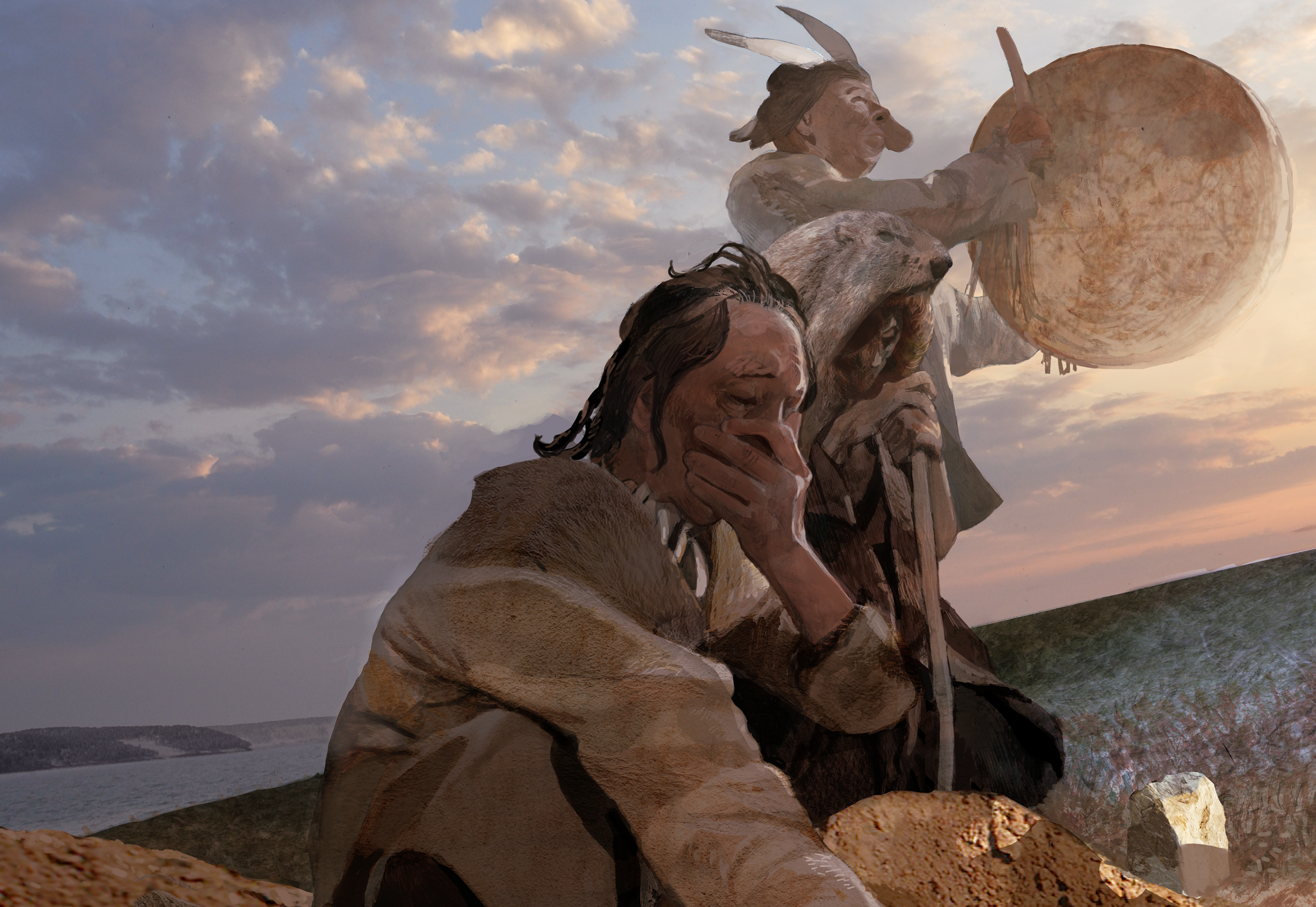
Artistic reconstruction of Baikal hunter-gatherers from 5500 years ago burying victims of plague. Credit: Kelvin Wilson.

Diseases have likely spread from animals to humans across human history, say scientists who found the earliest known plague victims in 5500-year-old graves. They found ancient plague virus DNA in about half of 40 Siberian hunter-gather skeletons in 4 cemeteries, discovering that small family groups, especially children, were often affected and buried together. The researchers said the hunter-gathers likely caught the plague from marmots, which they hunted, but then probably spread it to each other by coughing. Finding plague victims among these small, mobile communities challenged the idea that epidemics only started once humans settled into large, dense communities, the researchers say.

News release

From: Springer Nature

Genetics: Oldest-known evidence of plague outbreaks in prehistoric communities

Plague outbreaks dating back to around 5,500 years ago documented in hunter-gatherer communities from southeast Siberia are described in a paper published in Nature. The findings, based on an analysis of ancient DNA, may be the oldest-known evidence of the plague and could shed light on its origins.

Plague accounts for some of the deadliest disease outbreaks in history; the study of ancient DNA has aided our understanding of the origin and evolution of the disease. Previous research had identified Yersinia pestis, the bacteria that causes plague, in prehistoric Europe. Some of the oldest documented strains date back up to 5,300 calibrated years before present (5300 cal BP), but these strains may have lacked classic virulence genes (sequences that cause disease).

Ruairidh Macleod, Eske Willerslev, and colleagues analysed ancient DNA from 42 hunter-gatherers from four cemeteries around Lake Baikal in Siberia. They identified Y. pestis in 18 individuals, at higher levels than any other pathogen, which indicated two separate plague outbreaks dated to 5520–5265 cal BP and 5315–4235 cal BP. The authors reconstructed kinship among the individuals and were able to show that small family groups were affected, aligning with human-to-human transmission of the disease. They found related individuals buried in separate graves, suggesting they died in different events and not in a single outbreak. They also indicate that the most acute infections appear to have occurred in children aged 8–11 years. They note that the Y. pestis genomes associated with these two outbreaks differ from currently known ancient and modern plague strains and suggest that this particular strain emerged before approximately 5,700 years ago.

The authors suggest that their findings demonstrate that plague outbreaks occurred in prehistoric hunter-gathers hundreds of years before infections were observed in Neolithic populations. They note that this challenges the idea that high population densities and the agriculture transition observed during the Neolithic were necessary for plague epidemics.

Multimedia

Artistic reconstruction of Baikal hunter-gatherers from 5500 years ago
The skull of a 9-11 year old girl
The skull of an adult woman (aged 25-35 years old)
Skeleton of a 10-12 year old boy
Shared grave
Shared grave
Shared grave with three individuals

Attachments

Note: Not all attachments are visible to the general public. Research URLs will go live after the embargo ends.

Research Springer Nature, Web page URL will go live after embargo ends.
Journal/
conference:
Nature
Research:Paper
Organisation/s: University of Copenhagen, Denmark
Funder: R.M., F.V.S., J.T.S., C.G., L.V., Y.W. M.S. and E.W. disclose support for this research from the Lundbeck Foundation (grant numbers R491-2024-1351, R302-2018-1799, R302-2018-2155 and R155-2013-16338), the Novo Nordisk Foundation (NNF18SA0035006, NNF24SA0092560 and NNF25SA0103965), the Wellcome Trust (UNS69906), the Carlsberg Foundation (CF18-0024), the Danish National Research Foundation (DNRF94 and DNRF174) and the University of Copenhagen (KU2016 programme). E.W. further discloses support for this research from Ferring Pharmaceuticals A/S and from Illumina. F.V.S. and M.S. disclose funding from Riksbankens Jubileumsfond (M 21-0018). F.V.S. discloses support from the Lundbeck Foundation (R491-2024-1351 and R322-2019-2610). R.M., A.L., R.S., O.I.G., V.I.B., C.B.R. and A.W.W. disclose support from the Social Sciences and Humanities Research Council of Canada (Major Collaborative Research Initiatives 410-2000-1000, 412-2005-1004, and 412-2011-1001, and Partnership Grant 895-2018-1004), and from the University of Alberta. O.I.G., V.I.B., and A.W.W. disclose support from a Russian Federation research grant (075-15-2019-866 “Baikal Siberia in the Stone Age: At the crossroads of the worlds”). B.D.S. discloses support from the President’s Postdoctoral Fellowship Programme (University of California). Y.W. discloses support from the Excellent Research Group Program for Tibetan Plateau Earth System (42588201). A.K.N.I. discloses funding from the OAK foundation (OFIL-20-095). R.M., A.T. and M.G.T. disclose support from the European Research Council Horizon 2020 programme (95183/COREX). M.G.T. discloses support from the European Research Council Horizon 2020 programme (865515/SUSTAIN). R.M. discloses further support from a research fellowship awarded by All Souls’ College, Oxford. S.V.V. and R.C.-D. declare no relevant funding.
Media Contact/s
Contact details are only visible to registered journalists.