Sign In



 International
News release
From:
Neuroscience: Tapping into brain responses to dancing
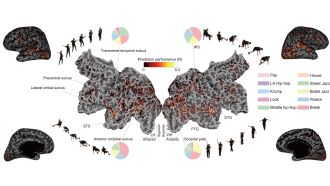
Dance styles engage the brain in different ways depending on the movements, aesthetics, and emotions associated with the dance, according to a study published in Nature Communications. The findings offer insights into the complex neurological activity associated with watching and performing dance.
The observation of neural activity whilst processing dance offers a window into how the brain translates visual information in conjunction with music and emotive cues. Prior neuroimaging studies have identified the brain regions that are most active whilst viewing dance videos or live performances. However, detailed accounts of how this information is processed in individual brains are less common.
Yu Takagi and colleagues scanned the brains of 14 participants (a mixture of 7 novice and 7 expert dancers) as they viewed approximately 5 hours of dance footage. The clips featured performances from over 30 dancers executing choreography to more than 60 different pieces of music across 10 genres of dance, which included hip hop, break dancing, street and ballet jazz. The authors then assessed brain activity in response to dancing using a deep generative artificial intelligence model trained on a large corpus of dance videos, which was then applied to the participants’ brain data. The authors found several features — a combination of movement, music, aesthetics, and emotions — that predict how the participants mapped dance in their brains. The modelling also suggested that expert dancers in this study had more unique, individualized brain maps of each dance style, particularly for mapping dance motion.
This work provides new insights into how human brains perceive and create choreography, and how brains may change with dance training.
Multimedia