How have human teeth strengthened through the ages?

Publicly released:
International
Emma Elagan, Pupa Gilbert

The structure of human tooth enamel has changed at the nanoscale throughout the course of human history to adapt to changes in our diet, according to international researchers. The team analysed samples of teeth from ancient primates to modern humans, spanning almost 18 million years of evolution. In the past 1.76 million years, the researchers say their samples show an increase in nanocrystal misorientation in the tooth enamel, coinciding with a shift toward more meat and grains in our diets. Looking at apes and monkeys, the researchers say this nanocrystal misorientation is more strongly present among species that mostly eat seeds compared to those that mostly eat fruit. This likely means this is a mechanism by which teeth became stronger and more resilient to tough and hard foods, the researchers say, and they suggest this finding could help the invention of new, tougher materials.

News release

From: Springer Nature

Materials science: Changes in enamel structure alongside human diets

Tooth enamel structure changed at the nanoscale as the human diet shifted toward meat and agriculture products over the past two million years, according to an analysis published in Nature. The findings uncover a possible mechanism that underlies enamel resistance, which may have implications for increasing the strength and resilience of bioinspired materials.

Enamel thickness and shape have been shown to evolve with changes in diet. Enamel consists of long nanocrystals of a mineral called hydroxyapatite — about 50 to 70 nanometres wide — which can vary in orientation. However, how these structural changes are related to diet and enamel resilience is poorly understood.

Pupa Gilbert and authors analysed tooth samples spanning almost 18 million years, including ancient primates and humans, as well as modern humans. The authors found an increase in enamel nanocrystal misorientation over the past 1.76 million years of Homo evolution as meat and agriculture became more common dietary staples. This change was notable as diets shifted with an increase in grain-based agriculture in Europe, which began 12,000 years ago. The authors found no evidence of further misorientation during the Industrial Revolution, although increases in cavities and dental crowding are documented consequences of industrialised diets. In an analysis of teeth from non-human apes and monkeys, those species that consumed fruit primarily saw the lowest misorientation, while species that consumed seeds saw the highest misorientation.

The authors conclude that nanocrystal misorientation could contribute to tooth resilience against tough or hard foods, such as meat and seeds. They suggest that misorientation of enamel could contribute to its resilience, which could influence the synthesis of bioinspired materials.

Multimedia
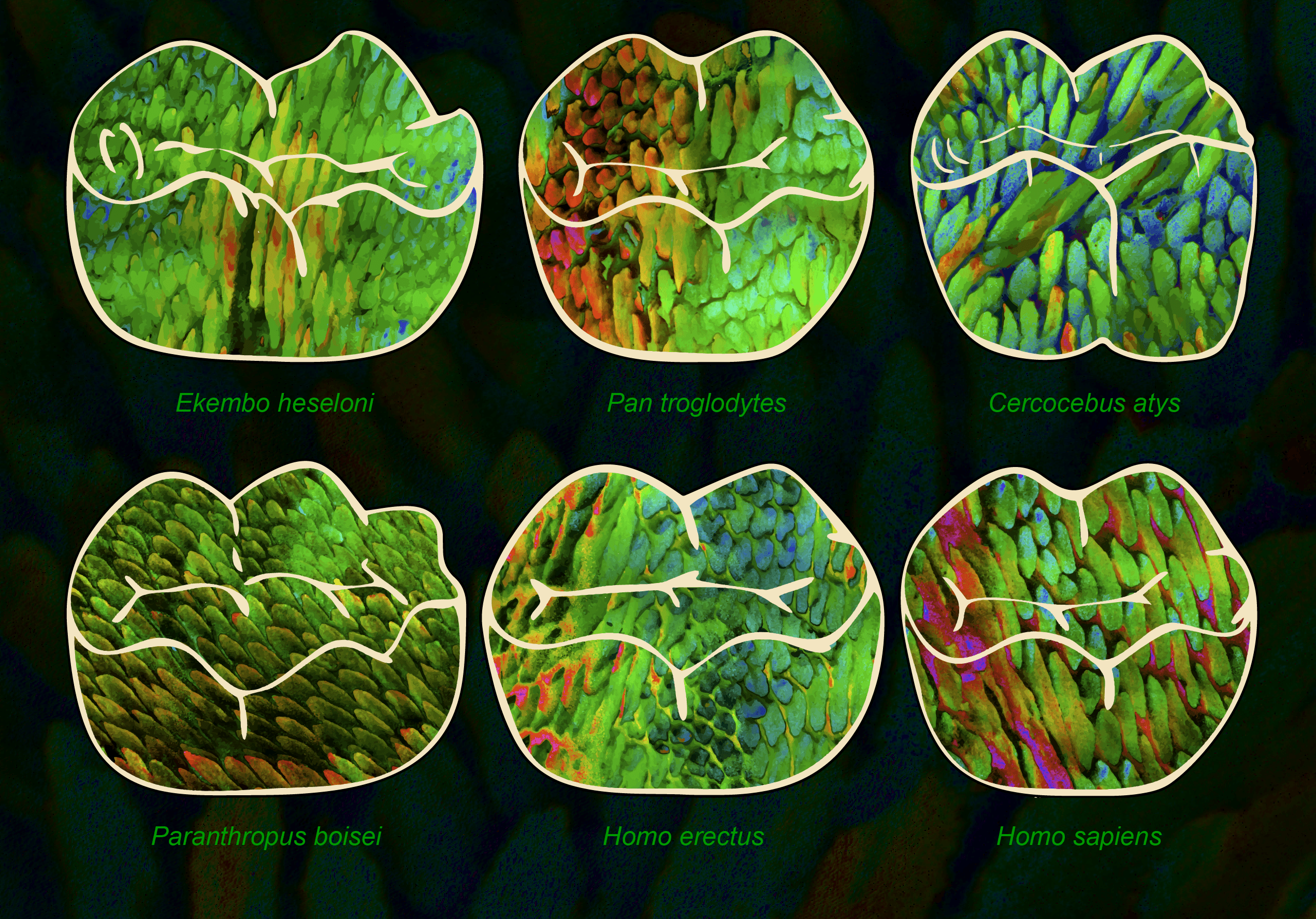
The enamel crystal nanostructure from six species
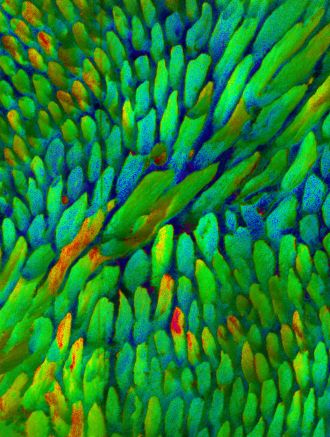
The pattern of crystal orientations in tooth enamel from a monkey
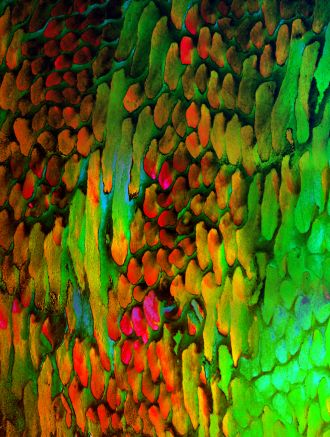
The pattern of crystal orientations in tooth enamel from a chimpanzee.

Attachments

Note: Not all attachments are visible to the general public. Research URLs will go live after the embargo ends.

Research Springer Nature, Web page The URL will go live after the embargo ends
Journal/
conference:
Nature
Research:Paper
Organisation/s: University of Wisconsin, USA
Funder: P.U.P.A.G. received 40% support from the Department of Energy, Basic Energy Science, Chemical Sciences, Geosciences, Biosciences, Geosciences (DOE–BES– CSGB-Geosciences) Grant DE-FG02-07ER15899 at University of Wisconsin, 40% support from award FWP-FP00011135 also from DOE–BES–CSGB-Geosciences at Lawrence Berkeley National Laboratory under contract number DE-AC02-05CH11231, and 20% support from the National Science Foundation (NSF), Biomaterials Grant DMR-2220274. M.C.O’H. received funding from the European Union’s Horizon 2020 research and innovation programme under the Marie Skłodowska-Curie grant agreement number 101026776. All PEEM experiments were done at the Advanced Light Source, a US DOE Office of Science User Facility under contract number DE-AC02-05CH11231. This research was additionally funded by the Turkana Basin Institute (D.R.G.), a Climate Center Grant from the Lamont-Doherty Earth Observatory of Columbia University (D.R.G.), and by the Harvard University American School of Prehistoric Research (D.R.G.).
Media Contact/s
Contact details are only visible to registered journalists.