Five years of lab 'minibrains' could show how our brain cells develop after birth

Publicly released:
International
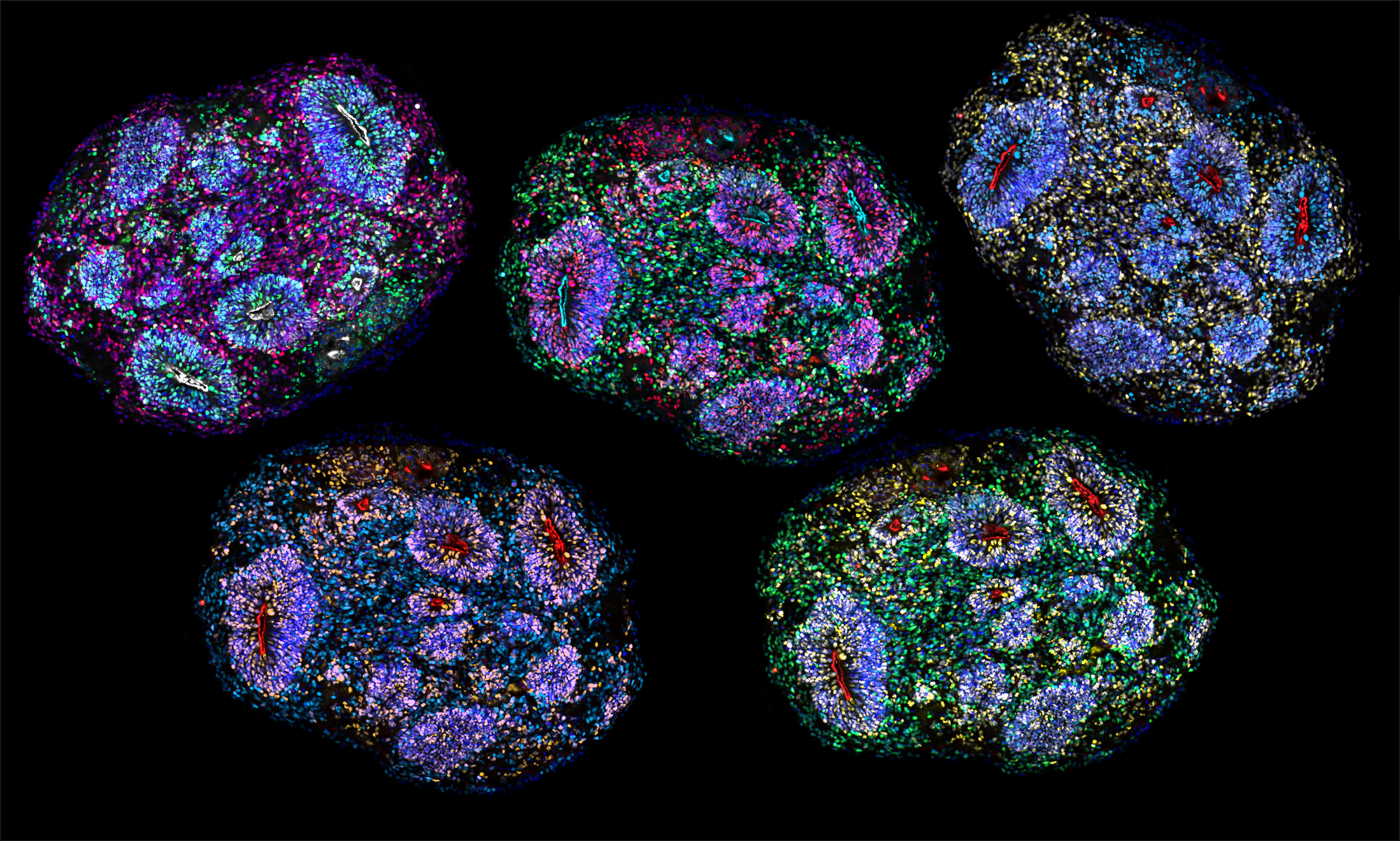
A composite mosaic of sections of an organoid immunolabelled for different cell type markers. Credit: Irene Faravelli and Noelia Antón-Bolaños

Mini 'brains' grown from human brain cells in the lab appear to record how old they are, say overseas researchers. These 'minibrains' grow at the same slow rate as real human brains, so they don't have time to reach maturity in most lab studies. By keeping them alive for 5 years, and making sure they contained the different cell types found in real brains, the team saw how 'minibrains' matured similarly to human brains after birth. The scientists also combined older and younger cells in the same 'minibrain' and found the older cells made more mature neurons, showing they had a 'memory' of how long they'd spent developing.

News release

From: Springer Nature

Neuroscience: Long-lived human brain organoids record the passage of timeBrain organoids (3D brain-like tissue formed from laboratory-grown human cells) exhibit molecular signatures of their developmental age, according to a paper published in Nature. The organoids — observed over five years, the longest period reported to date — successfully matured and developed traits resembling those of postnatal brains, offering key insights into later-stage brain cell development.

The human brain takes around two decades to fully mature. Brain organoids may facilitate research into postnatal brain development, but current studies largely mimic early phases and in most studies last for just months, with low rates of long-term survival and early loss of vulnerable cells such as neurons. Successfully culturing complex tissue with many different types of brain cells over years in the lab may enable a more accurate representation of mature brains and their development.

Paola Arlotta and colleagues cultured human brain organoids for more than five years. The authors created ‘chimeric organoids’ by mixing specialised biological brain cells of different ages, both younger and more mature. Subsequently, older progenitor cells bypassed earlier stages of development and produced mature neuron types (which would usually take two months to form) in just two weeks. This indicates that the cells recorded markers of both age and the time spent developing. Overall, whole-genome profiling of long-cultured organoids revealed traits resembling those in late-prenatal and postnatal human brains. As the organoids aged, they eventually acquired more mature gene expression patterns, neuronal types, and spine structures.

These long-lived organoids, which accurately retain characteristics associated with both developmental age and time spent in culture, present future research opportunities for the study of mature brain cells, the authors conclude.

Multimedia
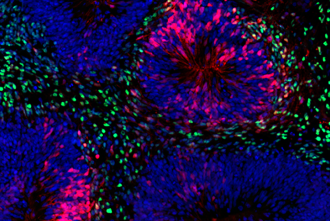
Close-up of a brain organoid
A close-up of an organoid
A composite mosaic of sections of an organoid immunolabelled for differ

Attachments

Note: Not all attachments are visible to the general public. Research URLs will go live after the embargo ends.

Research Springer Nature, Web page Please link to the article in online versions of your report (the URL will go live after the embargo ends)
Journal/
conference:
Nature
Research:Paper
Organisation/s: Harvard University (USA)
Funder: This work was supported by grants from the Stanley Center for Psychiatric Research to P.A. and J.Z.L., the Broad Institute of MIT and Harvard, the National Institutes of Health (RF1MH123977 to P.A. and E.S.B.; R01MH112940 to P.A. and J.Z.L.; RF1MH132710 to J.L.; and R01AG087374, R01EB024261, R01AG070831 and RF1MH123403 to E.S.B.), the Blavatnik Biomedical Accelerator at Harvard University to P.A., the Klarman Cell Observatory to A.R., the Max Planck Society to A.M., and the HHMI, Lisa Yang, Schmidt Futures, Open Philanthropy/Good Ventures and John Doerr to E.S.B. Competing interests P.A. is a scientific advisory board member at Foresite Labs, and is a co-founder of Vesalius and a co-founder and equity holder at Foresite Labs and at Avatar Bio. A.R. is a founder and equity holder of Celsius Therapeutics, an equity holder in Immunitas Therapeutics and, until 31 August 2020, was a scientific advisory board member of Syros Pharmaceuticals, Neogene Therapeutics, Asimov and Thermo Fisher Scientific. From 1 August 2020, A.R. has been an employee of Genentech and has equity in Roche. A.M. is a co-founder and scientific advisor of Harbinger Health, and is on the scientific advisory board of Zymo Research.
Media Contact/s
Contact details are only visible to registered journalists.