 Sign In



 Australia; International; ACT
News release
From:
Australian scientists have released data from a massive, stellar mapping survey that has analysed nearly 1 million stars in the Milky Way. The data will form the basis for decades of research into the origins and development of our galaxy, as well as providing a valuable training set for the next generation of huge artificial intelligence-driven astronomical surveys.
The dataset, the pinnacle of 10 years’ work, was gathered by astronomers from Australia’s ARC Centre of Excellence in All Sky Astrophysics in 3 Dimensions (ASTRO 3D) using the Anglo-Australian Telescope (AAT) near Coonabarabran in NSW, itself celebrating 50 years of operation this week.
“Our work is focused on collecting as much quality data as we can,” said ASTRO 3D’s Sven Buder, a research fellow at the Australian National University.
“GALAH has shown us which chemical elements make up the stars of the Milky Way. This dataset now helps further our ability to accurately age the stars in our neighbourhood and understand where they came from.
“This data becomes a powerful tool for astronomers to test new theories and make new scientific discoveries about the Universe.”
The release is the fourth from the Galactic Archaeology with HERMES (GALAH) project, which has for 10 years been investigating star formation, chemical enrichment, migration and mergers in the Milky Way.
Previous GALAH data releases have fuelled a raft of significant discoveries regarding the evolution of the Milky Way, the existence of exo-planets, hidden star clusters, and many more.
The mapping survey, which made 1.08 million observations of 920,000 stars over 684 nights, uses an Australian instrument called the High Efficiency and Resolution Multi-Element Spectrograph, or HERMES, which is connected to the AAT.
“We have measured the elements within these stars, like carbon, nitrogen, oxygen, as well as heavy elements found in our smartphones and electric vehicles,” explained Dr Buder.
“This data will help us figure out how these elements are produced in stars, which is fundamental to explaining the origins of the building blocks of life.”
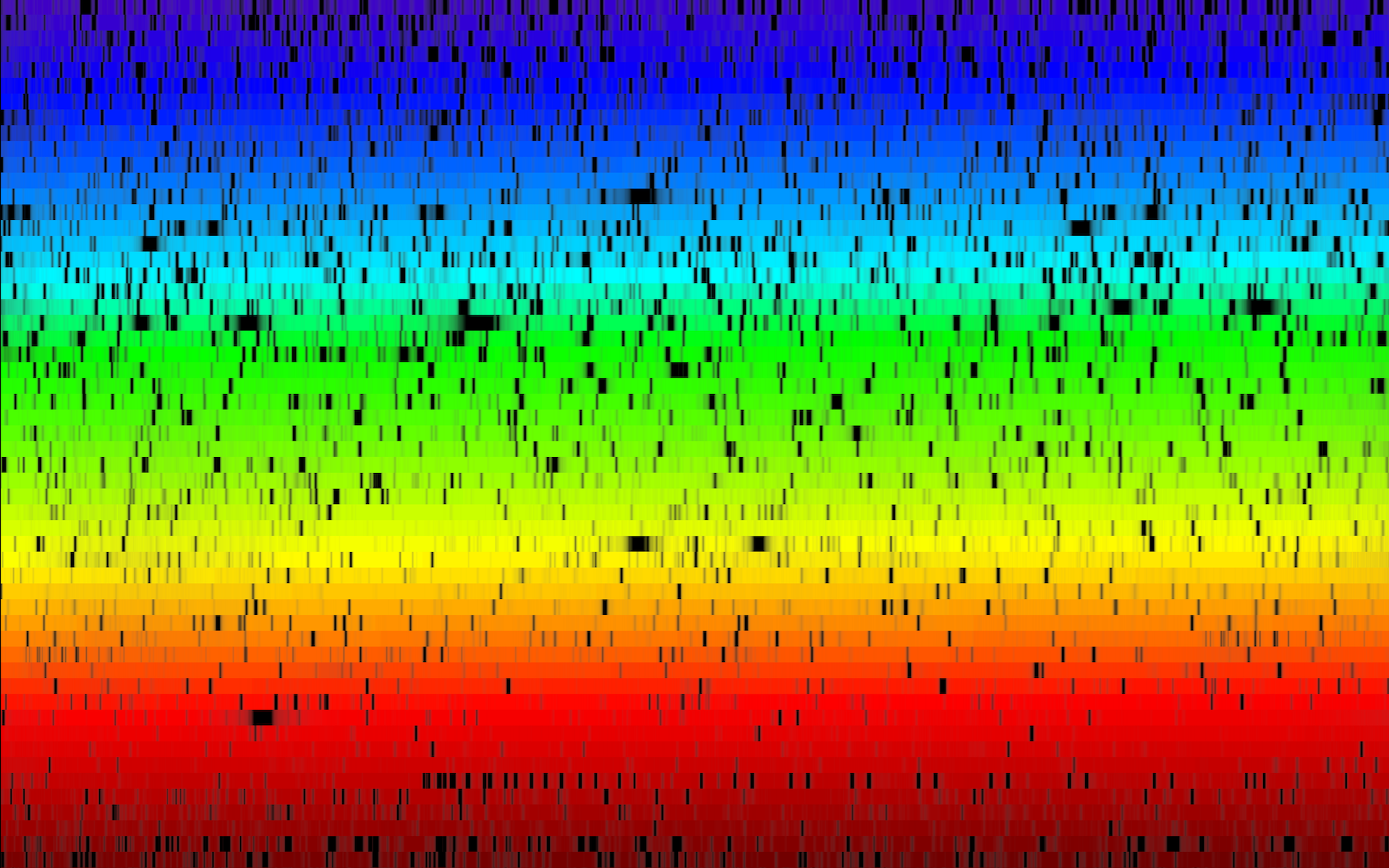
The data collected from the stars appears almost like ‘stellar rainbows’ – overlapping barcodes that when analysed can show the chemical composition of the stars. This can help us understand how elements are formed and distributed in the universe, as well as for potentially detecting signatures of planetary systems around the stars.
GALAH datasets are keenly awaited by the global astronomical community with 290 scientific studies using GALAH data to date. The previous data release paper, covering 300,000 stars, with more than 400 citations is the most cited work of the year in the journal that it was published in.
The GALAH data has in the past shown how stars may have consumed planets as the Milky Way developed.
“The GALAH survey has detected signs that some stars may have ‘eaten’ planets that were orbiting them,” said Professor Daniel Zucker of Macquarie University. “This can be observed by looking at the chemical composition of the star, as the elements from the consumed planet would show up as markers in the star's spectrum.”
Beyond the immediate scientific insights, the GALAH dataset will serve as a valuable training set for the next generation of artificial intelligence tools in astronomy. As the field increasingly relies on machine learning to analyse vast datasets, this Australian-led survey is helping to lay the groundwork for the future of the discipline around the world.
“Australia is leading the pack for the future of all of astronomy looking to tackle Big Data,” said Professor Zucker. “This dataset will serve as a one of the leading textbooks for training these AIs.”
Associate Professor Sarah Martell of UNSW, a key member of the project, said she was excited by what astronomers around the world could do with the data.
“We are really looking towards an incredibly exciting period over the next few years where all of these discoveries about what’s happening in our Universe are going to flow from the data that we've collected right here in Australia using Australian telescopes and building on Australian research.”
More than 100 scientists collaborate on the GALAH project. They are based at universities in Australia, Italy, UK, Slovenia, US, Hungary, Sweden, the Netherlands, and Germany.
Professor Emma Ryan-Weber, the Director of ASTRO 3D, said that GALAH and the research the survey enables directly speaks to ASTRO 3D’s mission.
“It helps us understand how galaxies build mass over time,” says Professor Ryan-Weber. “The chemical information the research team has gathered is like stellar DNA – we can use it to tell where each star has come from. We can also determine their ages and movements and gain a deeper understanding of how the Milky Way and other galaxies formed and have evolved.
“What’s more, as the ASTRO 3D mission comes to a close, the GALAH project will leave a lasting legacy of Australian science informing astronomical discoveries about the Universe’s origins and development for decades to come.”
The GALAH DR4 dataset can be found here.
Attachments
Note: Not all attachments are visible to the general public. Research URLs will go live after the embargo ends.


