 Sign In



 Australia; NSW; VIC; QLD; SA; WA; TAS; ACT
Expert Reaction
These comments have been collated by the Science Media Centre to provide a variety of expert perspectives on this issue. Feel free to use these quotes in your stories. Views expressed are the personal opinions of the experts named. They do not represent the views of the SMC or any other organisation unless specifically stated.
Associate Professor Gail Iles is a Doctor of Physics at RMIT University and a former Astronaut Instructor at the European Space Agency
In April 2026, we see the first launch of humans to our Moon over 50 years since the last men walked on the surface in 1972. This historic occasion provides a wealth of 'firsts' with the first woman to fly to the Moon - Christina Koch - the first flight of the SLS - Space Launch System - and the first crewed flight of the Orion capsule. Launch was scrubbed a month ago when the helium valves on the SLS upper stage had a flow issue. We've had to wait for the lunar calendar to come back around for our next 'moon shot'. So yes, it's once again a Full Moon to give everyone the best view of the instruments and the Moon en route to the destination.
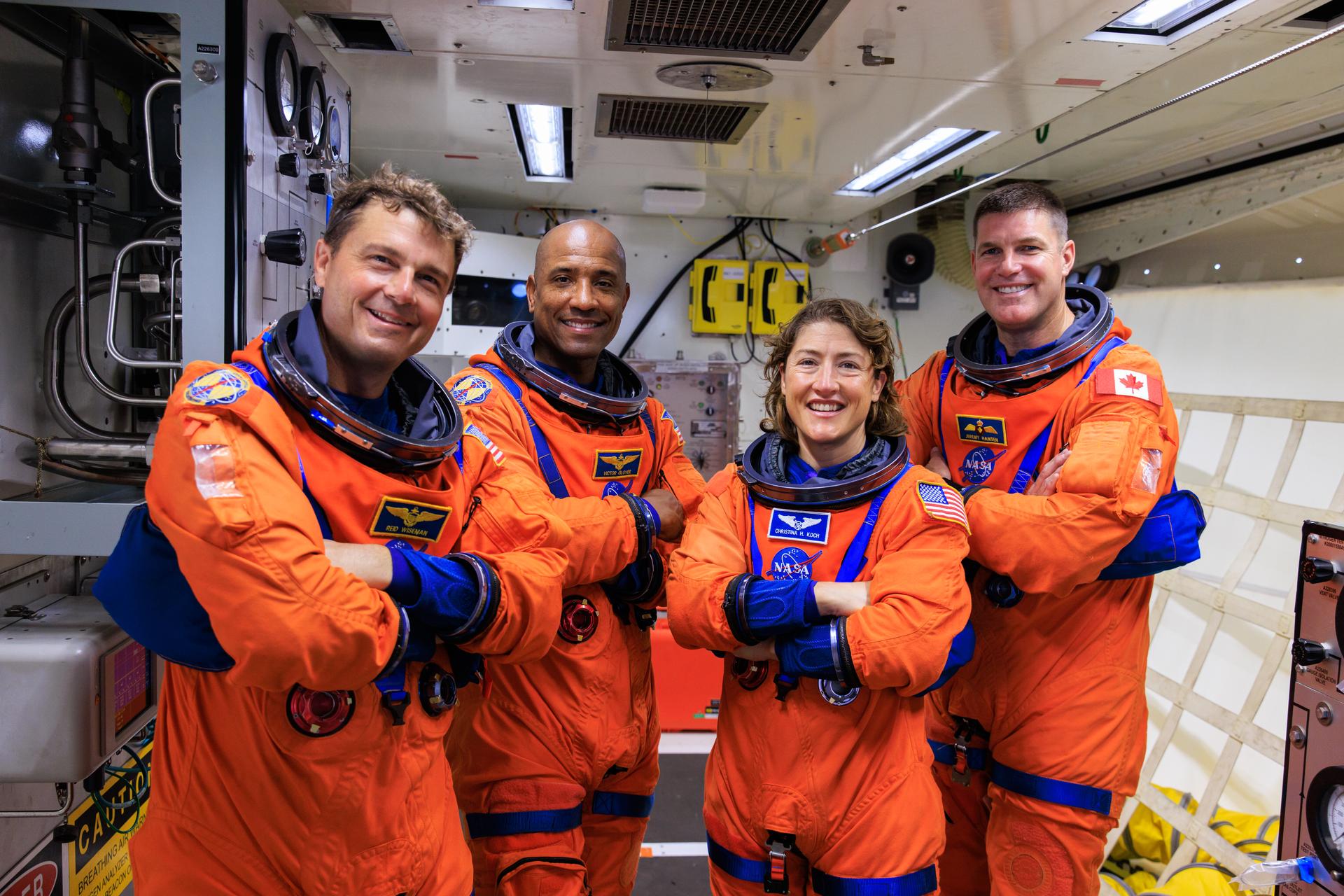
The crew of 4; Christina Koch, Victor Glover, Ried Wiseman, and Jeremy Hansen will NOT land on the Moon - this is a flyby mission, where the Orion capsule will swing around the 'dark side' of the Moon and then come home. So in that regard, it's similar to Apollo 8 (Dec 1968), essentially a practice before Artemis III - "Boots on the Moon". In contrast to the Apollo missions, which typically entered lunar orbit at around 100 km altitude, Artemis 2 will conduct a fly-by at over 6,500 km! This will be another first for humanity - these 4 brave astronauts will travel further than anyone in the history of our species.

Belinda Rich is a PhD Researcher in Lunar Metals Manufacturing at the Swinburne University of Technology
"We’re going to the Moon, to stay, and it’s those two extra words that change everything. This mission truly signals the start of a new era of human space exploration.
The goal of the Artemis programme is to enable long-term stays on the lunar surface. Apollo astronauts stayed for three days; Artemis IV astronauts will stay for a week. One day, a permanent lunar outpost will enable lunar visits lasting months or years.
Establishing outposts for long-term habitation means solving entirely new challenges around infrastructure and mission sustainability. A major solution to many of those challenges is the processing of moon dust – known as lunar regolith - into usable resources.
Regolith contains oxygen and metals like iron, silicon and aluminium. At Swinburne, we are researching how those metals can be made in-situ into products like wire, which can then power electrical systems or feed 3D printers to make spare parts. These technologies will be the key enablers for humanity’s future in space, a future that starts here with these early missions. Artemis II will be proving system capabilities that NASA astronauts will rely upon for years to come."
Dr Guifré Molera Calves is a senior space researcher at the University of Tasmania and Head of space research activities at HENSOLDT Ltd.
"Artemis II represents a key moment for human space exploration. For the first time in over half a century, astronauts are heading back toward the Moon — and this time, the mission is about far more than flags and footprints. The Artemis program roadmap envisions crewed lunar landings by 2028, only two years away, and ultimately, the first step to send humans to Mars.
In recent years we've seen a boost in lunar activity, from private companies to national agencies. In 2026 alone, at least six missions are planned to carry a wide range of payloads and satellites for science, communications, and resource prospecting. Growing plants in lunar regolith, extracting oxygen and water from local resources — these are no longer distant ambitions but active experiments that could transform how we sustain life beyond Earth.
Australia is playing a big part in this future thanks to top-class radio communications facilities, with CSIRO’s deep space communication center. Meanwhile, the University of Tasmania, with one of the world's largest distributed antenna networks, will be tracking the mission for orbit determination and scientific purposes. These ground-based contributions from the Southern Hemisphere aren't just supporting roles — they're essential pieces of a global effort to make humanity a multi-planetary species."
Prof Andrew Dempster is Director of the Australian Centre for Space Engineering Research at UNSW
"The launch of Artemis 2 towards the moon is obviously a cause for great excitement. Not since the seventies has such a thing been attempted. An interesting question for the intervening decades has been why could we do it then, and not 'now'. A better question is why do it at all. Last time it was all about the Cold War. Now it is more about colonisation of space.
The moon is interesting, but in many scenarios, it was simply a stepping stone to Mars, the real target. That is why the recent announcement by NASA that they will 'pause' the Gateway station, which would be in a fancy lunar orbit, in favour of the development of a lunar base is interesting. Gateway would have allowed access 'up and down' to the lunar surface, but would also have allowed spacecraft and astronauts transiting to Mars to avoid the Moon's gravity well. The new program seems to refocus the strategic aims once again to the Moon."
Dr Matt Shaw is a Research Fellow specialising in astrometallurgy at Swinburne University of Technology
"Artemis 2 is the start of a very ambitious proposed human launch schedule aiming for boots back on the Moon in 2028 with the Artemis 4 and 5 missions.
This mission is the exciting first step in NASA’s newly announced $20 billion campaign to establish a base on the Moon in the next 10 years. This is a timeline that is intriguingly close to China’s proposed timeline to complete the initial stages of their International Lunar Research Station (ILRS). It is this similarity that is sparking comments of a second space race.
A permanent presence on the Moon is an exciting prospect. A Moon base will allow us to better understand our near neighbour, as well as start leveraging the resources there to build up a cislunar economy. This is very exciting, but there are a lot of challenges to meet along the way.
This is a field that researchers at the Swinburne University Space Technology and Industry Institute have been leading the world in over the last 8 years. With expertise in astrometallurgy, space manufacturing, robotics, advanced materials, microgravity research and space radiation.
Artemis 2 is the start of the next phase of human space travel. We’ll be watching the launch, along with everyone else, with bated breath!"
Mr Gregory Radisic is a Space Lawyer, Senior Teaching Fellow in the Faculty of Law at Bond University and Fellow of the Australian Centre for Space, Cyberspace and Data Law in the Gold Coast
"The Artemis II mission is important not only as the first crewed return to the Moon in over fifty years, but also because it includes astronauts from both the United States and Canada, showing a clear demonstration of renewed cooperation at a time of broader geopolitical strain. Signally that outer space has remained a domain of collaboration, even when tensions persist on Earth.
Artemis highlights how much remains unresolved from a legal and governance perspective. As governments and companies prepare for sustained lunar activity, international law is being tested by questions it was never designed to answer. These include how to regulate the use of lunar resources, how ‘safety zones’ around proposed Moon bases should operate without being viewed as a land grab, and how to safeguard lunar areas of scientific and historical importance, like frozen ice for scientific study or the first boot prints on the Moon's surface.
The success of Artemis II will not only be measured in technical or scientific terms, but also in how it accelerates the need for clear, cooperative rules on the Moon. The coming decade will be critical in shaping a legal framework that ensures the Moon remains accessible, peaceful, and responsibly used by all spacefaring governments and companies."
Professor Juan Francisco Salazar is Director of the Institute for Culture and Society at Western Sydney University
"The Launch of Artemis II marks a before and after in NASA space exploration programs. While the 10-day circumlunar flyby itself is undeniably a complex feat of engineering, it also opens a debate about the social and cultural dimensions of returning humans to the moon as a stepping stone for further human habitation in outer space.
The Artemis Program functions as an authoritative and multilateral declaration on how the future of space is currently being defined and executed by certain nations and corporations, and not others. The selection of the three astronauts on this mission, while representing an expansion in diversity compared to historical crews, still largely operates within a deeply entrenched, Western-centric narrative of space exploration.
This prevailing imaginary risks inadvertently sidelining or excluding alternative, more diverse, and potentially more inclusive visions for humanity's future in space. Achieving the stated goal of exploring deep space "for the benefit of all" demands a critical examination of the frameworks being established.
Artemis II is the first step to a renewed mapping of lunar space, setting the stage for future claims, resource utilisation, and infrastructure, such as a first human settlement in the next decade. So, it is most interesting to ask ourselves which earthly narratives and discourses are hitching a ride."
Professor Mathew Lewsey is Node Leader in the ARC Centre of Excellence in Plants for Space at La Trobe University
"Artemis II is a significant step in our return to the surface of the moon. The crew will fly around the moon without landing, then return to Earth, in about 10 days. On the journey they’ll test key technologies needed for future Artemis missions, which plan to land and take astronauts onto the moon in 2028. As part of the team selected by NASA to develop LEAF, an instrument for growing plants on the lunar surface in those future missions, we’re excited to see what the Artemis II crew learn. Their achievements will help us better design our space crop experiments."
Lieutenant General USAF (Ret) Larry James is Professor of Practice in Space Innovation at Monash University
"The Artemis 2 mission is a major milestone in humanity’s return to the moon, moving beyond the initial Apollo landings to a more permanent presence on the lunar surface.
This is the first step in that journey which is a multi-national effort, and includes Australia providing critical tracking and communication from the Deep Space Communications Complex outside of Canberra as well as developing the Roo-ver lunar rover which will collect lunar soil samples to test for oxygen and water by the end of the decade.
As our lunar capabilities grow, this will provide great opportunities for Australian researchers and commercial companies to support the expanding habitation and scientific research on the lunar surface and inspire our next generation of explorers.
We wish the Artemis crew Godspeed and an incredibly successful mission!"
Professor Alan Duffy is Director of the Space Technology and Industry Institute, Swinburne University of Technology
"Artemis II is will break records, sending humans beyond low Earth orbit for the first time since the Apollo missions, indeed reaching further from Earth than anyone in history. It is also historic because of who is on board - the first woman and person of colour to orbit the moon.
While Artemis II will not land on the Moon, it is the crucial step before that, or in other words, one small step before the next giant leap. NASA’s powerful new SLS rocket and Orion spacecraft bring together an extraordinary number of systems that all have to work perfectly, far from Earth and with astronauts on board. It is a mission of immense ambition and real risk. That is why these missions are carried out in stages rather than going straight to the lunar surface.
Australians should be proud to be a part of that historic journey. As with Apollo, we are helping connect NASA to its astronauts through the CSIRO-operated NASA Deep Space Communication Complex in Tidbinbilla, Canberra. But more than that, we are also helping explore the Moon directly through the Australian Space Agency’s Roo-ver mission. This lunar rover is being built by an Australian-wide consortium, led by ELO2 that includes my own university, Swinburne. Missions like this inspire the next generation into STEM but also create real jobs today for Australian advanced manufacturing, robotics and high technology industry."
Associate Professor Thierry Peynot is a researcher in Robotics and AI at the Queensland University of Technology (QUT)
"The launch of Artemis 2 marks a major milestone in our journey to go back to the moon, decades after the last voyage of this kind, and in preparation to an upcoming moon landing. It is also a major step in the overall Moon to Mars program, one of the most ambitious space programs in recent times.
Australia is proud of having a part to play in this program, with the Roo-ver program. Roo-ver is Australia’s first Moon rover. It is being designed, built and tested in Australia by the ELO2 Consortium, in partnership with the Australian Space Agency, which QUT is proudly part of. Roo-ver will travel to the Moon later this decade. As a robotics academic and research passionate about space robotics, working on such a program is a dream come true!"
Marco Aliberti is Associate Director of International Engagement and Education at the European Space Policy Institute (ESPI) – visiting the Jeff Bleich Centre for Democracy and Disruptive Technologies at Flinders University
"With the launch of Artemis II, the new space race is finally heating up. While the US still holds the lead – a lead contingent on Artemis II being successful and the entire programme staying on track – China is very close thanks to its quiet determination and a marathon approach dating back more than a decade ago.
This is why the Artemis programme has recently undergone a drastic shake-up. What began as an architecture built around partnerships and a long-term vision has been refocused almost entirely on a single imperative: return Americans to the lunar surface ahead of China. Yet, if FOMO and competitive anxiety are effective in the short term, they are less so to sustain a complex programme on the long run.
A programme of the scale of Artemis needs an ample and sustained political backing, and that, in turn, requires affirmative reasons to go. Reasons are of course real and manifold, but so is the risk of political and programmatic volatility seen in the past."
Professor Rodrigo Praino is Director of the Jeff Bleich Centre for Democracy and Disruptive Technologies at Flinders University
"Artemis is basically less about what the US will find on the Moon and more about what the US will be missing out if it does not go there. The current US administration is very clear in its messaging: beat China, don't cede the Moon, win Mars. This 'America First' framing by President Trump fuels Isaacman’s recent restructuring and acceleration.
To cede the Moon is to signal something about the US position in the world order that goes far beyond the Moon itself and would be a strategic disadvantage that is unacceptable to the United States, particularly in the current geopolitical climate of competition that is a direct consequence of the actions of the current US administration. Down on Earth, Artemis II might even produce ripple effects in terms of national unity in the US, and even some kind of uptick in support for the current administration, provided that it goes well."
Dr Douglas Bock is CSIRO Director of Space & Astronomy
"We are proud to be supporting NASA’s next stage in the return to the Moon. Australia was there for the first Moon landing and CSIRO is excited to be here for these next important steps toward the long-term return to the Moon and future missions to Mars. CSIRO’s long-standing relationship with NASA stretches back more than 60 years, creating innovative solutions fuelled by our shared ambition to push the boundaries of space exploration and discovery to benefit life back on Earth. Our expert team at the Canberra Deep Space Communication Complex will help NASA stay connected with the astronauts on their journey to the Moon and back."
Rhianna Lyons is an Education Officer at the CSIRO
“The CSIRO team operating NASA’s Deep Space Communication Complex near Canberra is really excited about the upcoming Artemis II mission – the first human lunar mission since 1972. All the operators, technicians, engineers and various support teams have been preparing for the mission for several years.
Something people don’t realise is the teams that operate the three complexes in the Deep Space Network operate the entire network when it’s their shift. So, when the CSIRO team is working, they operate antennas near Canberra, Goldstone in California, and Madrid in Spain to communicate with Artemis II and all the other spacecraft we support.”
John Sarkissian is an astronomer at the CSIRO
“Murriyang, CSIRO’s Parkes radio telescope, will be passively tracking the mission as part of Intuitive Machines’ ground station network, demonstrating the network’s capabilities for future missions. Artemis II will be the first crewed mission Murriyang has supported since Apollo 17 54 years ago, which is very exciting. It is amazing to think as a six-year-old, I was watching Neil Armstrong walk on the Moon and now I’m part of this global mission inspiring a new generation to look up and consider careers in space.”
Craig James is an engineer at the CSIRO
“This is really exciting on a number of levels. Seeing astronauts fly past the Moon again is incredible, but it’s just as exciting to see CSIRO’s mobile mission operations centre step up and support its first full mission.
Being able to position the facility directly beside ANU’s Quantum Optical Ground Station has simplified team and technology coordination, and its quiet, comfortable interior provides the ANU team with a focused workspace away from the noise of servers and laser equipment. We wish ANU all the best for their optical comms demonstration.”
Richard de Grijs is Professor of Physics and Astronomy at Macquarie University, with expertise in China’s space program, international space science and science diplomacy.
"Artemis II marks a decisive shift from testing hardware to renewed testing of human deep-space capability, more than 50 years after the Apollo program. Unlike Apollo’s short, intense burst, the Artemis program is designed for continuity: sustained missions, repeatability and ultimately a long-term human presence beyond low-Earth orbit, with a lunar base now a realistic prospect. The science is not just about the Moon but about proving that life-support systems, navigation and radiation protection can function reliably in cislunar space over extended periods.
At its core, Artemis is as much an engineering validation as a scientific one. After all, before you can do great science on the Moon, you must prove that you can get there (and back!) safely—every single time. This mission is where that confidence is either earned or compromised.
Internationally, Artemis will reshape the space ecosystem—but the context is not as simple as another space race. It is less about flags and footprints, and more about building the rules of the road in deep space. The program will set technical, operational and legal standards that many partners will align with. At the same time, the program exists alongside parallel efforts, including China’s rapidly advancing human spaceflight achievements and their highly successful Chang’e lunar exploration program. This isn’t a new space race; it’s really a set of parallel space futures.
In that sense, Artemis II is not just a mission. It is a signal of how humanity will organise itself beyond Earth. What we are seeing is the early architecture of a shared human presence in deep space. The real milestone is not reaching the Moon again, but learning how to stay there together. This decade will be defined not by who gets there first, but by who builds systems others can join and benefit from. In deep space, cooperation isn’t optional—it is the architecture. The Moon is no longer just a destination; it is a laboratory for international cooperation as much as for technology."
Dr Rebecca Davies is a Senior Lecturer and ARC DECRA Fellow in the Centre for Astrophysics and Supercomputing at Swinburne University of Technology
"NASA is planning to launch Artemis II tomorrow morning! The Artemis II mission will take four astronauts on a ten-day trip around the Moon. While the crew won’t land on the moon, the mission will be a critical test of life-support systems, navigation, communications and deep-space operations in preparation for future lunar landings. This launch is a major milestone - Artemis II will mark the first time humans have travelled beyond Low Earth Orbit in more than 50 years, since Apollo 17 in 1972. The Artemis program signals the start of a new era for human space travel, and takes us one step closer to establishing a long-term human presence on the moon and eventually sending astronauts to Mars. Australia will play an important supporting role: our deep space communication facilities will help NASA maintain contact with the astronauts even when they are out of sight of ground stations in the US, as was the case during the Apollo missions. The targeted launch time is 6:24pm Wednesday April 1 EDT, corresponding to 9:24am Thursday April 2 AEDT."
