 Sign In



 New Zealand; Pacific; International
News release
From:
Review of the impacts of deep-sea mining highlights the risk of biodiversity loss in unique ecosystems
- First comprehensive review of environmental impacts of deep-sea mining from 50 years of experimental studies published
- Scientists now have a reasonable understanding of the local impacts of nodule mining, and the decadal-scale recovery timescales
- Deep-sea mining at vents and seamounts is likely to lead to irrevocable biodiversity loss, and is thus scientifically incompatible with existing policy
The deep sea contains a wealth of mineral resources which have been explored for potential commercial use since the 1970s. As demand and technology make the mining of the seafloor a real possibility, a new review looks at over 50 years of data to assess the real effect such activity might have.
The review led by Prof. Adrian Glover, Merit Researcher Natural History Museum, London, highlights how the different types of deep-sea mining being considered affect different environments. These environments range from cobalt and nickel-rich nodules on abyssal plains to copper deposits at hydrothermal vents on mid-ocean ridges. The team assessed likely impacts of mining at these sites, and what further research is needed to understand risks to species in the different deep-sea ecosystems.
The three most prominent mineral resources being explored are polymetallic nodules on the abyssal seabed, seafloor massive sulphide (SMS) deposits formed at hydrothermal vents and cobalt-rich crusts on seamounts (underwater hills that rise from the ocean floor). These resources lie at typical depths of greater than 2000m and beyond national jurisdictions. Despite this, 30 such areas are contracted to an international body setup to regulate mineral exploration as debate on the environmental advantages and disadvantages continues.
Prof Adrian Glover said, “It is surprising that such a major environmental issue has not yet been comprehensively reviewed in the scientific literature.”
“Over the course of two years we reviewed more than 200 published and unpublished reports on the environmental impacts of deep-sea mining with a focus on studies of the baseline biodiversity in the regions targeted, and experimental work that measured the actual impacts of mining tests.”
The team conclude not by attempting to advocate for or against mining but instead look at how scientifically compatible the different types of deep-sea mining are with existing policy.
Prof Glover adds, “An important distinction we highlight is the difference between mining polymetallic nodules, hydrothermal vents and seamounts. These systems could not be more different.”
“Active vents and seamounts host extraordinary ecosystems rich in unique species, and it is clear that major disturbance at these sites would not be scientifically compatible with policy on biodiversity that almost all nations have already agreed to.”
“For nodule mining, some simple scientific steps would help to resolve the risk of biodiversity loss, which is still mostly unknown. For example, supported by our scientific community, the regulator has already set up a protected area system that covers 30% of the main targeted region.”
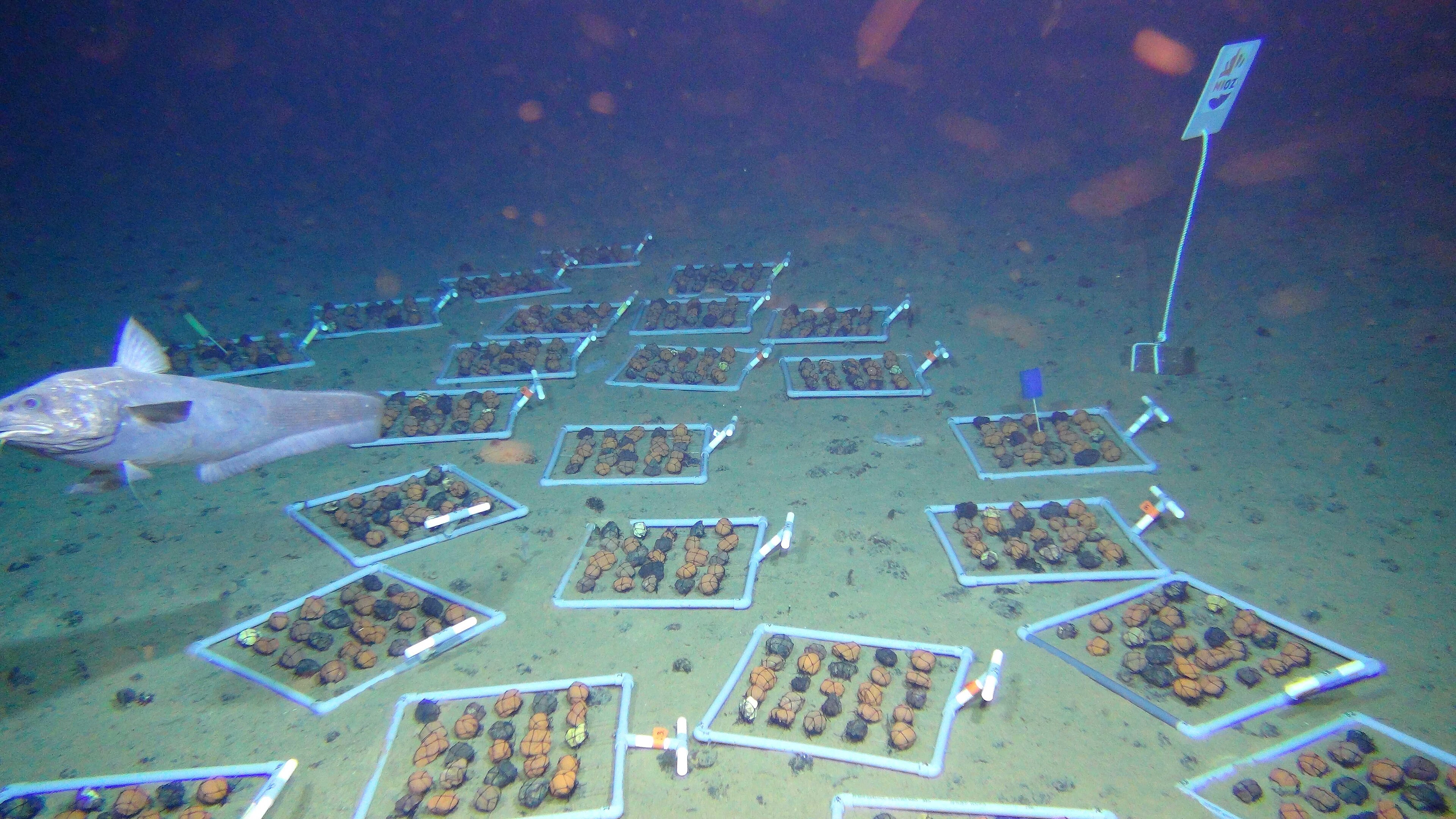
The team acknowledge that we have very little understanding of how well the protected area system will work as there is so little data from these sites. The Clarion-Clipperton Zone (CCZ), a six million square kilometre area of deep ocean between Hawaii and the west coast of Mexico rich in metallic nodules, is estimated to be home to 6000-8000 species of which only 436 are named.
The NHM together with colleagues around the world have been leading efforts to describe the many species brought up by the recent surveys. “Making taxonomic data available including DNA sequences of species is critical to understanding the risks of biodiversity loss” says Glover. The NHM team have described over 50 new species from the deep sea in the last 10 years. These include a remarkable new worm found living inside the nodules and two new species of hydrothermal vent tubeworm. Most recently, they worked together with the National Oceanography Centre to describe 24 new species of deep-sea crustacean.
Co-author of the study, Prof. Jon Copley at the University of Southampton said “In the case of any mining at active deep-sea hydrothermal vents, no further research is necessary – we know enough to see that there is a risk of species extinctions from such activity in those rare habitats. But mining manganese nodules is a different prospect, where further research is still needed to understand those potential risks.”
Prof Glover concludes, “A simple path forward would be to recognise that mining some undisturbed unique deep-sea ecosystems such as active vents and seamounts is not scientifically compatible with existing policy. In other areas, such as polymetallic nodule regions, scientific data can support the creation and refinement of protected areas, helping policymakers determine whether mining could be considered sustainable.”
The review ‘The environmental impacts of deep-sea mining’ is published in the journal Current Biology.
Expert Reaction
These comments have been collated by the Science Media Centre to provide a variety of expert perspectives on this issue. Feel free to use these quotes in your stories. Views expressed are the personal opinions of the experts named. They do not represent the views of the SMC or any other organisation unless specifically stated.
Associate Professor Kat Bolstad, Department of Environmental Science, AUT
"The deep sea is full of life. These habitats seem extreme to us, but life has survived, thrived, and diversified here for billions of years. Many of these lives are conducted across time scales that we have trouble imagining—some microbes may divide only once every thousand years. Some fish live for centuries. Abrupt disturbances are rare, and deep-sea life has evolved within these stable conditions.
"Enter deep-sea mining (DSM): catastrophically destructive to the immediate seafloor, and producing noise, vibrations, clouds of sediment, and other impacts that we cannot yet fully predict. The effects of large-scale DSM are likely to be substantial, longer lasting, and more complex than we can anticipate.
"This study summarises our current state of knowledge on the known and likely impacts of DSM on the communities of animals living in habitats where DSM is being considered or explored. It also considers the risk of extinctions and biodiversity loss (key considerations for international agreements on managing Earth’s biodiversity) that DSM may carry for different targeted habitats including abyssal plains, hydrothermal vents, and seamounts. There is widespread scientific agreement: We need a far greater understanding of some of these deep-sea ecosystems before we can make responsible decisions; for the ones we have been studying the most, it is clear that the effects of DSM will be dire and long lasting. Other recent studies have revealed important, surprising discoveries such as the fact that the polymetallic nodules being targeted are producing oxygen, which may be a critical factor in supporting the biodiversity of these sites.
"Many countries (including Aotearoa) and Indigenous groups are calling for a moratorium or outright ban on commercial-scale DSM. Authorities are under great pressure to determine the future of this proposed industry, but I hope we will not rush into this, and that future generations can look back at this moment and see that we acted in their—and our planet’s—best interests."

Jonathan Gardner, Professor of Marine Biology (Adjunct), Te Herenga Waka - Victoria University of Wellington
"Adrian Glover and colleagues have today published a large and comprehensive paper in the journal Current Biology addressing the potential environmental impacts of deep-sea mining. It is important to appreciate that commercial deep-sea mining has not yet commenced anywhere in the world but that the technology and business developments are now at a state where some mining could commence. Perhaps the greatest obstacle to the start of mining is the global paucity of environmental data about the state of the deep-sea ecosystems (e.g., baseline datasets of biodiversity before mining starts). This is a gap that the mining companies are aware of and are trying to address.
"Glover and colleagues provide a history of the discovery of deep-sea mineral resources and more importantly they review the history of disturbance/recolonisation experiments in different deep-sea ecosystems that have been carried out by exploration or the testing of mining activity. The paper covers the three main areas of the deep sea that are likely to experience mining activities directly - the abyssal seafloor, hydrothermal vents and seamounts, as well as a fourth - the water column - which will experience indirect effects. The review includes information on the different size classes (types) of organisms, where such classes have been studied.
"The major findings of the paper come as no great surprise. The authors point out that the three separate systems (abyssal seafloor, vents, seamounts) are very different systems with their own suites of species, and as such must be treated independently. The same can be said for the pelagic (water column) environment. The authors highlight a paucity of environmental data and also the spatial differences that exist within a given zone. The authors note that we are still waiting for a 'Mining Code' to be developed by the International Seabed Authority. In addition, the authors point out the need for protected regions to be established alongside mined areas.
"Perhaps the single most important contribution of the Glover et al. paper is to state that 'If vents and seamounts were to be classified as Ecologically or Biologically Significant Areas under the Convention on Biological Diversity, deep-sea mining at these sites would not be scientifically compatible with the Kunming-Montreal Global Biodiversity Framework.' This may not be the first time that this point has been made openly but it is important because it does provide governments with the opportunity to protect some regions of the deep sea from the activities of mining, if they and their citizens so wish.
"The review paper is well written and illustrated, and is easy to read. It is up to date and comprehensive, and will serve as a useful resource for numerous different groups - policy makers, students, researchers, NGOs, concerned citizens, etc. Deep-sea mining may seem like a distant activity but it should be a matter of interest and concern for everyone in New Zealand given our current 'fast track' legislation, the possibility of iron sands mining commencing in the near future off the coast of southern Taranaki (technically not deep-sea mining but still mining of the seafloor) and the possible development of other forms of deep-sea mining in our region (e.g., nodule mining on the Chatham Rise). Deep-sea mining is a key issue for everyone with an interest in environmental issues and with a General Election in November of this year it is, or at least could be, a defining issue. I can recommend this paper as an excellent read to anyone interested in environmental issues."
Attachments
Note: Not all attachments are visible to the general public. Research URLs will go live after the embargo ends.

