Sign In



 Australia; NSW; QLD
Expert Reaction
These comments have been collated by the Science Media Centre to provide a variety of expert perspectives on this issue. Feel free to use these quotes in your stories. Views expressed are the personal opinions of the experts named. They do not represent the views of the SMC or any other organisation unless specifically stated.
Ross Gordon is a Professor of Behaviour and Social Change at UTS Business School, University of Technology Sydney. Ross is also the Director of Change for Good @ UTS – a Research Centre focused on transdisciplinary behaviour and social change for social good.
Is this number worse than expected given the current restrictions?
"The number of COVID-19 cases announced in NSW today of 239 from a record 111,000 tests is certainly alarming and will be disheartening to residents of the Sydney metropolitan area. The case rate is trending in the wrong direction, and the question becomes, are the current lockdown restrictions and health advice enough? Currently it seems that this is not the case. The key to reducing case numbers and Sydney coming out of lockdown is influencing people’s behaviour. Indeed, the key role that behaviour, and behaviour change is key to tackling health problems such as COVID-19 is recognised by the World Health Organization.
While the current lockdown settings do not seem to be working, we should acknowledge that they certainly have had some impact on restricting an exponential growth in case. The COVID-19 Delta variant that is currently spreading in Sydney is estimated to be 60 per cent more infectious than the previously dominant Alpha variant – which was in turn double as infectious as the original COVID-19 variant that emerged in Wuhan in late 2019. Without a lockdown in Sydney, cases would be far higher. However, if the goal is to reduce case numbers in Sydney down to, or close to zero – it is clear that a coherent package of further measures is required."
Has NSW lost control or are they on the verge of losing control?
"The rise in cases in certainly a worry. And there is a lot of conjecture about whether Sydney should have gone into lockdown earlier. And inter-state squabbling and hyperbole has typified the Australian experience of the pandemic lately. But this doesn’t help ordinary members of the public, and in Sydney we need constructive action moving forward. The best time for recriminations and learning from our mistakes would come in a public inquiry post-pandemic.
However, the current restrictions will have had some impact in preventing exponential growth in cases given how virulent the Delta variant is. And while 239 cases is a seemingly shocking number, this is still some way off the peak of 725 cases reached in Victoria last year. Most of the cases in NSW are emerging in essential workplaces among younger and unvaccinated people who work in those settings, and in families – so further action will need to address this and control the outbreak."
Measures that were used in Victoria last year that either haven't been used in Sydney or were adopted late like curfews, 5km radius and outdoor mask wearing - how much difference would they make in this situation?
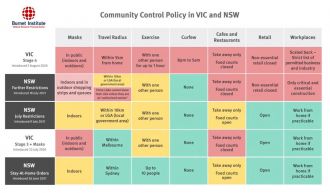
"As a diagram from the Burnet Institute illustrates [see attached], the current lockdown settings in NSW are largely similar to those in Victoria last year. There is not much evidence to suggest that late night curfews help reduce transmission. Perhaps curfews might have prevented some of the parties that spread the virus at the start of the Sydney outbreak. But restricting people’s civil liberties to go outside at night based on little evidence of effective risks a backlash among the population. The 5km radius of travel rule could have some impact – but this is already being used in the eight LGAs of most concern in Sydney. Furthermore, a 5km rule can carry some inconsistencies depending on where you live. This could prevent people obtaining essential supplies, medicines, reaching a Service-NSW or Centrelink office for vital business – depending on their proximity. The 5km measure was very unpopular in Melbourne last year. And outside of the eight LGAs currently with the tightest restrictions, the evidence is not great and support from the community to adhere to this behaviour would be questionable.
The risk of transmission of COVID-19 outdoors, while technically possible, is minimal. This means that mask wearing outside is likely to have little effect on reducing cases in Sydney. However, it does act as a visual reminder to everyone that we are in the middle of a pandemic and to stay on guard and stick to COVID-safe behaviours such as wearing a mask, physical distancing, hand washing, getting tested if you develop symptoms, testing and isolating if you are a case contact, checking in to any venues of visit, and of course getting vaccinated as soon as possible.
What is needed in Sydney is further action to target transmission in essential workplaces, and among families, particularly in Western and South Western Sydney.
With regards to NSW restrictions - what is working and what needs work?
"Many of the obvious restrictions for which we have good evidence of effectiveness are already in place and do work to an extent. These health orders include working from home unless a listed essential worker, wearing a mask indoors away from your home, and only exercising with one other person. Pubs and bars are closed and cafes and restaurants are take-away only. Only critical and essential construction is permitted. Each of these measures will in some way have limited case transmission. All but essential retail outlets are now closed – and there have been few cases of transmission between members of the public in places like supermarkets or banks. However, authorities could also work with retailers to offer free delivery of groceries and other essential items – again removing a barrier and providing an inventive for people to able to stay at home.
What needs to be done is to limit transmission further in essential workplaces, and among family households. The additional financial supports offered to people yesterday, especially those who have lost work but were ineligible due to receiving some other government support benefits, will help a lot. This measure needs time to assess the impact on cases, but it removes a barrier to people who may feel compelled to go to work due to loss of income.
Further improving infection controls, and introducing grouped shift work in essential workplaces could help restrict interactions between employees and slow the spread. There is also a need for better segmentation, targeting and positioning of health advice. Simply communicating generic messages about how to avoid catching COVID-19, or issuing the latest figures and health advice at 11am press conferences when essential workers are out at work is not enough. Given the significant populations of people from a CALD [Culturally and linguistically diverse] background in the parts of Sydney that the Delta variant is spreading in, there is a need for a more segmented, targeted and positioned approach that is also culturally competent. Furthermore, many of these people are younger, more likely to be affected by loss of income and unemployment, and less risk-averse to catching the virus.
Rapid and responsive language translations of key information and messages should be distributed through multiple channels – TV, radio, and targeted social media. Faith-based and community leaders can also help – for example through online religious services to communicate key messages about COVID-19 safe behaviours, and how to access vaccination.
There is a need to better engage with young people regarding COVID-19 in Sydney, understand the unique challenges they face during the pandemic, be empathetic, and support them in their behaviours to reduce transmission. "
Will vaccinations make a difference to numbers or will it take too long to have an impact?
"Given that Sydney now faces a long lockdown vaccinations can absolutely have an effect. Even one dose of a vaccine can reduce likelihood of transmission, hospitalisation and death. So, as the WHO sets out we need to create an enabling environment, draw on social influences, and motivate people to get vaccinated.
Currently there is a big need for vaccines in Sydney, especially given that very few younger people, such as those who are essential workers in Western and South West Sydney are currently not vaccinated. Further provision of AstraZeneca and redirection of Pfizer vaccines is needed fast to get jabs into the arms people in Sydney hotspots.
To enable people to get vaccinated we need to acknowledge that shift workers in Western and South West Sydney often aren’t able to access GP surgeries during office hours, or take up the first available appointments at mass vaccination centres that may not align with their work or family responsibilities. Mobile cancer screening and blood donation vans are used to successfully promote other health behaviours. Similar mobile vaccination units could get into communities across Sydney and get jabs into arms on convenience. These mobile units would permit vaccines to be delivered on streets, in local parks and other suitable community locations in the outdoors with good ventilation to reduce risk of virus spread.
In terms of motivation, the Commonwealth Government recently launched a much-criticised campaign encouraging Australians to ‘Arm yourself’. The campaign has been criticised for being beige and uninspiring, and fails to motivate people to take action. Another federal government graphic fear campaign ad has been running in Sydney featuring a young woman struggling to breathe on a ventilator – but this has also been criticised. The evidence on fear campaigns is mixed and there are ethical questions about scaring people to change their behaviours. Fear campaigns also tend to only work when people believe they can do what is necessary – i.e. get vaccinated. With Pfizer/BioNtech vaccines for younger people largely unavailable at the moment, and the ongoing controversy over the Oxford/AstraZeneca vaccine – people may disengage from this messaging. Instead, the use of positive emotional appeals in campaigns that highlight the benefits of vaccination bringing freedom to reconnect with loved ones, socialise, and travel can better motivate people to get vaccinated.

Multimedia