Sign In



 Australia; VIC; ACT
News release
From:
A large rotating tank of water in a laboratory in Canberra is an alternative to supercomputers for the scientists trying to predict the impacts of climate change - and the results are a mix of good and bad news for Australia.
A key challenge facing the world’s researchers is understanding the role of polar amplification on the Earth. Polar amplification refers to the phenomenon in which human-driven weather and climate change happens faster and stronger in the Arctic and Antarctica than the global average.
The Arctic, for example, is warming about four times faster than the rest of the world. As sea ice melts, it exposes dark ocean water, which absorbs more of the sun’s energy than bright ice and white snow, leading to increased warming and increased melting. This is a particularly vicious feedback loop of the climate system, and it’s just one of many changes occurring in a region that’s bearing the brunt of global warming.
Climate scientists and meteorologists are also trying to understand how polar amplification will impact the atmosphere, which is mathematically and physically complex. And running supercomputer simulations to predict the many potential changes in the atmosphere is very expensive, requiring huge amounts of data and electricity.
Australia and other countries around the world do have the supercomputers necessary to crunch those numbers, but time and energy on such powerful devices is in high demand.
So what’s the alternative?
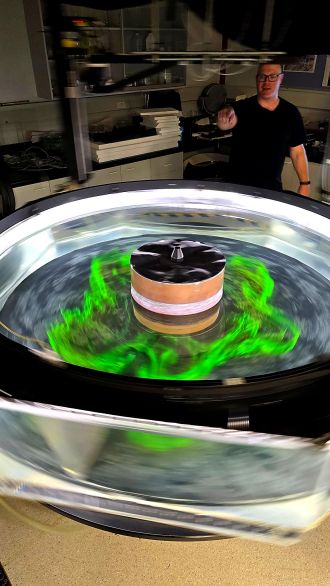
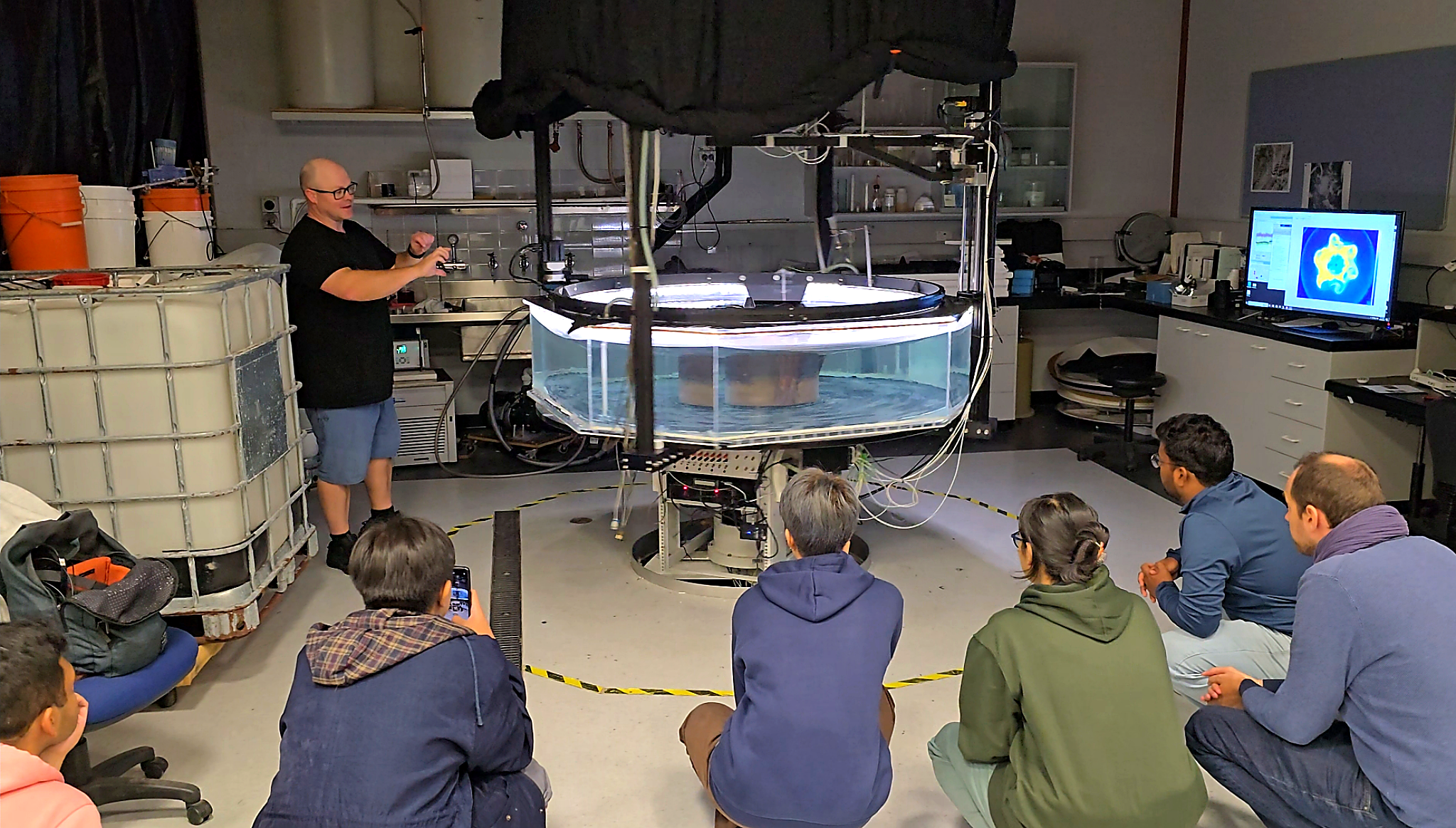
For Dr Kial Stewart and his team at the Australian National University in Canberra, it involves filling a container reminiscent of a giant fishbowl full with water and spinning it around. Coined the “Large Rotating Annulus”, this apparatus is the only one of its kind in the Southern Hemisphere, and is Australia’s latest weapon in the battle to understand and prepare for weather and climate change.
The flagship of the Climate & Fluid Physics Laboratory, it’s an ingenious and relatively low cost model for the rotation of the Earth, and the movement of water and air around it.
By tweaking the settings, Dr Stewart and his collaborators can recreate complicated climate processes, and see how the atmosphere and ocean dynamics will change as the Earth system heats up.
In their latest experiment, they learned that polar amplification could lead to fewer short-term, small-scale storms, but may cause more prolonged and persistent extreme events, such as heat waves or cold spells.
The good news, though, is that while those extreme heats may be more prolonged, their scope could in fact be lessened by polar amplification, meaning they will affect a smaller geographic area.
“Experiments like these simplify the complicated climate system down to its basic state, allowing us to better understand its fundamental dynamics,” Kial said.
“Once we understand the system in its simplest form, we gradually reintroduce additional layers of complexity, growing our understanding step-by-step.
“Our next goal is to incorporate seasonality into the experiment, allowing us to explore the dynamical transitions back-and-forth between summer and winter weather conditions.”
The results have been published in the Journal of Climate
Multimedia