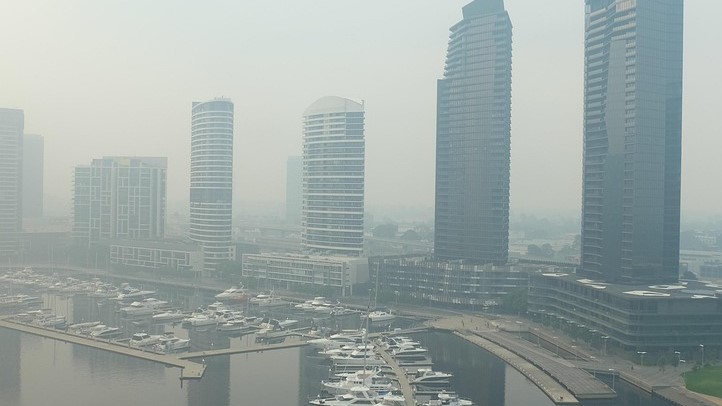
Bushfire smoke increases hospitalisation risks more than other types of air pollution

Publicly released:
Australia; New Zealand; NSW; VIC; QLD; SA; TAS
Image by Michael Dahlenburg from Pixabay

Bushfire smoke increases people's risk of being hospitalised for respiratory conditions and asthma, and may increase it more than other types of air pollution, according to Australian-led research. The study, which the authors say is the largest study on the links between wildfire-specific fine particulate matter and respiratory hospitalisations, included data from Australia, Brazil, Canada, Chile, New Zealand, Vietnam, Thailand and Taiwan. It found that bushfire-specific fine particulate matter was linked with increased hospitalisation risks for respiratory conditions, including asthma, influenza and pneumonia. It also found that wildfire-specific fine particulate matter posed a greater hospitalisation risk for various respiratory diseases than other types of fine particulate matter.

Attachments

Note: Not all attachments are visible to the general public. Research URLs will go live after the embargo ends.

Research Springer Nature, Web page Please link to the article in online versions of your report (the URL will go live after the embargo ends).
Journal/
conference:
Nature Sustainability
Research:Paper
Organisation/s: Monash University, The University of New South Wales, University of Tasmania, The University of Sydney, Queensland University of Technology (QUT), The University of Adelaide, University of Otago, The University of Queensland
Funder: This study is supported by Australian Research Council (DP210102076) and Australian National Health & Medical Research Council (APP2000581). Yiwen Zhang is supported by the NHMRC e-Asia Joint Research Program Grant (GNT2000581). R.X. is supported by Monash Faculty of Medicine Nursing and Health Science (FMNHS) Bridging Postdoctoral Fellowships 2022 and VicHealth Postdoctoral Research Fellowships 2022. W. Huang and T.Y. are supported by China Scholarship Council funds (W. Huang, 202006380055; T.Y., 201906320051). S.L. was supported by an Emerging Leader Fellowship (GNT2009866) of the Australian National Health and Medical Research Council. Y.G. was supported by Career Development Fellowship (GNT1163693) and Leader Fellowship (GNT2008813) of the Australian National Health and Medical Research Council.
Media Contact/s
Contact details are only visible to registered journalists.