 Sign In



 Australia; NSW
News release
From:
Neuroscientists at the University of New England (UNE) have found three distinctive brain patterns shared by people with childhood maltreatment and depression that could provide the launching pad for a new approach to diagnosis and treatment.
PhD candidate Christopher Watson led the first-ever comprehensive review of existing research on the topic, revealing people who suffered child maltreatment and depression were more likely to have altered brain wave activity, an imbalance between the left and right frontal brain regions, and a disruption in the brain regions responsible for emotional processing.
Now, the UNE Brain Behaviour Research Group (BBRG) is investigating this further to address critical gaps in our knowledge.
“Childhood maltreatment and depression are serious global issues with high prevalence and lifelong impacts on physical and mental health,” said Mr Watson.
“Experiencing childhood maltreatment has been shown to increase an individual’s risk of developing depression in adulthood by two-and-a-half times; however, very little is known about the underlying neurobiological mechanisms of this association.”
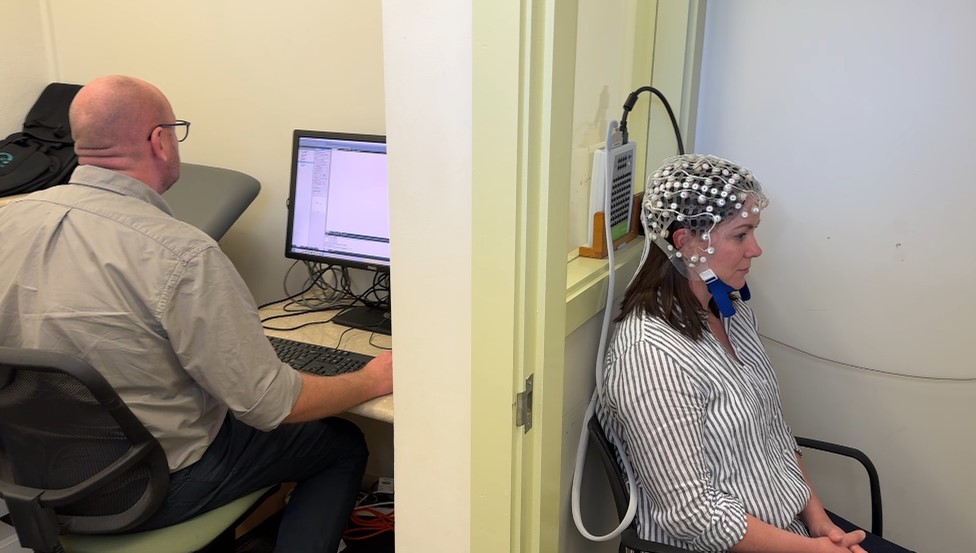
As part of another study called PROFILE-D, which is a large-scale regional study into mental health, the BBRG is collecting information regarding the immunological, hormonal, psychological, relationship, and brain-based profiles of New England residents.
A particular strength of this work is the use of Electroencephalographic (EEG) technology to record the electrical activity within the brain of 300 community volunteers, some of whom have experienced childhood maltreatment and depression.
“Through this, we’ll be looking for biomarkers that have the potential to create a more objective approach to depression diagnosis, improving the existing subjective self-report and clinical assessment approaches,” Mr Watson said.
Improving treatment and diagnosis is critical to improving global health outcomes, with depression found to be the leading cause of disability across the world.
Depression also poses a significant economic burden, with studies suggesting an estimated loss of 12 billion productive workdays each year and an approximate annual cost approaching $1 trillion USD.
“Through our research, we are making a difference to the community and to the lives of those impacted by depression,” said PROFILE-D leader Professor Chris Sharpley.
Read the full literature review here and read more about the PROFILE-D project here.
Multimedia


