Ancient squirrel turds include DNA from mammoths, bison, horses, and even cheetahs

Publicly released:
International
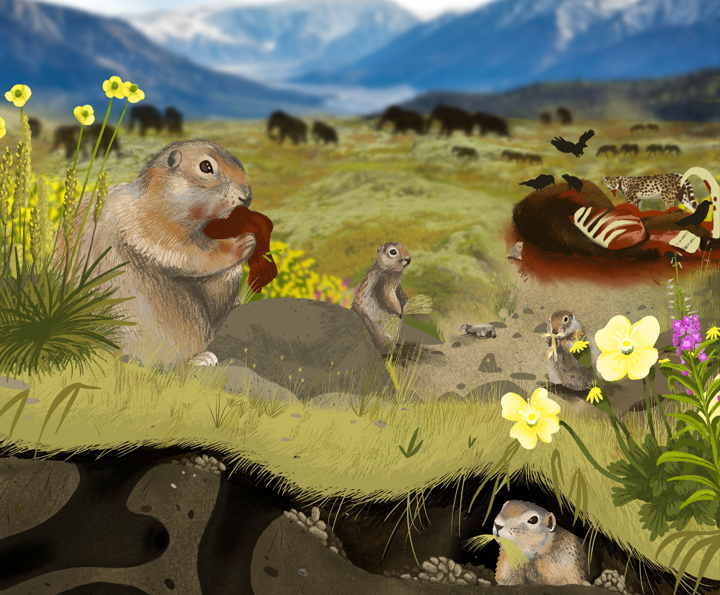
An artist’s reconstruction of Pleistocene Yukon, showing Arctic ground squirrels scavenging meat and foraging on plants within the mammoth-steppe ecosystem. Ancient DNA from their preserved burrows and faeces reveals this complex food web—where even small rodents fed on megafauna like mammoths. Credit: Mercedes Minck/Hakai Institute,

Squirrel poop preserved in Canadian permafrost contains 700,000-year-old ancient DNA from woolly mammoths, horses, American cheetahs, and steppe bison, according to international researchers, but they say this was not the squirrel equivalent of Monty Python's bloodthirsty 'Rabbit of Caerbannog'. The team analysed 13 Arctic ground squirrel poop samples found in the Yukon in Canada, and identified DNA from a range of plants, microbes, insects, and animals, including large animals such as woolly mammoths, horses, American cheetahs, and steppe bison. DNA cannot usually be obtained from ancient poop samples because it degrades easily, but  in Arctic regions, ground squirrel burrows can remain frozen and sealed for thousands of years, preserving any DNA. The authors say that these ancient squirrels were collecting all sorts of different bits of plants, seeds, but also likely scavenged on carrion from dead animals, which is probably the source of much of the animal DNA. They also suggest that the existence of predator DNA may even be due to predators attempting to break into the squirrels' burrows and dying while trying.

News release

From: Springer Nature

Genetics: Ancient squirrel droppings reveal rich prehistoric ecosystem *IMAGES & VIDEO*

Squirrel droppings preserved in Canadian permafrost containing 700,000-year-old ancient DNA are reported in Nature Communications. The findings, which include DNA from woolly mammoths, horses, American cheetahs, and steppe bison, enable the reconstruction of vibrant and diverse ancient ecosystems and shed new light on the evolutionary history of certain species.
Coprolites, or fossilised faeces, can preserve a variety of biomolecules from ancient animals, including ancient DNA from both the defecator and the surrounding environment. However, coprolites are less commonly used for ancient DNA analysis than bones or sediments because they degrade more easily. In Arctic regions, ground squirrel burrows can remain frozen and sealed for thousands of years, allowing genetic material in coprolites to be preserved.
Tyler Murchie and colleagues analysed 13 Arctic ground squirrel (Urocitellus parryii) coprolite samples from central Yukon in Canada. This research was conducted with permission from the Tr’ondëk Hwëch’in First Nation, within whose traditional territory the study occurred. They identified DNA from a wide range of plants, microbes, insects, and animals, including megafauna such as woolly mammoths, horses, American cheetahs, and steppe bison, as well as more than 200 different plant groups.  The authors were able to reconstruct 18 mitochondrial genomes from the coprolite samples, including twelve ground squirrel (Urocitellus), one hare (Lepus), two bison (Bison), and three horses (Equus). The genomes recovered from Urocitellus point to a rich diversity in Arctic ground squirrels, including a potentially new lineage dating to approximately 700,000 years ago.
The authors note that some of the DNA may have been picked up from the surface of the coprolite at a later time, and that incomplete reference databases may affect species identification. They acknowledge that further work is needed to refine and expand these techniques. However, these results suggest that permafrost coprolites can be effectively used to create high-resolution snapshots of prehistoric environments and complement insights from sedimentary and skeletal ancient DNA.

Multimedia
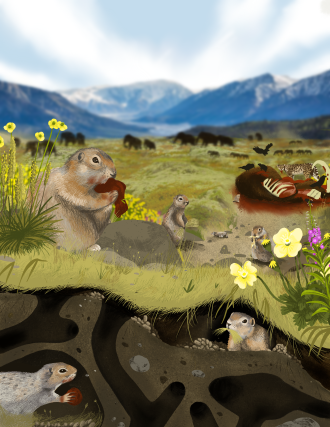
An artist’s reconstruction showing Arctic ground squirrels scavenging meat
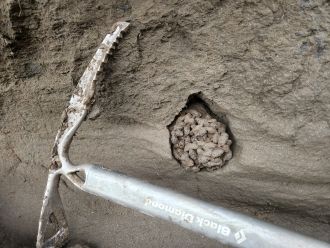
Researchers document a cluster of ancient Arctic ground squirrel faecal pellets
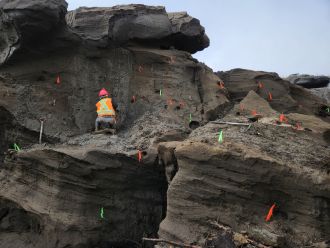
Permafrost cores at Hunker Creek, Yukon
Squirrel Coprolite video
Journal/
conference:
Nature Communications
Research:Paper
Organisation/s: Hakai Institute, Canada
Funder: This work was funded by the Tula Foundation, CANA Foundation, Belmont Forum, NSERC Alliance (to HNP and TJM), BiodivERsA grants (to DGF and HNP for the Future ArcTic Ecosystems [FATE] research consortium), NSERC Discovery grants (to DGF and HNP), and University of Alberta Northern Research Awards (to SLC).
Media Contact/s
Contact details are only visible to registered journalists.