 Sign In



 International

News release
From:
In mafias, marriages are strategic tools
Marriages between lesser-known clans can be especially important to the resilience of one of the world’s most powerful mafia networks
A new analysis of inter-family marriages, in the mafia-type organized crime group ’Ndrangheta, suggests that matrimonial ties between non-powerful families may play a previously under-appreciated role in maintaining the resilience of the entire ’Ndrangheta network. Maurizio Catino and colleagues at the University of Milano-Bicocca, Italy, present these findings in the open-access journal PLOS One on May 6, 2026.
Law enforcement agencies have described the ’Ndrangheta as one of the world’s most dangerous organized crime groups. The ’Ndrangheta originated in the Calabrian region of Italy around the mid-19th century and now has members worldwide. The group is patriarchal and hierarchical, and it recruits primarily through family ties, making marriage a strategic tool in which women are “given away” to cement inter-family alliances within the ’Ndrangheta network.
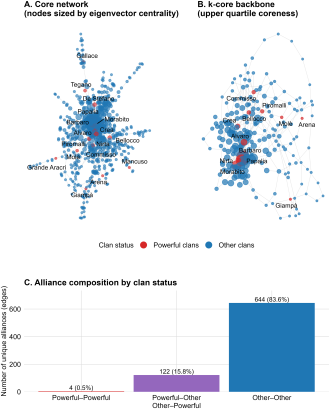
However, research on links between inter-family marriage and the overall power structure of the ’Ndrangheta has been limited. To shed new light, Catino and colleagues applied network analytic tools to data on 770 inter-family alliances formed by 906 marriages across 623 ’Ndrangheta families, or “clans.”
The analysis affirmed that known powerful clans occupied central positions in the ’Ndrangheta inter-clan marriage network, holding such privileges as multiple immediate ties to other clans and rapid paths of access to all other ’Ndrangheta clans. However, contrary to widespread “bride-hoarding” narratives about powerful families in mafias receiving the most brides from other families, the families who either gave or received the most brides occupied less-central positions in the network.
The researchers also ran simulations to test what happened to the cohesion of the entire ’Ndrangheta marriage network when different marriage ties were broken. They found that powerful clans tended to have redundant, overlapping marriage alliances, such that the removal of marriage ties between powerful clans did not disrupt the overall network. In contrast, marriages between less influential families were significantly more “load-bearing”; removing them disrupted the cohesion and integrity of the entire ’Ndrangheta network far more rapidly.
The findings deepen our understanding of organized crime groups and could help guide efforts to weaken organizations like the ’Ndrangheta, suggesting that targeting alliances between less powerful clans could weaken the network more quickly than targeting core clans.
The authors add: “Our research demonstrates that 'Ndrangheta marriages are a sophisticated 'organizational technology.' While elite families occupy central positions, the web of alliances between smaller, peripheral clans provides the critical 'load-bearing' ties that keep the entire criminal network from fragmenting.”
“The 'Ndrangheta’s reliance on blood-based redundancy makes it incredibly resilient. It has the lowest number of collaborators with justice among Italian mafias because collaboration with law enforcement entails severing ties not only with a criminal group, but with one's own parents, siblings, and children.”
“The instrumental role of women reflects an organization shaped by powerful patriarchal traditions, where marriages function as tools to seal alliances and expand control. These ties preserve the organization's values across generations, transmitting cultural norms like loyalty, silence (omertà), and honor.”
“The 'Ndrangheta's use of kinship is not an isolated phenomenon. Even within modern business elites and 'closed' social communities, marriage remains a strategically valuable asset used to reduce transaction costs and accumulate social capital within a 'community of interest.”
Multimedia

Attachments
Note: Not all attachments are visible to the general public. Research URLs will go live after the embargo ends.


