An implant restored a patient's movement after paralysis

Publicly released:
International

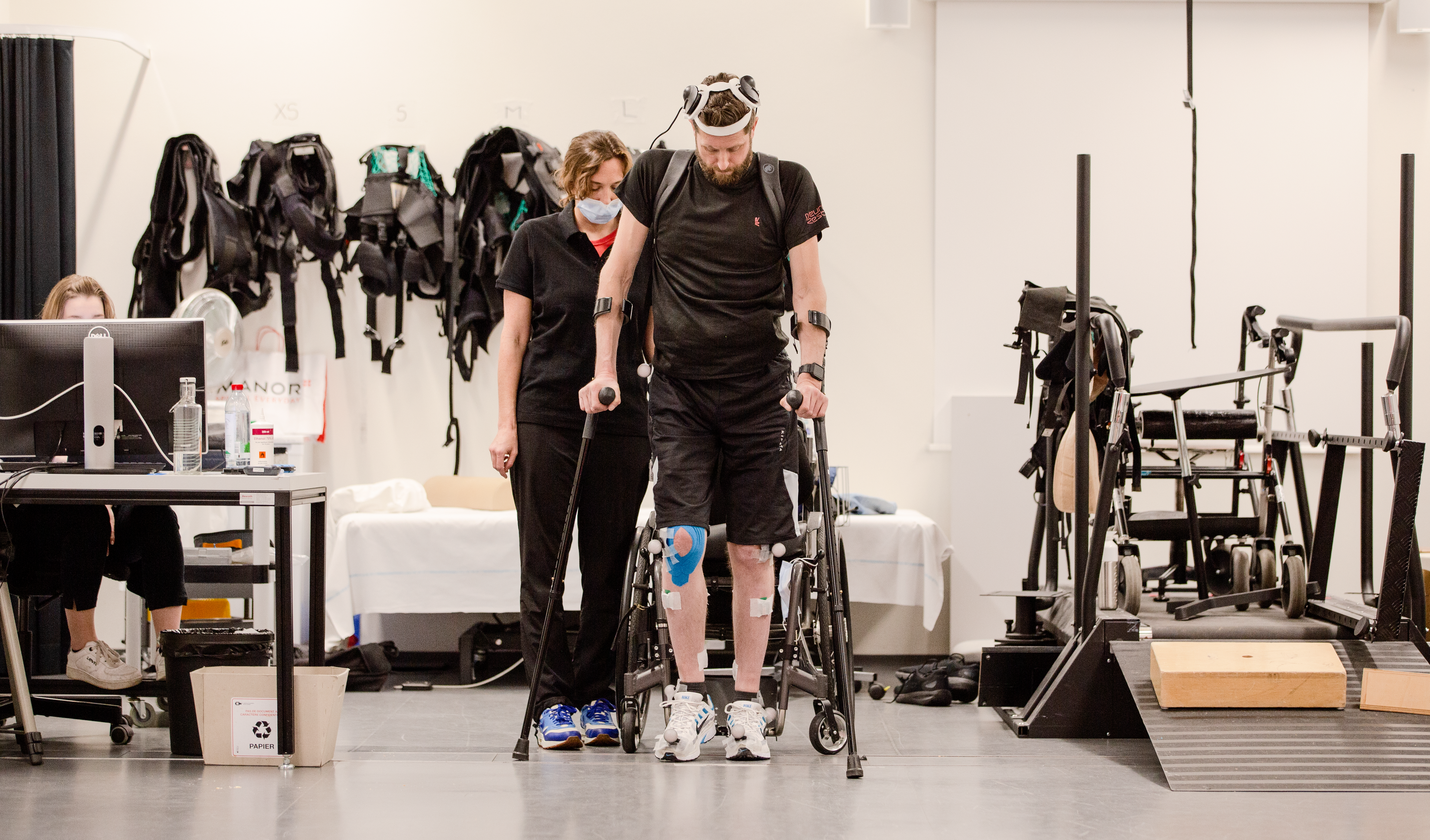
A patient with paralysis of the arms and legs has been able to stand and walk naturally, thanks to international researchers who developed an implant that restores communication between the brain and spinal cord. The Brain-Spine Interface (BSI) was also found to improve neurological recovery, and the patient was able to walk with crutches even when the implant was switched off. The BSI consisted of an implanted recording and stimulation system that linked the brain and spinal cord regions involved in walking. It was able to calibrate within a few minutes and has remained reliable and stable for over one year, including at home without supervision. The patient reports that the BSI enables a natural control over the movements of the patient’s legs to stand, walk, climb stairs and even traverse complex terrains.

Media release

From: Springer Nature

1.  Neuroscience: Restoring movement after paralysis *PRESS BRIEFING* *IMAGES*

Grégoire Courtine and colleagues tested a brain–spine interface (BSI), consisting of an implanted recording and stimulation system, that establishes a direct link between the brain and spinal cord regions involved in walking. The BSI was able to calibrate within a few minutes and has remained reliable and stable for over one year, including at home without supervision. The patient reports that the BSI enables a natural control over the movements of the patient’s legs to stand, walk, climb stairs and even traverse complex terrains. Moreover, neurorehabilitation supported by the BSI improved neurological recovery and the patient regained the ability to walk with crutches over ground even when the BSI was switched off.

The concept of a digital bridge between the brain and spinal cord may help to improve the treatment of movement deficits due to neurological disorders.

**Please note that an online press briefing for the paper below will take place UNDER STRICT EMBARGO on Tuesday 23rd May at 3 pm London time (BST) / 10 am US Eastern Time**

Authors Grégoire Courtine, Jocelyne Bloch, Henri Lorach and Guillaume Charvetwill discuss the research. This will be followed by a Q&A session.

Multimedia
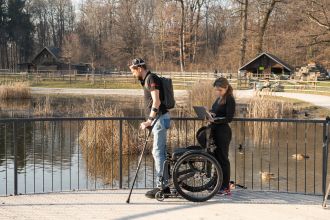
Image 1
Image 1
Image 2
Image 2

Attachments

Note: Not all attachments are visible to the general public. Research URLs will go live after the embargo ends.

Research Springer Nature, Web page The URL will go live after the embargo lifts.
Briefing link Springer Nature, Web page Springer Nature press briefing details
Journal/
conference:
Nature
Research:Paper
Organisation/s: Ecole Polytechnique Fédérale de Lausanne (EPFL), Switzerland
Funder: Supported by Defitech Foundation, Rolex Award for Enterprise, International Foundation for Research in Paraplegia, Translational Medical Research Award 2021 from the Leenaards Foundation, Pictet Group Charitable Foundation, ONWARD medical, Medtronic, the Swiss National Science Foundation through the National Centre of Competence in Research in Robotics (51NF40- 185543), Sinergia (CRSII5-183519), the Lead Agency Program with the French National Research Agency (Think2Move SNF-32003BE-205563, ANR-21-CE19-0038), A F Harvey Prize award, Swiss Innovation Agency InnoSuisse (CTI-41871.1 IP-LS Bridge), Eurostars (E!12743 Confirm and E!113969 Prep2Go), the European Commission (ERC-2019-PoC Braingait 875660, EIC 2021- TransitionChallenges-01-01 ReverseParalysis 101057450, Horizon-EIC-2021-Pathfinderchallenges- 01-02 NEMO-BMI 101070891), Fonds de dotation Clinatec (WIMAGINE implant development) and Institut Carnot Leti. ETH domain PHRT grant 2022-279. Open access funding provided by EPFL Lausanne.
Media Contact/s
Contact details are only visible to registered journalists.