 Sign In



 International
News release
From:
Table tennis robot aces it
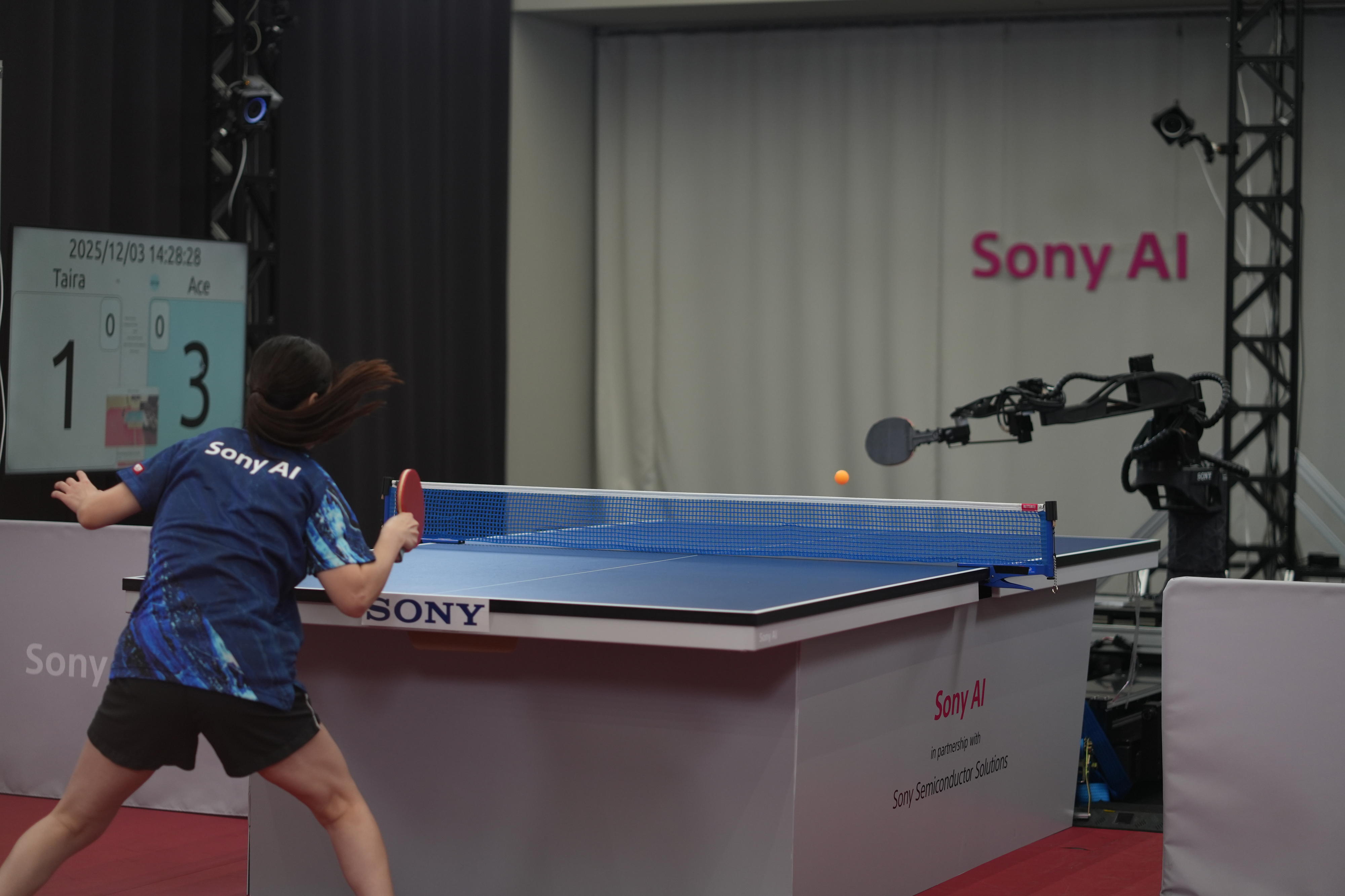
An artificial intelligence (AI)-based robotic system capable of outperforming elite table tennis players, developed by Sony AI, is described in a Nature paper this week. The results demonstrate the potential of robotic systems to perform complex, real-time interactive tasks and suggest broader applications in areas that require fast and precise physical interactions.
Table tennis is a particularly challenging sport for robots as it requires rapid responses with low latency perception (minimal delays in processing), and accurate prediction of ball trajectories, including complex spin effects. In previous research, various robotic systems have attempted to address these challenges, but they were often tested against beginners or amateur players, using non-standard, modified equipment (typically limiting ball spin and speed) as well as non-standard rules.
Peter Dürr and colleagues present an autonomous robotic system that can compete with elite human table tennis players. The system, named Ace, consists of a high-speed perception system using a network of cameras, an AI-based control system, as well as a high-speed robot arm with eight joints. Ace was evaluated in a series of matches conducted under Japanese professional table tennis league rules. Contenders included five elite players (each with over ten years of active table tennis experience and an average of 20 hours of weekly training), and two professional players (Minami Ando and Kakeru Sone, both active in the Japanese professional league). Ace won three out of its five matches against elite players, but lost both matches against professional players (although it won one game against a professional). Nevertheless, Ace demonstrated a sophisticated range of abilities, including handling spins, winning points through diverse types of spins rather than simply faster shots, and reacting quickly to unusual shots, such as balls bouncing off the net.
The findings represent an important milestone for AI systems competing with and outperforming humans in complicated, interactive real-world tasks, the authors suggest. At the same time, such systems may reshape how humans interact with and play sports like table tennis. After observing a shot played by Ace, former Olympic table‑tennis player Kinjiro Nakamura remarked that he never thought it was possible — and that seeing the robot achieve it made him believe humans could as well.
Multimedia


