 Sign In



 International

News release
From:
The brain region associated with moral inconsistency
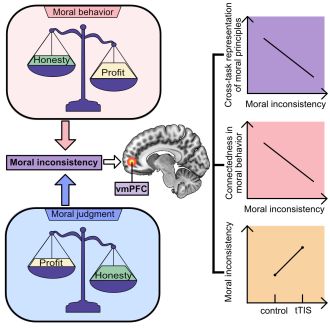
Why don’t some people practice what they preach? Researchers reveal that a brain region called the ventromedial prefrontal cortex (vmPFC) is involved. Publishing March 19 in the Cell Press journal Cell Reports, the researchers used fMRI imaging to identify brain activity patterns associated with moral behavior and judgement. People who behaved dishonestly despite judging the same behavior as immoral in others had less activity in the vmPFC, and when the researchers stimulated participants’ vmPFCs, they became more morally inconsistent.
“Moral consistency is an active biological process,” says coauthor Xiaochu Zhang of the University of Science and Technology of China and Guizhou Education University. “Being a ‘moral person’ requires the brain to integrate moral knowledge into daily behavior—a process that can fail even in people who know the moral principle perfectly well.”
Though previous studies have identified brain regions that are involved in moral behavior and moral judgement, little is known about how brain activity underpins moral inconsistency. “As neuroscience researchers, we wanted to understand why knowing the right thing to do doesn't always translate into doing it,” says Zhang.
To identify brain regions associated with moral inconsistency, the researchers used fMRI imaging to scan people’s brains during a task that required them to weigh honesty and profit. Participants could earn more money by being dishonest, but they were also asked to rate their own behavior on a 10-point scale from “extremely immoral” to “extremely moral.” The team also monitored the participants’ brain activity while they judged the morality of other people undertaking the same task.
In people who were morally consistent—meaning, they judged themselves and others by the same moral standards—the vmPFC was activated similarly during both the behavioral and judgement tasks. However, in morally inconsistent participants—those who judged other people’s cheating as immoral but rated their own cheating more leniently—the vmPFC was less active during the behavioral task and less connected to other brain regions involved in decision making and morality.
To examine whether vmPFC activity plays a causal role in moral inconsistency, the researchers stimulated some participants’ vmPFCs via a non-invasive method called transcranial temporal interference stimulation (tTIS) before they undertook the behavioral and judging tasks. They showed that vmPFC stimulation resulted in higher levels of moral inconsistency compared to participants who received mock stimulation.
These results suggest that people who are morally inconsistent don’t make use of their vmPFC to integrate information when making behavioral decisions, the researchers say. “Individuals exhibiting moral inconsistency are not necessarily blind to their own moral principles; they are just biologically failing to consider and apply them in their own moral behavior,” says Zhang.
In future research, the team plans to investigate the brain activity related to the “victim perspective” to understand how these neural circuits react when people are treated unfairly.
“Our findings suggest that we should treat moral consistency like a skill that can be strengthened through deliberate decision making,” says senior author Hongwen Song of the University of Science and Technology of China. “These findings have huge implications for education and AI.”
Multimedia

Attachments
Note: Not all attachments are visible to the general public. Research URLs will go live after the embargo ends.


